Key Findings
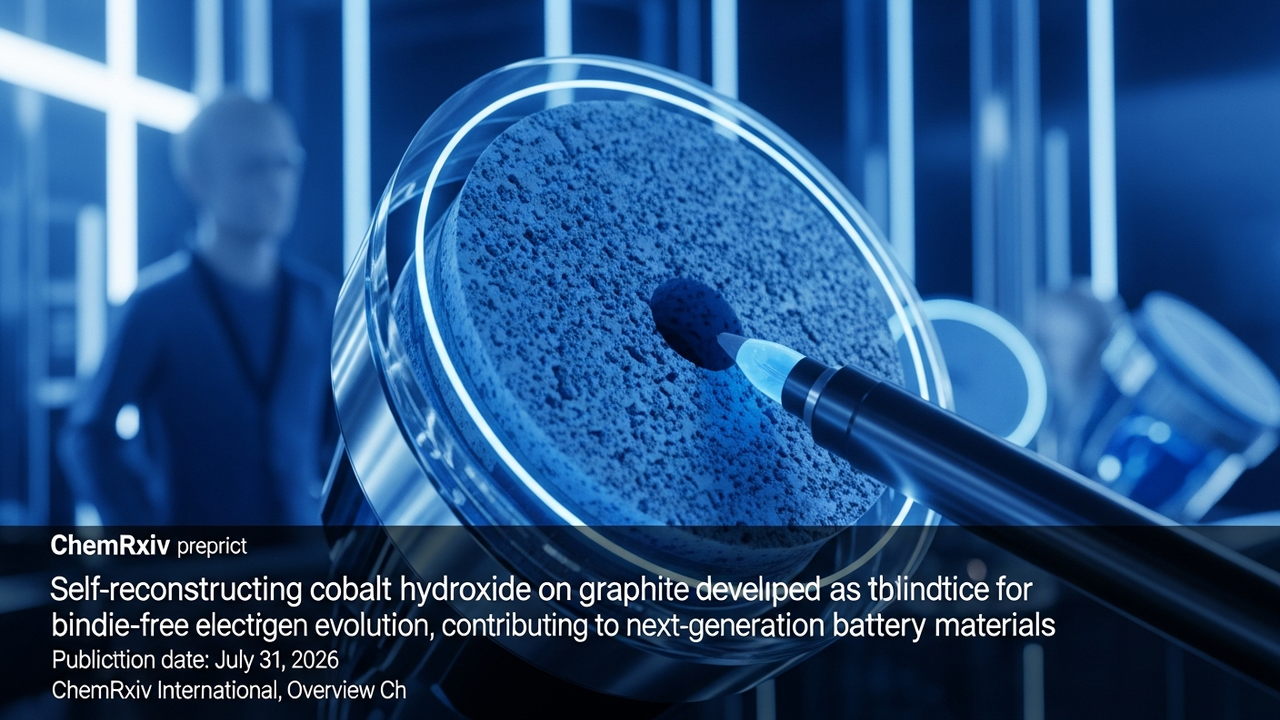
A recent preprint published on ChemRxiv reports groundbreaking research on the development of self-reconstructing cobalt hydroxide on graphite, serving as a high-performance, binder-free electrode for the alkaline oxygen evolution reaction (OER). This innovative electrode eliminates the need for polymeric binders traditionally used in electrode fabrication, thereby simplifying the manufacturing process and potentially enhancing both the conductivity and active surface area of the electrode. This discovery is expected to significantly contribute to advancements in materials science for next-generation energy storage and conversion technologies, particularly rechargeable metal-air batteries and fuel cells.
Technical and Business Details
The alkaline oxygen evolution reaction is a crucial half-reaction in processes like hydrogen production via water electrolysis and the charging cycle of metal-air batteries. Conventional OER electrodes typically utilize polymeric binders to immobilize catalyst particles onto the electrode substrate. However, these binders often mask active catalyst sites, impede electron conduction, and can degrade electrode stability. The “self-reconstructing cobalt hydroxide” developed in this study is characterized by the in-situ formation of the catalyst on the graphite surface, which autonomously transforms into an optimal active structure during the electrochemical reaction. This binder-free approach maximizes the utilization efficiency of the catalytic material.
Specifically, this binder-free electrode reduces interfacial resistance between the catalyst layer and the current collector, thereby improving OER performance at high current densities. The self-reconstruction capability implies that the electrode can maintain stable and high activity under long-term operating conditions, directly translating to enhanced device lifespan and efficiency. The research demonstrated superior catalytic activity and stability in alkaline solutions, providing strong evidence for future practical applications. This approach also holds potential for cost reduction and minimized environmental impact in electrode manufacturing.
Background and Industry Context
Efficient energy storage and conversion are indispensable for building sustainable energy systems. OER occurs in many processes that convert electrical energy into chemical energy, such as hydrogen production and rechargeable metal-air batteries. These technologies’ commercialization is hindered by the lack of high-efficiency, long-lasting, and cost-effective OER catalysts. Cobalt-based catalysts have shown promise, but challenges regarding stability and efficiency trade-offs persisted. This research, through its novel binder-free and self-reconstructing approach, offers a potential solution to these issues, opening new avenues for the development of next-generation batteries and fuel cells.
Strategic Significance and Outlook
This technology, featuring self-reconstructing cobalt hydroxide electrodes on graphite, has the potential to dramatically improve the performance of various electrochemical devices involving OER. It is expected to significantly contribute to the practical realization of high-energy-density metal-air batteries, such as rechargeable zinc-air and lithium-air batteries. Moreover, it could enhance the cost-efficiency of green hydrogen production through water electrolysis. Future research is anticipated to focus on further improving electrode durability, exploring scalability for large-scale manufacturing, and integrating these electrodes into actual devices. This innovative material design represents a crucial step towards realizing a sustainable energy future.
Source: https://chemrxiv.org/engage/chemrxiv/article-details/66ad7b8417ae41c2c366059d
Get our weekly technology intelligence — free
Receive an infographic that lets you judge at a glance whether each field’s analysis report is worth reading.
Subscribe Free — Weekly Tech Intelligence
By subscribing, you’ll receive Troy-Technical’s weekly technology intelligence newsletter.
- Your email and selected fields are used only to deliver the newsletter.
- We never share your information with third parties.
- You can unsubscribe anytime via the link in each email.
See our Privacy Policy for details.
Takes about a minute · Unsubscribe anytime