Key Findings
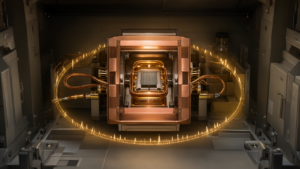
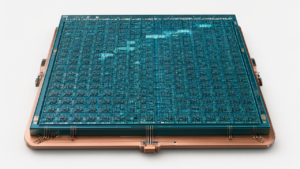
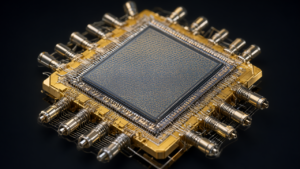
SpinQ has announced progress in its research and development of next-generation superconducting quantum chip technology. The company’s objective extends beyond simply increasing qubit count; it also aims for significant improvements in coherence time and gate fidelity—two primary metrics that dictate quantum computing performance. Furthermore, this new chip is being designed for broader compatibility with the entire quantum stack, encompassing software, control hardware, and cooling systems, thereby seeking to enhance the overall integration and practicality of superconducting quantum computing systems.
Technical / Clinical Details
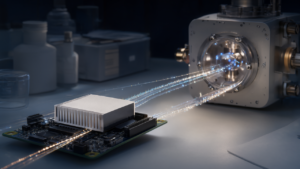
Superconducting quantum chips form qubits using superconducting circuits that operate at extremely low temperatures. Coherence time refers to how long a qubit can maintain its quantum state; longer coherence times enable more complex and accurate computations. Gate fidelity measures the precision of quantum gate operations, with higher fidelity leading to fewer computational errors. SpinQ’s research focuses on new materials, chip architectures, and manufacturing processes to improve these characteristics. For instance, designing resonators with higher Q-factors and developing layout techniques to reduce crosstalk between qubits are under investigation. By developing the chip not just as hardware but as an integral part of the entire ‘quantum stack’—including control electronics, software platforms, and cryogenic refrigerators—SpinQ aims to create a system where each component is mutually optimized and works seamlessly together.
Background & Context
Superconducting quantum computing is one of the leading technological platforms, pioneered by major players like IBM and Google. While scaling the number of qubits has progressed in this field, maintaining and improving the quality of individual qubits (coherence and fidelity) remains a significant challenge. To achieve large-scale fault-tolerant quantum computers, it is essential to push the performance of individual qubits to their limits, which is a primary focus for next-generation superconducting chip development. Moreover, the integration of quantum hardware with software and control systems is indispensable for transitioning quantum computing from laboratories to practical tools. Companies like SpinQ adopting this integrated approach are crucial for fostering efficiency and innovation across the entire industry.
Strategic Significance & Outlook
SpinQ’s exploration into next-generation superconducting quantum chip technology represents a vital step toward the practicalization of quantum computing. Improvements in coherence time and gate fidelity will enable more reliable quantum computations, pushing the boundaries of current NISQ (Noisy Intermediate-Scale Quantum) devices. Furthermore, broad compatibility with the quantum stack will facilitate quantum computer utilization for developers, accelerating the creation of new algorithms and applications. This will open pathways for quantum computers to provide concrete solutions to complex optimization and simulation problems in various industries, including pharmaceuticals, materials science, finance, and logistics. SpinQ’s efforts are expected to maximize the potential of superconducting quantum computing and contribute to the realization of universal quantum computers.
Source: https://www.spinquanta.com/news-detail/next-generation-superconducting-quantum-chip2026
Get our weekly technology intelligence — free
Receive an infographic that lets you judge at a glance whether each field’s analysis report is worth reading.
Subscribe Free — Weekly Tech Intelligence
By subscribing, you’ll receive Troy-Technical’s weekly technology intelligence newsletter.
- Your email and selected fields are used only to deliver the newsletter.
- We never share your information with third parties.
- You can unsubscribe anytime via the link in each email.
See our Privacy Policy for details.
Takes about a minute · Unsubscribe anytime