Key Findings
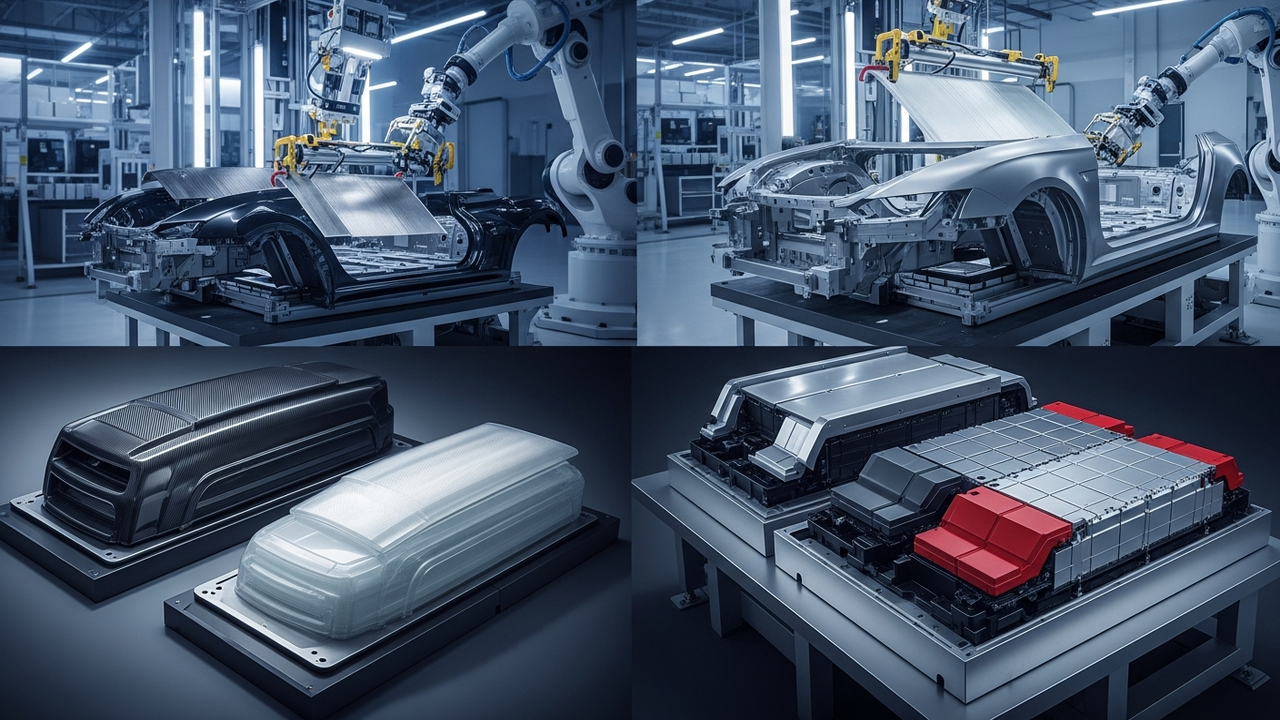
Smartech reports that the automotive industry is rapidly transitioning from traditional metal materials to carbon fiber and glass fiber composites. This shift is primarily driven by critical demands for weight reduction, enhanced fuel economy, and extended driving ranges for electric vehicles (EVs). These advanced composite materials, offering superior strength-to-weight ratios and design flexibility, are increasingly integrated into key automotive components such such as body panels, structural frameworks, and battery enclosures.
Technical / Clinical Details
Automotive composites typically consist of high-strength fibers (carbon or glass) embedded within a polymer matrix. Carbon Fiber Reinforced Polymers (CFRPs) are gaining traction, especially in high-performance vehicles and EVs, due to their strength being comparable to or exceeding steel at approximately one-quarter of its density, and half that of aluminum. Glass Fiber Reinforced Polymers (GFRPs) offer a cost-effective alternative with good mechanical properties, making them suitable for broader automotive applications. These materials also contribute to improved crash safety and reduced NVH (Noise, Vibration, and Harshness) characteristics. Technological advancements include faster-curing thermoset resins to shorten production cycle times, and thermoplastic composites that allow for welding and overmolding. Automated manufacturing processes like Automated Fiber Placement (AFP) and Automated Tape Laying (ATL) efficiently produce complex parts while minimizing material waste.
Background & Context
Stringent global environmental regulations and increasing consumer awareness of sustainability are compelling automotive manufacturers to prioritize lightweighting and emissions reduction. For EVs, battery weight significantly impacts range, making lightweighting the body and chassis indispensable. Composites are a pivotal technology for addressing this challenge, offering potential weight reductions of up to 70% compared to equivalent metal parts. This not only enhances vehicle performance but also optimizes battery sizing and improves manufacturing efficiency.
Strategic Significance & Outlook
The automotive composites market is projected to continue its expansion, fueled by the proliferation of EVs and increasingly stringent fuel efficiency standards. Crucially, advancements in recyclable thermoplastic composites and innovations that reduce manufacturing costs are key to accelerating the adoption of composites in high-volume production vehicles. In the future, the integration of smart functionalities (e.g., embedded sensors) and digitalization across the entire composite manufacturing process will lead to the realization of higher-performance, environmentally friendlier, and more cost-efficient automobiles.
Source: https://smartechonline.com/resources/automotive-composites/
Get our weekly technology intelligence — free
Receive an infographic that lets you judge at a glance whether each field’s analysis report is worth reading.
Subscribe Free — Weekly Tech Intelligence
By subscribing, you’ll receive Troy-Technical’s weekly technology intelligence newsletter.
- Your email and selected fields are used only to deliver the newsletter.
- We never share your information with third parties.
- You can unsubscribe anytime via the link in each email.
See our Privacy Policy for details.
Takes about a minute · Unsubscribe anytime