Key Findings
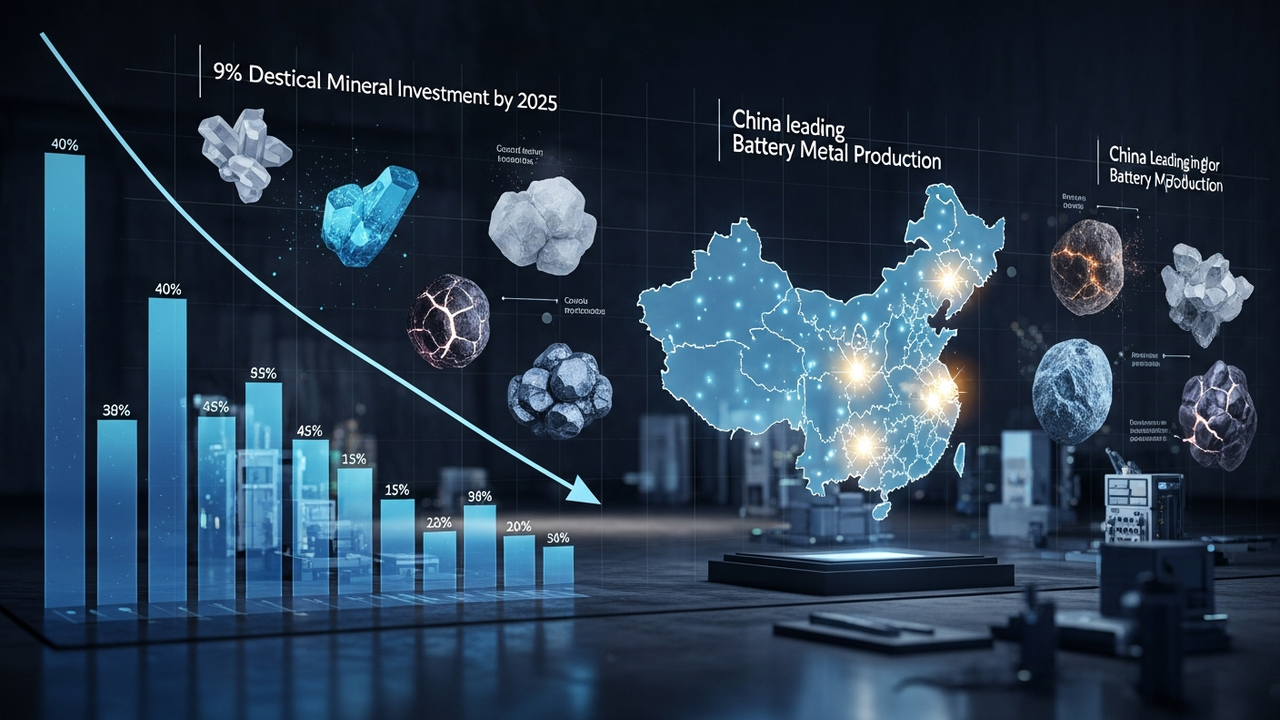
According to a report from the International Energy Agency (IEA), global investment in critical minerals—essential for batteries and the clean energy transition—declined by 9% year-over-year in 2025. This downturn was particularly pronounced among battery materials companies, which reduced their spending by 20%, and even more so among lithium specialists, who cut spending by a significant 40%. This trend clearly indicates that market oversupply and corresponding price declines are reinforcing a risk-averse stance among investors. Indeed, lithium carbonate prices fell to 140,000 CNY per tonne by August 3, 2026, though this level remains substantially higher than year-ago figures. This market environment increasingly favors lower-cost, more efficient projects, which are attracting greater investor attention.
Technical / Market Details
The slowdown in investment is primarily attributed to lithium price volatility, perceptions of oversupply, and significant price differentials in the nickel market (a $900 cost gap). Fluctuations in raw material prices directly impact battery manufacturing costs, influencing the economic viability of projects. Indonesia and China play central roles in the mining, refining, and processing of battery metals, with their policies and market dynamics exerting substantial influence over global supply chains and cost structures. China, in particular, maintains its market leverage by actively managing domestic refining throughput and technological development directions, as outlined in its Ministry of Industry and Information Technology roadmap published on July 31, 2026. This roadmap aims to optimize the entire battery metal supply chain, including recycling, signaling China’s intent to strengthen its leadership in this sector.
Background & Context
The global battery market continues its growth trajectory, driven by the surging demand for electric vehicles (EVs) and energy storage systems. However, post-pandemic supply chain disruptions and geopolitical tensions have highlighted vulnerabilities in the stable supply and price volatility of critical minerals. Countries worldwide are intensifying policy interventions to strengthen domestic supply chains and reduce foreign dependencies. The IEA’s report indicates that, in this context, the market is pursuing efficiency and cost reduction, with investors tending to allocate capital towards lower-risk, economically robust projects. This creates a challenging environment for new technologies and high-cost extraction projects.
Strategic Significance & Outlook
While the decline in critical minerals investment might alleviate short-term supply bottlenecks, it could also impact the industry’s capacity to meet future demand increases in the long run. The preference for lower-cost projects could stimulate greater interest in battery technologies that utilize more affordable materials, such as sodium-ion batteries. The roles of China and Indonesia will remain pivotal, with their policy movements continuing to exert significant influence over the global battery metal market. Investors and industry stakeholders must carefully balance market volatility, policy changes, and technological innovation, formulating strategies that build sustainable supply chains. Advances in recycling technologies and investments in resource-efficient new extraction and processing methods will be key to overcoming these challenges.
Get our weekly technology intelligence — free
Receive an infographic that lets you judge at a glance whether each field’s analysis report is worth reading.
Subscribe Free — Weekly Tech Intelligence
By subscribing, you’ll receive Troy-Technical’s weekly technology intelligence newsletter.
- Your email and selected fields are used only to deliver the newsletter.
- We never share your information with third parties.
- You can unsubscribe anytime via the link in each email.
See our Privacy Policy for details.
Takes about a minute · Unsubscribe anytime