Key Findings
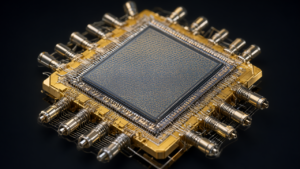
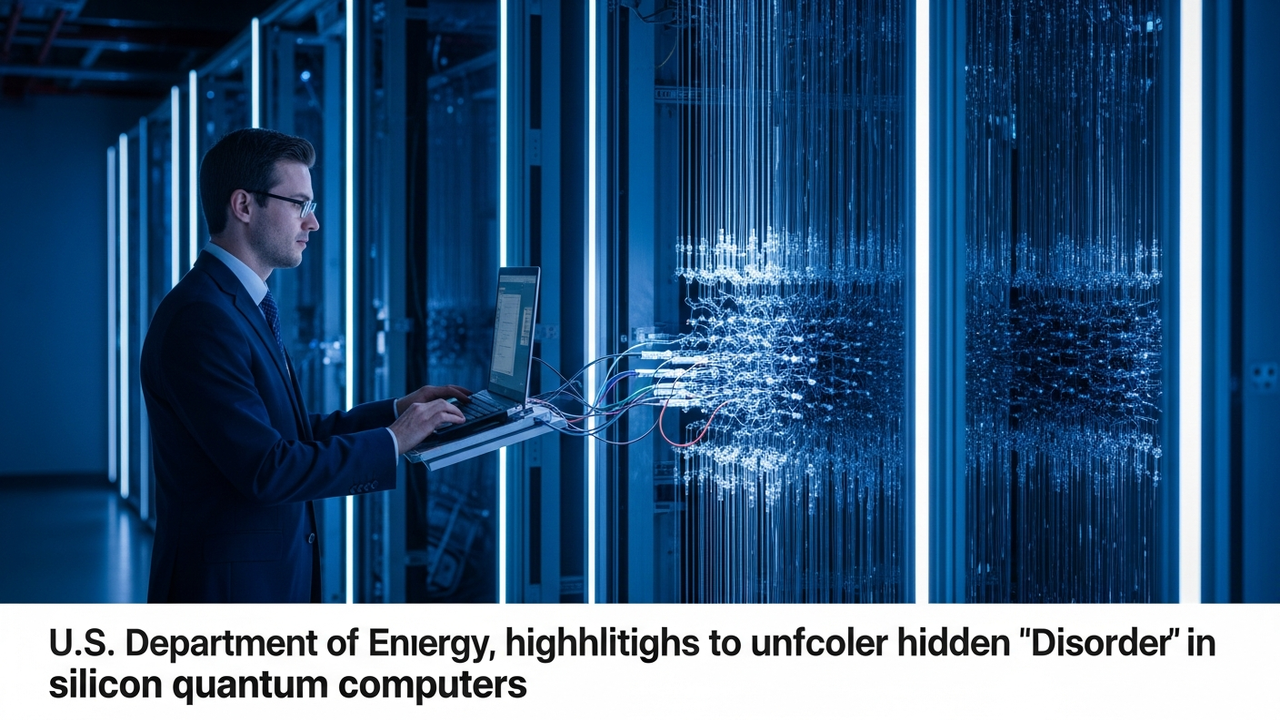
The U.S. Department of Energy has highlighted cutting-edge research on silicon spin qubits. This study aims to elucidate the ‘hidden disorder’ inherent in silicon-based quantum computers, exploring critical challenges and solutions for achieving scalable quantum computing. Silicon qubits are drawing significant attention as a promising candidate for future quantum computers due to their high compatibility with existing semiconductor manufacturing technologies.
Technical / Clinical Details
Silicon spin qubits utilize the spin state of a single electron within a silicon crystal as an information carrier. However, minute imperfections or impurities in the silicon crystal can affect the delicate quantum state of qubits, leading to errors. This article specifically details how the coherence time (the duration a quantum state can be maintained) of electron spins and valley states (degrees of freedom derived from silicon’s electronic band structure) within silicon quantum well structures are influenced by these ‘disorders.’ Researchers are developing methods to understand and precisely control the impact of atomic-level defects and interface roughness on qubit performance, thereby realizing more stable and high-fidelity qubits. This includes optimizing material growth processes and new design principles for accurately tuning interactions between qubits.
Background & Context
One of the biggest challenges for commercializing quantum computers is reducing qubit error rates and achieving scalability. Silicon-based quantum computers, capable of leveraging established semiconductor manufacturing technologies, are being actively researched worldwide due to their high potential for large-scale integration. However, controlling minute imperfections at the qubit level with existing semiconductor technologies has been difficult, limiting quantum computer performance. The U.S. Department of Energy, as part of its national science and technology strategy, is focusing on materials science research as a foundation for quantum information, and this study represents the forefront of that effort.
Strategic Significance & Outlook
Elucidating and controlling ‘hidden disorder’ in silicon quantum computers is an indispensable step towards realizing fault-tolerant quantum computers. Progress in this fundamental research will accelerate the development of high-performance quantum chips that can stably integrate more qubits. In the future, this technology holds the potential to create innovative applications across diverse fields such as drug discovery, new material development, and artificial intelligence. The U.S. Department of Energy’s continuous investment in this area is expected to strengthen U.S. leadership in quantum technology and play a crucial role in opening up new frontiers in next-generation science and technology.
Source: https://www.energy.gov/science/bes/articles/uncovering-hidden-disorder-silicon-quantum-computers
Get our weekly technology intelligence — free
Receive an infographic that lets you judge at a glance whether each field’s analysis report is worth reading.
Subscribe Free — Weekly Tech Intelligence
By subscribing, you’ll receive Troy-Technical’s weekly technology intelligence newsletter.
- Your email and selected fields are used only to deliver the newsletter.
- We never share your information with third parties.
- You can unsubscribe anytime via the link in each email.
See our Privacy Policy for details.
Takes about a minute · Unsubscribe anytime