Key Findings
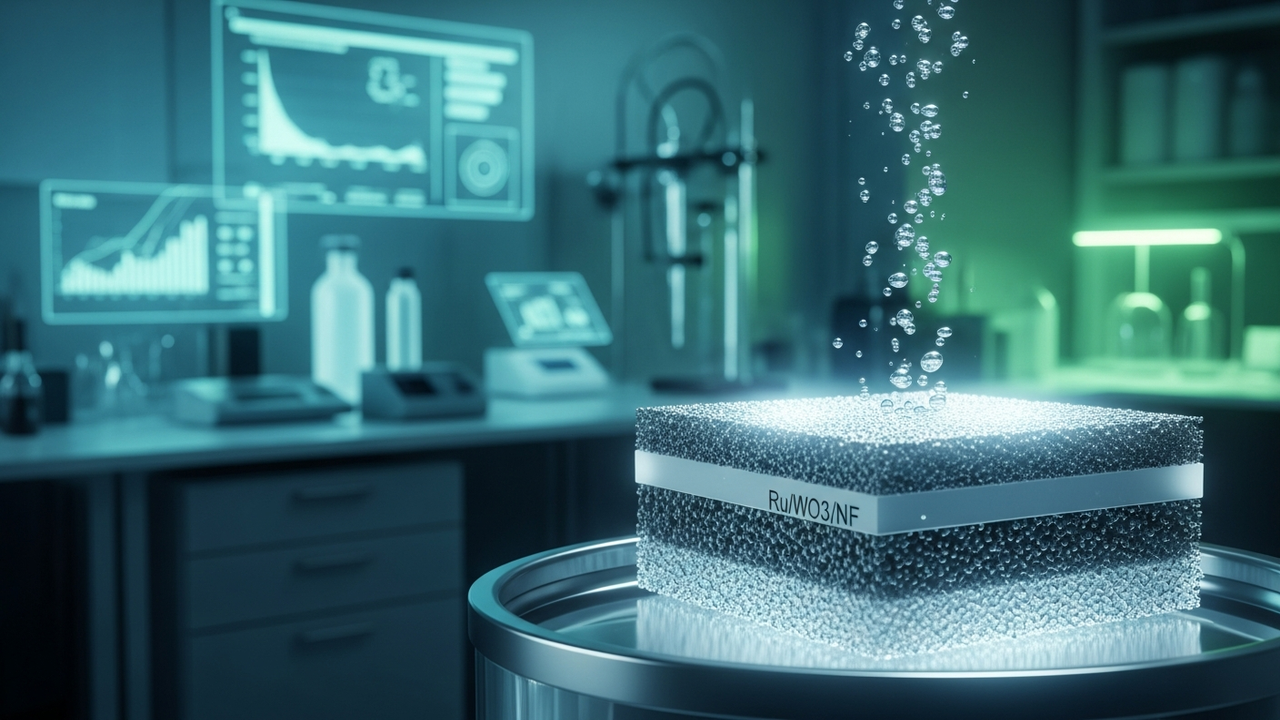
This research presents a groundbreaking advancement in energy-saving hydrogen production: the development of a Ru/WO3/NF heterostructured electrocatalyst enabling ultra-low potential hydrazine oxidation (HzOR) for hydrazine-assisted water electrolysis. The optimized electrocatalyst achieved an exceptionally low HzOR potential of just 0.11 V vs RHE to reach a high current density of 400 mA cm–2, demonstrating remarkable stability and durability for 120 hours at 200 mA cm–2. This holds the potential to significantly reduce energy consumption compared to conventional pure water electrolysis.
Technical Details
The research team utilized molecular dynamics simulations and density functional theory (DFT) calculations to elucidate the mechanism by which the presence of WO3 (tungsten trioxide) promotes the migration of hydroxide ions (OH–) from the ruthenium (Ru) catalyst surface, exposing Ru active sites. This mechanism accelerates the rate-limiting step of the HzOR reaction—OH– desorption—leading to a dramatic reduction in HzOR potential. The heterostructure, comprising Ru and WO3 composited on a Ni foam (NF) substrate, maximizes the number of catalytic active sites and electron conductivity, enabling highly efficient reactions. An HzOR potential of 0.11 V vs RHE signifies that the reaction can be driven with a very low overpotential of 0.11 volts relative to the reversible hydrogen electrode, which is highly advantageous from an energy efficiency perspective. Furthermore, a small Tafel slope of 26 mV dec–1 indicates a gradual increase in overpotential with increasing current density, allowing for efficient operation at high current densities.
Background and Industry Context
Hydrogen, as a clean energy carrier, plays an indispensable role in achieving a decarbonized society. Hydrogen production via water electrolysis is a clean source but requires high energy input and is costly. Hydrazine-assisted water electrolysis is gaining attention as an energy-saving method for hydrogen production because it can generate hydrogen at a lower potential than water electrolysis thermodynamically. However, challenges include the toxicity of hydrazine and the development of high-performance catalysts for efficient HzOR. Ru is known for high activity towards HzOR but faces cost and stability issues. This research overcomes conventional challenges by forming a heterostructure with WO3, further enhancing Ru’s activity and improving its stability.
Strategic Significance and Outlook
The development of this Ru/WO3/NF heterostructured electrocatalyst will significantly boost the commercialization of energy-saving hydrogen production technology. By achieving ultra-low potential, high current density, and long-term stability, the scope of hydrazine-assisted water electrolysis expands, enabling more sustainable and economical hydrogen production. In the future, this technology, when combined with renewable energy sources, could facilitate on-site green hydrogen production and the development of systems for safe hydrazine storage and transport. The catalyst design principle is also expected to find applications in other electrochemical reactions and fuel cell technologies. This breakthrough is anticipated to accelerate the transition to a hydrogen energy economy and play an essential role in achieving global clean energy goals.
Get our weekly technology intelligence — free
Receive an infographic that lets you judge at a glance whether each field’s analysis report is worth reading.
Subscribe Free — Weekly Tech Intelligence
By subscribing, you’ll receive Troy-Technical’s weekly technology intelligence newsletter.
- Your email and selected fields are used only to deliver the newsletter.
- We never share your information with third parties.
- You can unsubscribe anytime via the link in each email.
See our Privacy Policy for details.
Takes about a minute · Unsubscribe anytime