Key Findings
A comprehensive review article published in ‘ACS Applied Energy Materials’ by ACS Publications underscores the paramount importance of sodium compensation (presodiation) techniques in overcoming the challenge of low initial Coulombic efficiency (ICE) in sodium-ion batteries (SIBs). This approach is shown to not only boost ICE to an ideal 100% but also significantly enhance the overall cycle life of the battery. The review details the mechanisms of sodium compensation and various presodiation methods, while acknowledging the inherent challenges in scaling these from laboratory coin cells to commercial SIB production.
Technical & Clinical Details
The review thoroughly explains the mechanisms of sodium compensation and various presodiation methods:
- Challenge of Initial Coulombic Efficiency (ICE): SIBs often experience irreversible sodium ion loss during the first charge, leading to reduced practical energy density and capacity. This loss is attributed to factors like the formation of the solid electrolyte interphase (SEI) layer and the consumption of sodium necessary for initial activation of active materials.
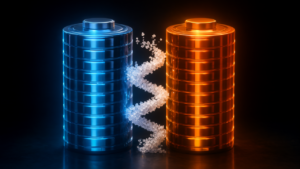
- Mechanism of Sodium Compensation: Sodium compensation refers to the technique of pre-doping (pre-introducing) excess sodium into either the cathode or anode during the initial battery assembly. This counteracts the irreversible sodium loss during the first charge, optimizing the total available sodium ions and enabling the battery to deliver its full nominal capacity.
- Presodiation Methods: Various chemical and electrochemical presodiation methods have been developed:
- Cathode Pre-doping: Utilizing cathode materials that inherently contain excess sodium.
- Anode Pre-doping: Directly introducing a sodium source (e.g., sodium metal, sodium-containing compounds) into the anode, or pre-saturating the anode with sodium ions.
- Electrolyte Additives: Incorporating specific sodium salts or additives into the electrolyte.
- Performance Improvement: These methods enable ICE to reach close to theoretical 100%, thereby increasing the practical discharge capacity of the battery. Furthermore, by promoting the formation of a stable SEI layer and suppressing electrode material degradation, presodiation contributes to an improved cycle life.
However, significant challenges remain in scaling these techniques from laboratory coin cell prototypes to commercial large-cell production, particularly concerning uniformity, safety, cost, and process complexity.
Background & Context
Sodium-ion batteries are widely seen as a promising sustainable alternative to lithium-ion batteries, but their commercialization faces several technical barriers. Low ICE has been a major limiting factor, constraining the practical energy density SIBs can achieve and increasing their initial cost. For large-scale applications such as stationary energy storage and electric vehicles, high ICE directly impacts the system’s economics and efficiency, making its resolution indispensable.
Strategic Significance & Outlook
Further advancements in sodium compensation technology are critically important for accelerating the commercialization of SIBs. Breakthroughs are needed to transition laboratory-scale successes to large-scale manufacturing. Future research will likely focus on developing safer, more cost-effective, and more efficient presodiation methods. If these challenges are overcome, SIBs could offer high-performance products at a more competitive price compared to lithium-ion batteries, solidifying their position in the global energy storage market. This would significantly contribute to further renewable energy integration and the realization of a decarbonized society.
Get our weekly technology intelligence — free
Receive an infographic that lets you judge at a glance whether each field’s analysis report is worth reading.
Subscribe Free — Weekly Tech Intelligence
By subscribing, you’ll receive Troy-Technical’s weekly technology intelligence newsletter.
- Your email and selected fields are used only to deliver the newsletter.
- We never share your information with third parties.
- You can unsubscribe anytime via the link in each email.
See our Privacy Policy for details.
Takes about a minute · Unsubscribe anytime