Key Findings
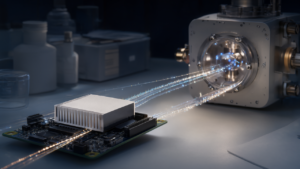
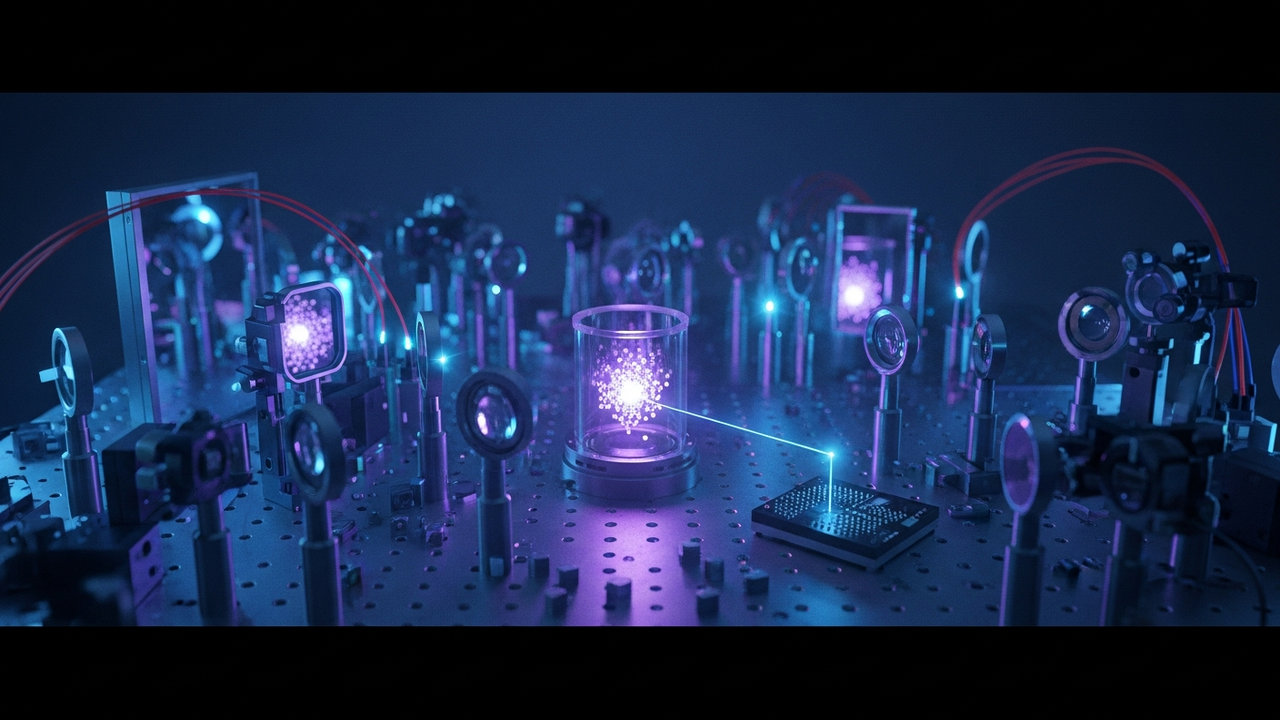
Pasqal, a leading company in neutral-atom quantum computing, announced a world-first breakthrough in collaboration with Aeponyx: successfully trapping individual atoms using laser light generated directly from a photonic integrated circuit (PIC). This technological innovation opens a new pathway to on-chip qubit control, representing a crucial milestone towards realizing large-scale, fault-tolerant quantum computers.
Technical Details
The core of this breakthrough lies in demonstrating the ability to capture and manipulate individual neutral atoms by forming optical tweezers using integrated optical components on a PIC chip. Previously, atom trapping required complex external optical systems; however, the introduction of PIC technology allows for miniaturization and high-precision control of this process. This significantly reduces system complexity and footprint, while enhancing the accuracy of qubit addressing and manipulation.
Pasqal aims to scale this photonic architecture towards systems capable of controlling over 10,000 atoms, ultimately targeting the realization of 100 logical qubits. Neutral atoms are considered highly promising candidates for qubits due to their long coherence times and strong interactions, but their control and scaling have been challenging. This on-chip control technology overcomes these hurdles, dramatically increasing the potential for neutral-atom-based quantum computers to possess truly large-scale computational power.
Background and Context
Various quantum computing modalities (superconducting, ion traps, neutral atoms, etc.) exist, each leveraging different physical properties. The neutral-atom platform is particularly anticipated for its excellent scalability and high connectivity between qubits. However, controlling and precisely manipulating a large number of individual atoms requires extremely advanced technology. Pasqal’s achievement addresses this control and scaling bottleneck, marking a significant step towards the commercialization and practical deployment of neutral-atom quantum computers.
Strategic Significance and Outlook
On-chip qubit control using photonic integrated circuits holds the potential to revolutionize the design and construction of next-generation quantum computers. Pasqal’s technology contributes to miniaturization, cost reduction, and improved reliability of quantum systems, serving as a foundation for achieving fault-tolerant quantum computing in the future. This advancement is expected to accelerate the application of quantum computing to complex problems in fields such as quantum chemistry, materials science, optimization, and machine learning, further advancing the industrial adoption of quantum technologies.
Get our weekly technology intelligence — free
Receive an infographic that lets you judge at a glance whether each field’s analysis report is worth reading.
Subscribe Free — Weekly Tech Intelligence
By subscribing, you’ll receive Troy-Technical’s weekly technology intelligence newsletter.
- Your email and selected fields are used only to deliver the newsletter.
- We never share your information with third parties.
- You can unsubscribe anytime via the link in each email.
See our Privacy Policy for details.
Takes about a minute · Unsubscribe anytime