Key Findings
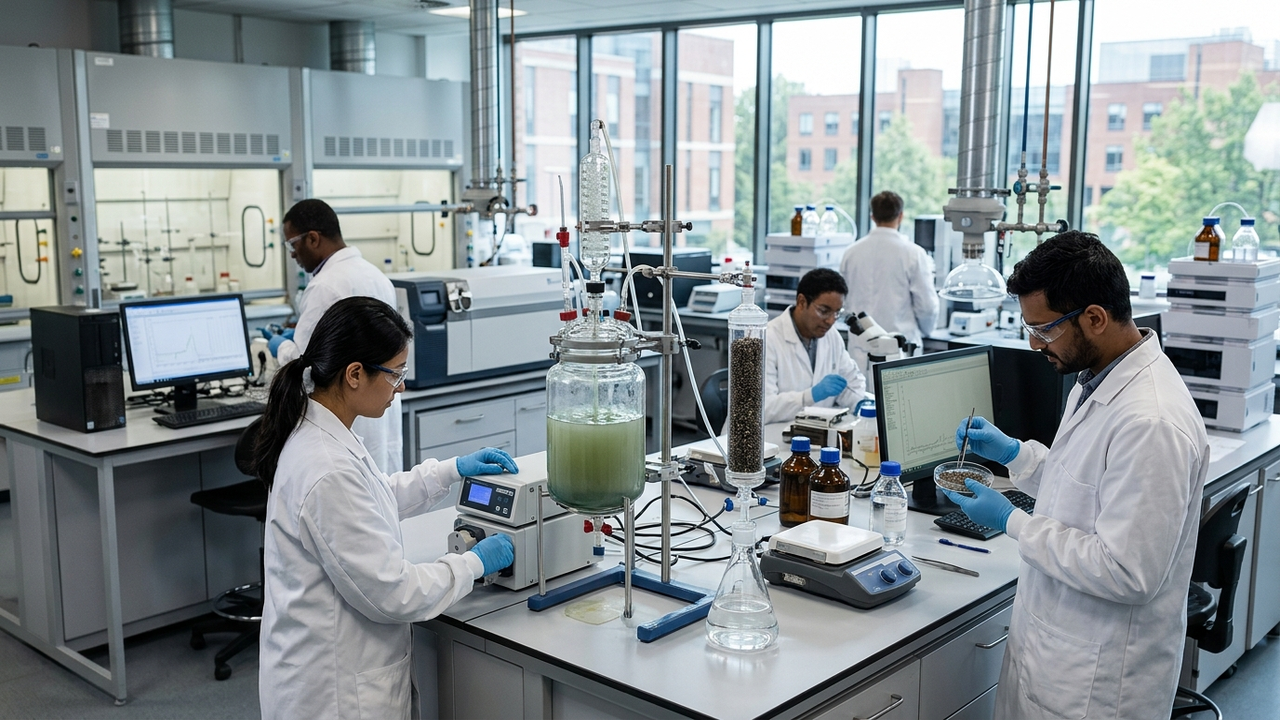
Researchers at the University of Birmingham have achieved a significant breakthrough in the production of metal-organic frameworks (MOFs), dramatically lowering manufacturing costs and environmental impact while maintaining superior performance in heavy metal removal from wastewater. Their innovative, greener process, incorporating freeze-drying, has increased usable MOF material recovery by over three times and reduced electricity consumption by approximately 74%. This translates to a profound reduction in production costs, from around $19 per gram to just over $5 per gram, making industrial-scale application of MOFs significantly more viable. Furthermore, the developed MOF material demonstrates exceptional efficacy, removing over 90% of lead from solutions within the first hour of contact.
Technical / Clinical Details
The core of this advancement lies in optimizing the MOF synthesis and post-synthetic processing, specifically by implementing an enhanced freeze-drying technique. This method minimizes solvent waste and energy intensity typically associated with traditional MOF production, adhering to principles of green chemistry. The MOF structure itself is precisely engineered with tunable porosity and functionalized ligands that exhibit strong affinity for heavy metal ions, particularly lead. This design enables efficient adsorption and sequestration of pollutants from aqueous solutions. The improved recovery rate and reduced energy footprint directly address two major barriers to MOF commercialization: scalability and economic feasibility. The team has filed a patent for this novel manufacturing process, indicating its readiness for industrial translation.
Background & Context
Heavy metal contamination in water bodies is a global crisis, posing severe risks to human health and ecosystems. Conventional water treatment technologies often struggle with high operational costs, suboptimal efficiency, or the generation of secondary pollutants. MOFs, with their extraordinary surface areas and customizable chemical properties, have long been recognized as highly promising materials for environmental remediation. However, their widespread adoption has been hampered by the expensive and energy-intensive methods required for their synthesis and large-scale production. The University of Birmingham’s innovation directly tackles this economic bottleneck, positioning MOF-based solutions as a more practical and sustainable option for addressing water pollution challenges.
Strategic Significance & Outlook
This greener MOF processing technology and the high-performing materials it yields are poised to revolutionize the water treatment industry. By enabling cheaper and more sustainable production, it opens doors for broader applications beyond heavy metals, including the removal of organic pollutants, pharmaceuticals, and other emerging contaminants from water sources. Moreover, this breakthrough could serve as a foundational technology, expanding the utility of MOFs in other high-value sectors such as catalysis, gas storage, and sensing. The next critical steps involve securing industrial partnerships and scaling up validation through pilot projects at actual water treatment facilities, with the potential for widespread commercial adoption within the next few years.
Get our weekly technology intelligence — free
Receive an infographic that lets you judge at a glance whether each field’s analysis report is worth reading.
Subscribe Free — Weekly Tech Intelligence
By subscribing, you’ll receive Troy-Technical’s weekly technology intelligence newsletter.
- Your email and selected fields are used only to deliver the newsletter.
- We never share your information with third parties.
- You can unsubscribe anytime via the link in each email.
See our Privacy Policy for details.
Takes about a minute · Unsubscribe anytime