Key Findings
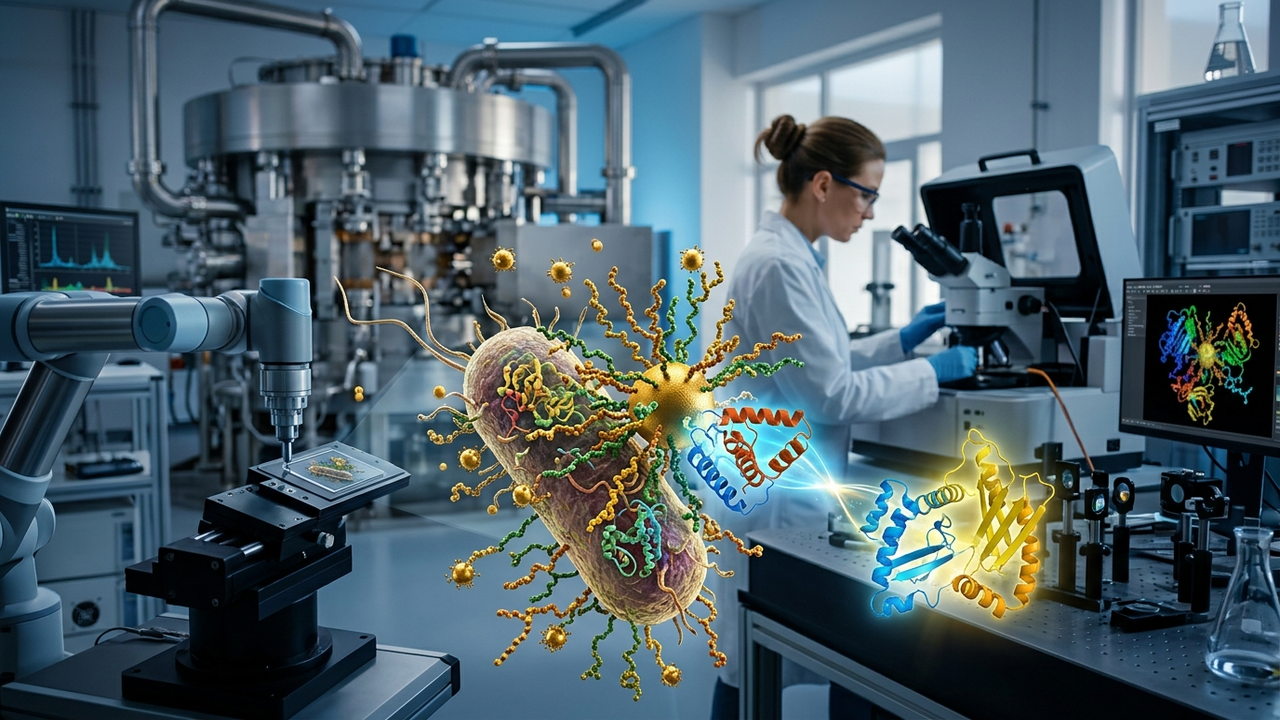
A recent preprint published on bioRxiv reports a detailed elucidation of carbohydrate-dependent protein conformational changes occurring at bacterium-nanoparticle interfaces, leveraging advanced synchrotron Nano-FTIR (nanoscale Fourier transform infrared spectroscopy) technology. This pioneering discovery significantly advances our understanding of how nanoparticles behave within biological environments and provides crucial guidance for the future design of biotechnological applications, particularly in bioimaging and drug delivery systems (DDS).
Technical / Clinical Details
The research team applied Nano-FTIR, which utilizes high-brightness infrared light from a synchrotron, to obtain localized molecular vibrational information at a resolution of just a few nanometers—a feat impossible with conventional FTIR. This enabled direct observation of how nanoparticles, once adsorbed onto bacterial surfaces, influence the secondary structure of adsorbed proteins in response to the presence of surrounding carbohydrate molecules. Specific patterns of structural changes were identified, suggesting their potential role in modulating nanoparticle biocompatibility and mechanisms of specific cellular recognition. This precise, molecular-level resolution is essential for establishing design principles to control nanoparticle behavior in complex biological systems.
Background & Context
Nanoparticles hold immense potential as diagnostic agents and therapeutic carriers in medicine; however, their in vivo safety and efficacy depend critically on how they interact with endogenous biomolecules, particularly proteins and carbohydrates. Understanding these intermolecular interactions at interfaces is a core challenge in nanotoxicology and nanobio-interface research. Previous studies were often limited to macro-scale observations, but the introduction of high-sensitivity, high-resolution techniques like Nano-FTIR has made it possible to elucidate the real-time dynamics and structural changes of nanoparticles and biomolecules at an unprecedented level.
Strategic Significance & Outlook
The insights gained from this study provide a roadmap for rationally designing nanoparticle surface modification strategies to enhance biocompatibility and targeting specificity. For example, new approaches to precisely control carbohydrate-protein interactions could emerge for developing DDS that exclusively bind to specific cancer cells, or biosensors that uniquely detect bacterial infection sites. Researchers and engineers can leverage these fundamental discoveries to accelerate the development of safer and more efficient nanomedical devices and diagnostic tools, pushing the boundaries of precision medicine.
Source: https://www.biorxiv.org/content/early/recent?page=34671
Get our weekly technology intelligence — free
Receive an infographic that lets you judge at a glance whether each field’s analysis report is worth reading.
Subscribe Free — Weekly Tech Intelligence
By subscribing, you’ll receive Troy-Technical’s weekly technology intelligence newsletter.
- Your email and selected fields are used only to deliver the newsletter.
- We never share your information with third parties.
- You can unsubscribe anytime via the link in each email.
See our Privacy Policy for details.
Takes about a minute · Unsubscribe anytime







Comments