Key Findings
A research team from the University of Freiburg and the Fraunhofer Institute for Solar Energy Systems (Fraunhofer ISE) has developed a groundbreaking ‘fully solvent-free’ process for manufacturing perovskite-silicon tandem solar cells, significantly reducing environmental impact. This innovative method, published in Joule, not only achieved a high power conversion efficiency of 27.1% but also demonstrated exceptional stability, maintaining 97.06% of its initial efficiency after 6800 hours of storage in dark nitrogen. This represents a crucial milestone towards the sustainable and scalable mass production of perovskite solar cells.
Technical Details
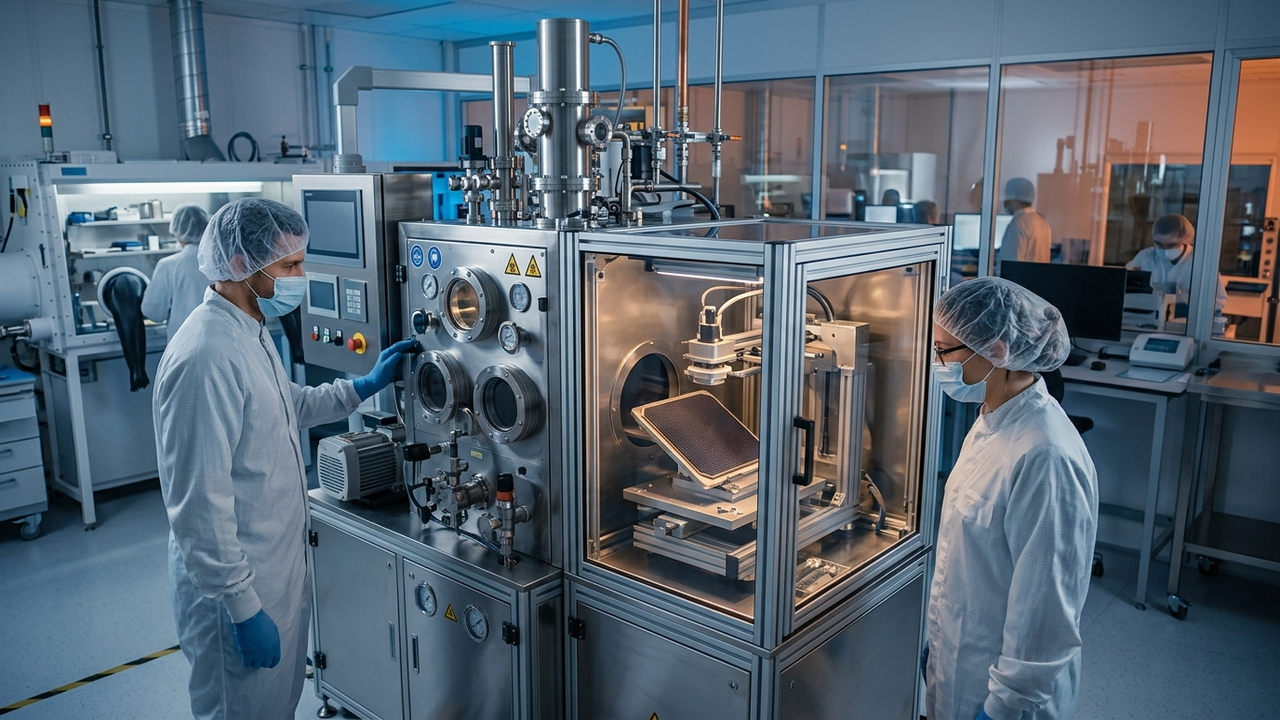
The core of this research lies in the introduction of industrially scalable, solvent-free manufacturing methods, such as Physical Vapor Deposition (PVD), for forming the perovskite layer. Traditional perovskite solar cell manufacturing often involves the use of harmful organic solvents, leading to environmental concerns, process complexity, and increased costs. The fully solvent-free process fundamentally addresses these challenges.
- Enhanced Manufacturing Sustainability: Eliminating the use of organic solvents minimizes environmental impact and enables a cleaner production environment, aligning with global sustainability goals.
- Ensured Scalability: Vapor deposition technologies like PVD are widely adopted and proven in industries such as semiconductor manufacturing, making them easy to integrate into large-scale production lines. This will accelerate the mass production of perovskite solar cells and contribute to cost reduction.
- Achieving High Efficiency and Stability: The developed tandem solar cell not only boasts 27.1% conversion efficiency but also demonstrated long-term stability. The 97.06% efficiency retention after 6800 hours is remarkably high, alleviating one of the primary concerns for the practical application of perovskite solar cells.
This technology is expected to contribute to the broader adoption of perovskite solar cells in various fields, particularly in Building-Integrated Photovoltaics (BIPV) and other outdoor applications requiring high durability.
Background & Context
Perovskite solar cells are garnering significant global attention as a next-generation photovoltaic technology, with the potential to achieve efficiencies exceeding 30%, surpassing the theoretical limits of conventional silicon solar cells. However, challenges related to environmental stability, lead content, and the use of solvents in manufacturing processes have been barriers to commercialization. This achievement by Fraunhofer ISE and the University of Freiburg will have a significant impact on the industry, particularly from the perspective of ‘sustainability’ in manufacturing processes. Solvent-free manufacturing offers a highly attractive option for the industry as environmental regulations become increasingly stringent.
Strategic Significance & Outlook
The development of a fully solvent-free manufacturing process is a pivotal advancement for the future of perovskite solar cells. If this technology further matures and is successfully applied to large-scale commercial production, it will enable the creation of high-efficiency solar cells through cleaner, cheaper, and more sustainable methods. This will accelerate the adoption of solar power and significantly contribute to achieving global carbon neutrality. This innovation has the potential to redefine the landscape of next-generation clean energy technologies.
Get our weekly technology intelligence — free
Receive an infographic that lets you judge at a glance whether each field’s analysis report is worth reading.
Subscribe Free — Weekly Tech Intelligence
By subscribing, you’ll receive Troy-Technical’s weekly technology intelligence newsletter.
- Your email and selected fields are used only to deliver the newsletter.
- We never share your information with third parties.
- You can unsubscribe anytime via the link in each email.
See our Privacy Policy for details.
Takes about a minute · Unsubscribe anytime








Comments