Background
Perovskite solar cells have garnered significant attention in the renewable energy sector due to their impressive power conversion efficiency and potential for low-cost manufacturing. Inverted structures, in particular, offer compatibility with flexible substrates and transparent electrodes, making them ideal for diverse applications such as Building-Integrated Photovoltaics (BIPV) and wearable devices. However, achieving long-term stability comparable to conventional silicon solar cells has been a critical hurdle for their commercialization. This latest achievement by the Lithuanian research team directly addresses this essential stability challenge, with profound implications for accelerating the practical implementation of perovskite solar cells.
Key Findings
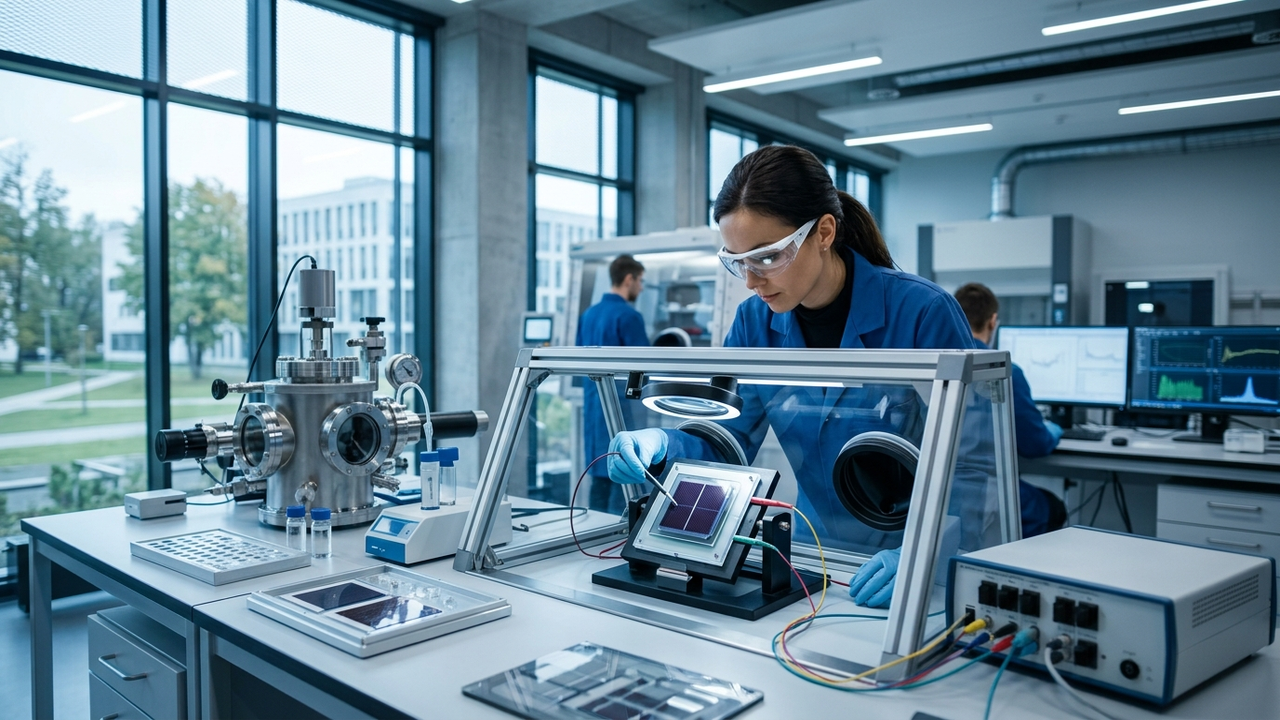
A research team at Kaunas University of Technology in Lithuania has made a pivotal discovery, directly addressing a major challenge in the long-term stability of inverted perovskite solar cells (IPSCs) – a highly promising next-generation photovoltaic technology. The researchers successfully mitigated the corrosive interactions between adjacent layers by precisely modifying the chemical composition of the critical interface layers. These interactions were previously a primary cause of IPSC efficiency degradation. This fundamental improvement dramatically enhances device stability, promising reliable performance over extended periods while maintaining high power conversion efficiency.
Technical Details
While inverted perovskite solar cells offer advantages like ease of manufacturing and high performance compared to conventional normal structures, their vulnerability to environmental factors such as moisture and oxygen has been a significant drawback. The Kaunas University team focused their efforts on the interface between the charge transport layer and the perovskite layer – critical components within IPSCs. They identified chemical reactions and material degradation occurring specifically at this interface as primary drivers of device performance loss.
To counter this, the researchers targeted specific chemical compositions within these interface layers, introducing novel materials and modification methodologies. Their specific approaches encompassed:
- Precise Interface Material Design: Developing new interface material compositions engineered to optimize charge transport pathways while simultaneously suppressing undesirable chemical interactions between distinct layers.
- Blocking Corrosive Pathways: Implementing effective inhibition of ion migration and parasitic reactions at the critical interface. This dramatically slows down intrinsic device corrosion processes, representing a significant leap forward in long-term stability.
Strategic Significance & Outlook
The interface stabilization technology pioneered by Kaunas University of Technology holds the potential to be a significant game-changer for the commercialization of inverted perovskite solar cells. Should this technology be further refined and successfully integrated into mass production processes, it will enable the widespread availability of more durable and higher-performing perovskite solar cells in the market. This, in turn, will facilitate their adoption in applications previously challenging for conventional solar cell installation, such as building windows and facades, thereby significantly expanding the scope of clean energy utilization. This breakthrough from Lithuania is poised to introduce new competitiveness and sustainable solutions into the global renewable energy market.
Source: https://www.thecooldown.com/green-tech/scientists-curb-performance-loss-perovskite-solar-cells/
Get our weekly technology intelligence — free
Receive an infographic that lets you judge at a glance whether each field’s analysis report is worth reading.
Subscribe Free — Weekly Tech Intelligence
By subscribing, you’ll receive Troy-Technical’s weekly technology intelligence newsletter.
- Your email and selected fields are used only to deliver the newsletter.
- We never share your information with third parties.
- You can unsubscribe anytime via the link in each email.
See our Privacy Policy for details.
Takes about a minute · Unsubscribe anytime



Comments