Key Findings
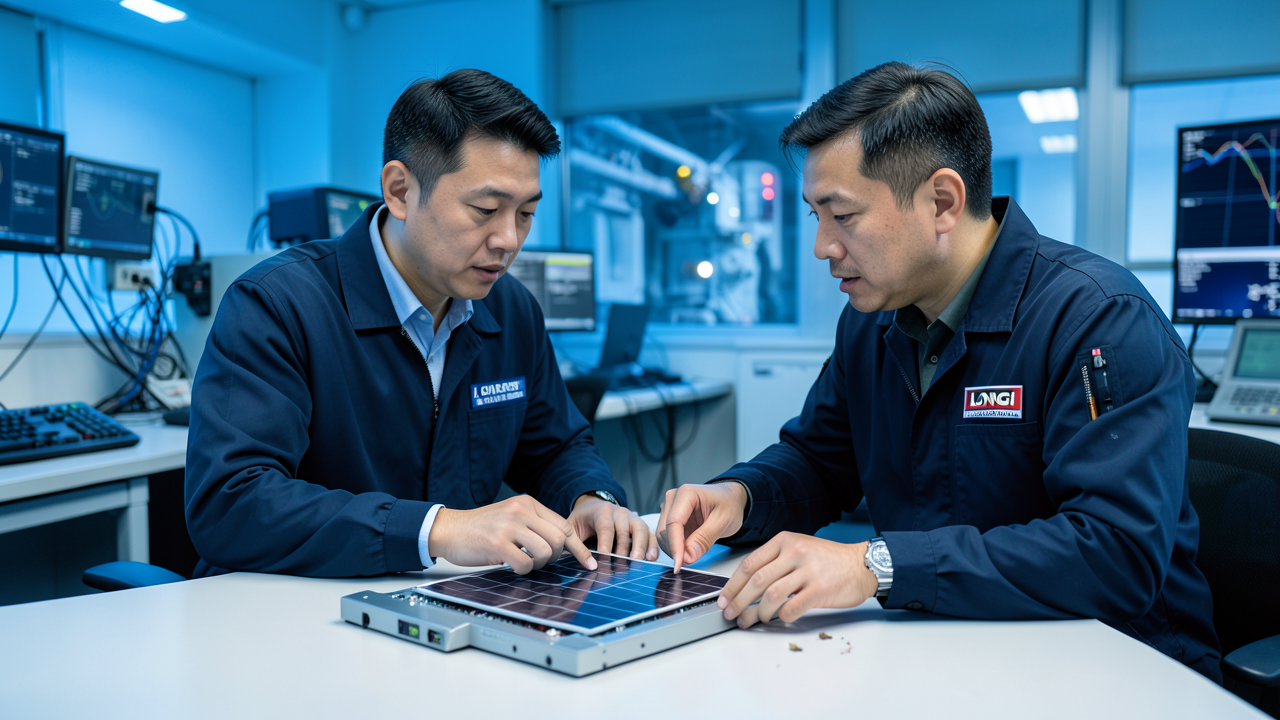
A research team from Soochow University in China and global photovoltaic leader LONGi has developed a groundbreaking dual-anchored interfacial design strategy, achieving an astounding 34.0% conversion efficiency in perovskite-silicon tandem solar cells. This novel approach demonstrates an effective method to simultaneously realize high efficiency, high voltage output, and long-term operational stability, marking a significant advancement in next-generation solar cell technology.
Technical / Clinical Details
The core of this breakthrough lies in the dual-anchored interfacial design, which effectively suppresses non-radiative recombination at the interface while maintaining efficient extraction of photo-generated charge carriers. In conventional perovskite-silicon tandem solar cells, charge loss at the interface between different material layers has been a critical challenge, leading to reduced efficiency and stability. The research team introduced a ‘dual-anchor’ layer with a specific molecular structure, creating a strong bond between the perovskite crystal and the electron transport layer. This meticulously engineered interface passivates defects and significantly reduces charge recombination. As a result, the developed tandem solar cell achieved a high open-circuit voltage (Voc) and a remarkable 34.0% conversion efficiency, alongside excellent long-term operational stability. This method not only enhances efficiency but also critically addresses the durability issue, one of the biggest challenges for the commercialization of perovskite solar cells.
Background & Context
Perovskite-silicon tandem solar cells are at the forefront of a global research and development race, poised to surpass the physical efficiency limits of single-junction silicon solar cells. This technology combines a high-bandgap perovskite layer with a low-bandgap silicon layer, allowing for broader utilization of the solar spectrum and converting more light energy into electricity. China is heavily investing in perovskite technology, with government and industry working in tandem to establish leadership in the renewable energy sector. LONGi, a company already holding a 35.5% world record in the field, is a frontrunner, and its collaboration with Soochow University represents a powerful model fusing academic insight with industrial application. This latest achievement, by balancing high efficiency and reliability, further solidifies the commercial viability of perovskite tandem solar cells.
Strategic Significance & Outlook
The success of the dual-anchored interfacial design by Soochow University and LONGi will be a significant driving force for the practical application of perovskite-silicon tandem solar cells. This interfacial engineering strategy has the potential to become a foundational technology for mass production, large-area fabrication, and ensuring long-term reliability of high-efficiency devices. Future developments are expected to accelerate product development and optimize manufacturing processes based on this technology. For LONGi, which plans to commence commercial module shipments, this achievement further strengthens its product competitiveness. Ultimately, widespread adoption of perovskite tandem solar cells, which combine high efficiency and long-term stability, could significantly reduce the cost of solar electricity, contribute to the expansion of renewable energy, and accelerate the global energy transition, opening new pathways for a sustainable future.
Get our weekly technology intelligence — free
Receive an infographic that lets you judge at a glance whether each field’s analysis report is worth reading.
Subscribe Free — Weekly Tech Intelligence
By subscribing, you’ll receive Troy-Technical’s weekly technology intelligence newsletter.
- Your email and selected fields are used only to deliver the newsletter.
- We never share your information with third parties.
- You can unsubscribe anytime via the link in each email.
See our Privacy Policy for details.
Takes about a minute · Unsubscribe anytime







Comments