Key Findings
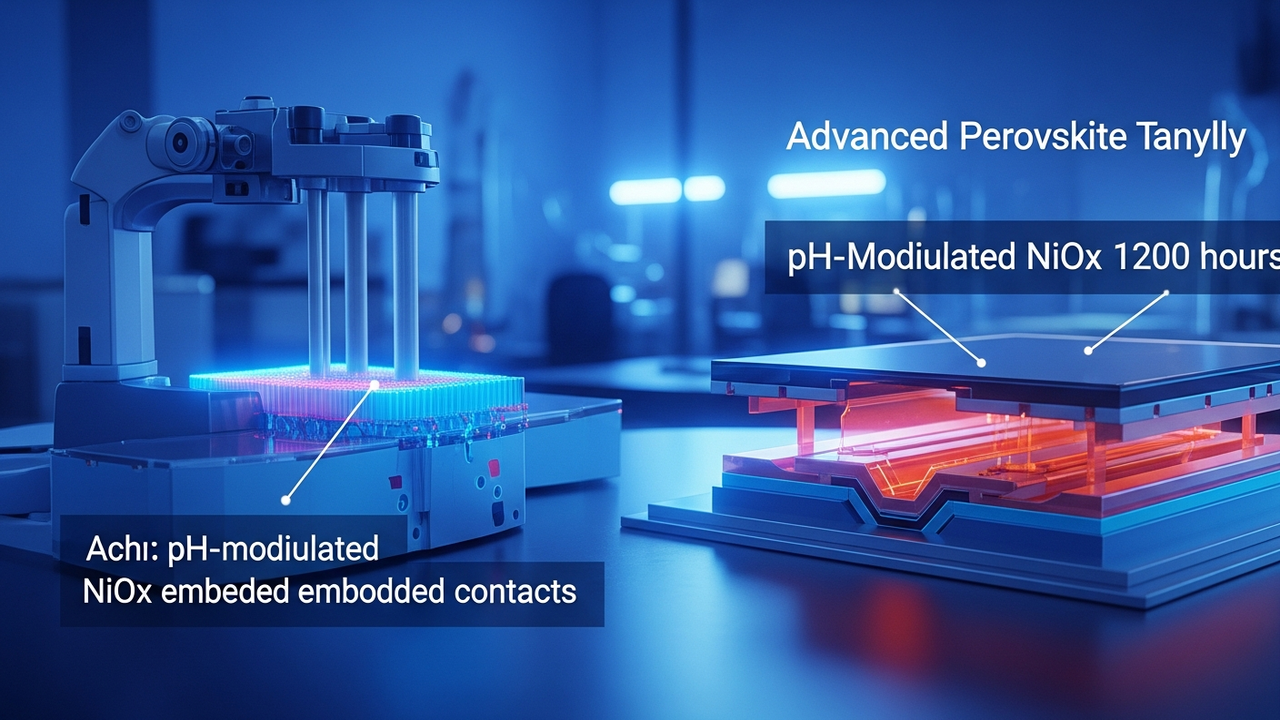
This study reports the development of a homogenization method for buried contacts via pH-modulated nickel oxide (NiOₓ), which enabled high-performance all-perovskite tandem solar cells to achieve an astonishing power conversion efficiency of 29.51%. Concurrently, this technology demonstrated excellent stability, maintaining over 80% of its initial efficiency after 1200 hours in a nitrogen atmosphere.
Technical Details
All-perovskite tandem solar cells aim for ultra-high efficiencies beyond the limits of single-junction cells by stacking multiple perovskite layers with different bandgaps to efficiently utilize the solar spectrum. In this architecture, the quality of the buried contacts between each layer is paramount for determining overall device performance and stability. The research team succeeded in homogenizing the buried contact interface by using NiOₓ films modified with KH₂PO₄ (potassium dihydrogen phosphate). This modified NiOₓ film promotes high coverage and the formation of stable self-assembled monolayers (SAMs), which effectively suppress non-radiative recombination originating from interfacial defects. As a result, a wide-bandgap perovskite solar cell (1.77 eV bandgap) alone achieved a power conversion efficiency of 21.17%, and the resulting all-perovskite tandem solar cell recorded a high efficiency of 29.51%. This improved interface enhances charge carrier transport efficiency and contributes to the device’s long-term stability.
Background and Context
All-perovskite tandem solar cells offer advantages over silicon tandems, such as lower cost and suitability for solution-based manufacturing processes. However, challenges in controlling interfaces when stacking multiple perovskite layers, particularly recombination losses due to interfacial defects and long-term stability, have hindered their commercialization. The optimization of NiOₓ through pH modulation provides a practical solution to these challenges, significantly accelerating the development of next-generation high-efficiency perovskite solar cells. An efficiency of 29.51% approaches world records at the laboratory level, serving as a crucial indicator of perovskite technology’s maturity.
Strategic Significance and Outlook
The achieved high efficiency of 29.51% and long-term stability of 1200 hours represent a major milestone towards the practical implementation of all-perovskite tandem solar cells. This technology will contribute to reducing the cost of solar power and maximizing power generation per unit area, promoting widespread adoption in applications ranging from large-scale solar farms and building-integrated photovoltaics (BIPV) to even space applications. Moving forward, the research team is expected to further optimize the pH-modulated NiOₓ technology, pursue large-area fabrication, and conduct long-term reliability assessments under more stringent conditions. If successfully introduced to the market, this technology holds immense potential to significantly contribute to the widespread adoption of clean energy and the realization of a sustainable society.
Get our weekly technology intelligence — free
Receive an infographic that lets you judge at a glance whether each field’s analysis report is worth reading.
Subscribe Free — Weekly Tech Intelligence
By subscribing, you’ll receive Troy-Technical’s weekly technology intelligence newsletter.
- Your email and selected fields are used only to deliver the newsletter.
- We never share your information with third parties.
- You can unsubscribe anytime via the link in each email.
See our Privacy Policy for details.
Takes about a minute · Unsubscribe anytime









Comments