Key Findings
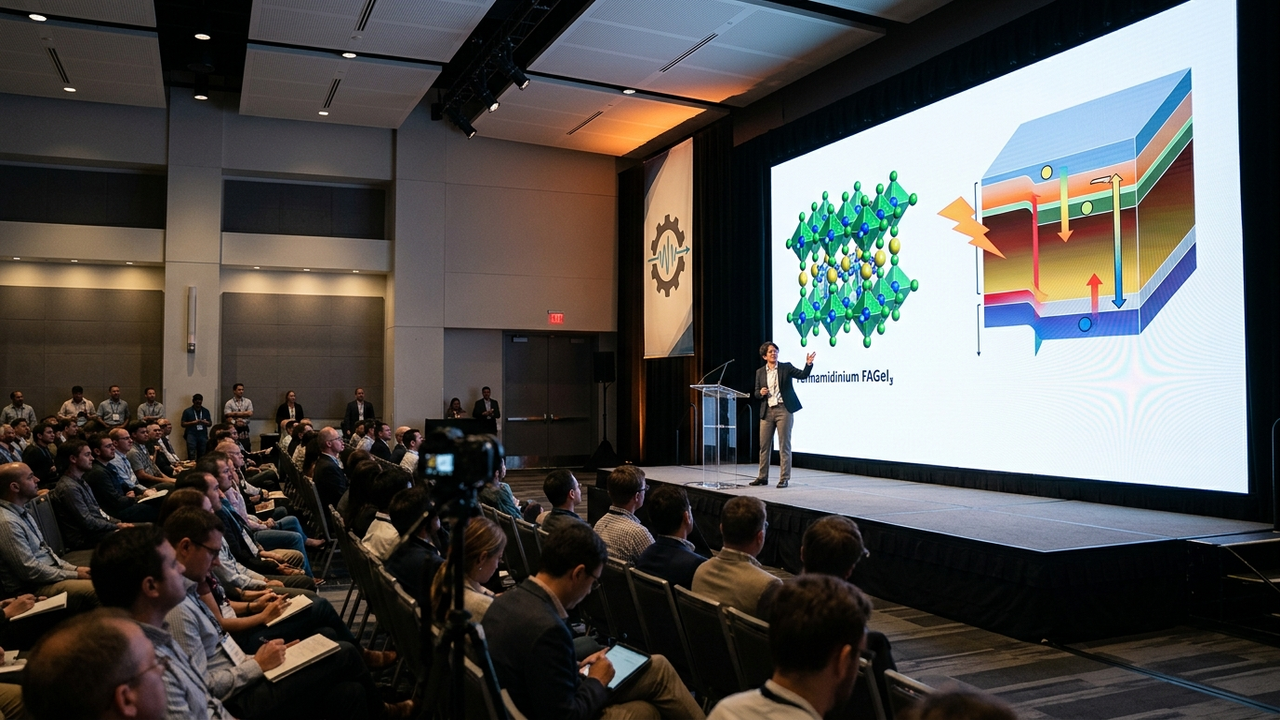
The ‘Organic, Hybrid, and Perovskite Photovoltaics XXVII’ conference, held from August 24 to 26, 2026, served as a platform for announcing two pivotal breakthroughs in the material science and device physics of perovskite solar cells. One significant development involved a novel absorber material for lead-free photovoltaics utilizing FAGeI₃ perovskite. Concurrently, researchers discussed advanced surface reconstruction methods aimed at significantly enhancing the performance of high-efficiency wide bandgap perovskite solar cells.
Technical / Clinical Details
The pursuit of lead-free perovskite solar cells is driven by urgent environmental concerns regarding lead toxicity in conventional perovskite formulations. The presented FAGeI₃ perovskite, a combination of formamidinium (FA) and germanium iodide (GeI₃), represents a promising new absorber material that exhibits excellent optoelectronic properties while entirely avoiding lead. This advancement is crucial for developing more environmentally benign and sustainable solar cell technologies. Additionally, wide bandgap perovskite solar cells are critical components for high-efficiency tandem and multi-junction solar cells, typically serving as the top cell. The discussed surface reconstruction methods are designed to optimize charge carrier transport and reduce recombination losses, thereby boosting the overall power conversion efficiency. These technical refinements are essential for pushing the performance limits of perovskite solar cells and unlocking new application areas.
Background & Context
Perovskite solar cells are recognized as a leading contender for next-generation photovoltaics due to their high power conversion efficiencies and potential for low-cost, versatile manufacturing. However, environmental concerns associated with lead content and challenges related to long-term stability remain significant hurdles. Research into lead-free alternatives is therefore paramount for enhancing market acceptance, particularly as environmental regulations become more stringent. Improving the efficiency of wide bandgap materials is also key to maximizing the overall efficiency of tandem solar cells. The presentations at this conference underscore the academic community’s focused efforts on these fundamental and critical challenges, which will likely have a profound impact on the future commercialization roadmap.
Strategic Significance & Outlook
The development of lead-free perovskites will significantly improve the environmental profile of perovskite solar cells, fostering broader adoption in various markets, including building-integrated photovoltaics (BIPV) and portable electronics where human contact is more frequent. The enhanced efficiency of wide bandgap perovskites promises to contribute to new world records for tandem solar cells, further driving down the levelized cost of solar electricity. These advancements offer researchers, engineers, and investors a compelling reason to re-evaluate the future viability and market potential of perovskite technology, pushing towards a more sustainable and efficient global energy landscape.
Source: https://spie.org/OP26P/conferencedetails/ohpvs
Get our weekly technology intelligence — free
Receive an infographic that lets you judge at a glance whether each field’s analysis report is worth reading.
Subscribe Free — Weekly Tech Intelligence
By subscribing, you’ll receive Troy-Technical’s weekly technology intelligence newsletter.
- Your email and selected fields are used only to deliver the newsletter.
- We never share your information with third parties.
- You can unsubscribe anytime via the link in each email.
See our Privacy Policy for details.
Takes about a minute · Unsubscribe anytime





Comments