Key Findings
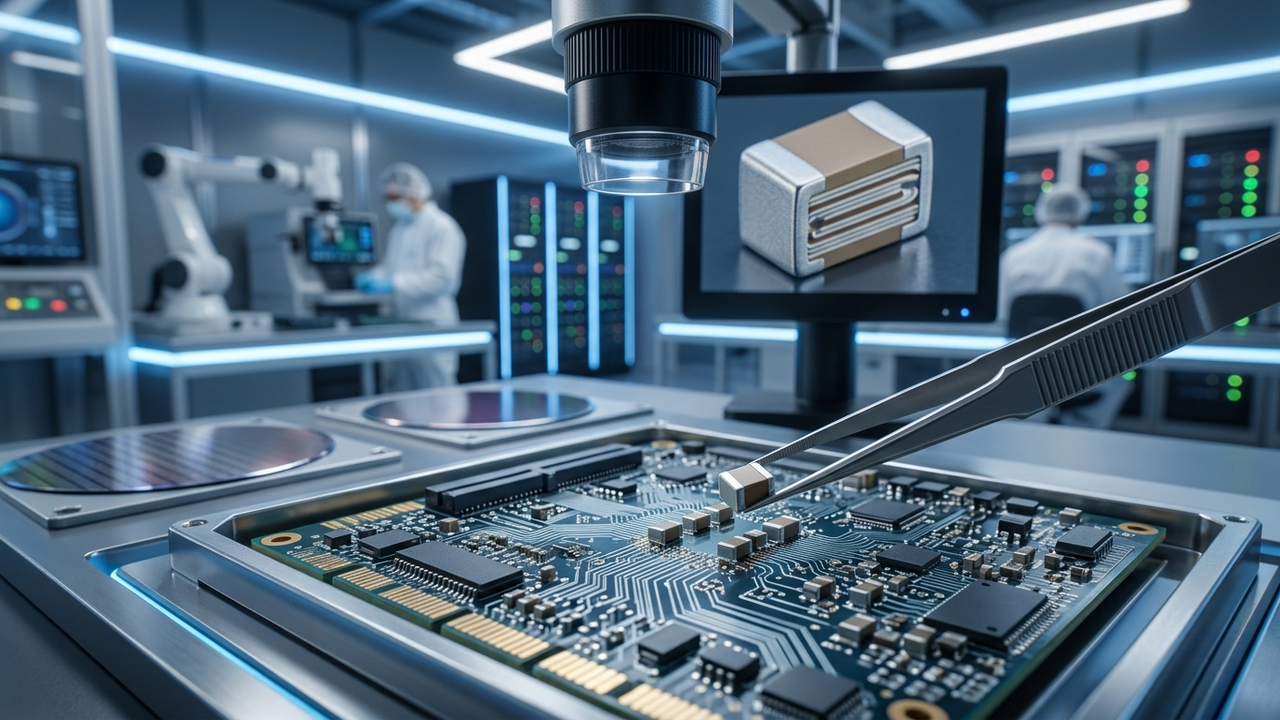
It has become clear that technological innovation in high-frequency multilayer ceramic capacitors (MLCCs) is essential for maximizing the performance of next-generation optical modules, such as 800G and 1.6T. These optical modules must efficiently and stably operate multi-channel lasers and complex digital signal processing (DSP) chips within confined, compressed spaces. Consequently, ultra-small, high-performance, and high-reliability MLCCs are critical components for ensuring signal integrity and minimizing power supply ripple.
Technical Details
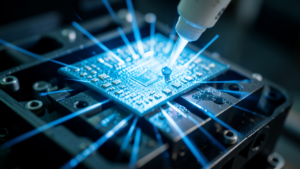
800G and 1.6T optical modules integrate a high density of electronic components to transmit vast amounts of data at high speeds. Particularly, multi-channel laser drivers, Transimpedance Amplifiers (TIAs), and high-speed DSPs require stable power supply and noise suppression. MLCCs are positioned in close proximity to these components, functioning as decoupling capacitors to filter out high-frequency noise and provide stable voltage in response to rapid current changes.
The challenges lie in the severe space constraints within the module and the high-frequency environment, extending into tens of gigahertz. Traditional MLCCs may struggle with self-resonant frequency and inductance characteristics, failing to deliver the desired noise suppression performance. Therefore, modern optical modules demand ultra-small MLCCs with lower Equivalent Series Inductance (ESL) and Equivalent Series Resistance (ESR), exhibiting stable characteristics across a broad frequency range. The strategic placement of multiple MLCCs to minimize power supply impedance is key to ensuring overall system signal integrity.
Background & Context
With the advancement of AI data centers and high-performance computing, the speed and density of optical communications are increasing exponentially. This in turn drives up power consumption and heat generation in optical modules, constantly demanding miniaturization and higher efficiency. MLCCs, as the “unsung heroes” of electronic circuits, play a vital, albeit often unnoticed, role in the stable operation of the entire system. Optical module vendors rely heavily on the performance improvement of passive components like MLCCs, in parallel with high-performance optoelectronic devices. Technological innovation from the supplier side is thus foundational to the evolution of optical communication.
Strategic Significance & Outlook
Future optical modules are expected to evolve towards 3.2T and even higher speeds. Correspondingly, MLCCs will be required to achieve further miniaturization, higher capacitance, and improved high-frequency characteristics. Ensuring reliability against temperature variations and aging will also be critical challenges. MLCC manufacturers are expected to meet these demands through the development of new dielectric materials and improvements in lamination technology. The continuous mutual evolution of optical modules and MLCC technology will lay the groundwork for future high-capacity, high-speed communication infrastructure.
Get our weekly technology intelligence — free
Receive an infographic that lets you judge at a glance whether each field’s analysis report is worth reading.
Subscribe Free — Weekly Tech Intelligence
By subscribing, you’ll receive Troy-Technical’s weekly technology intelligence newsletter.
- Your email and selected fields are used only to deliver the newsletter.
- We never share your information with third parties.
- You can unsubscribe anytime via the link in each email.
See our Privacy Policy for details.
Takes about a minute · Unsubscribe anytime




Comments