Key Findings
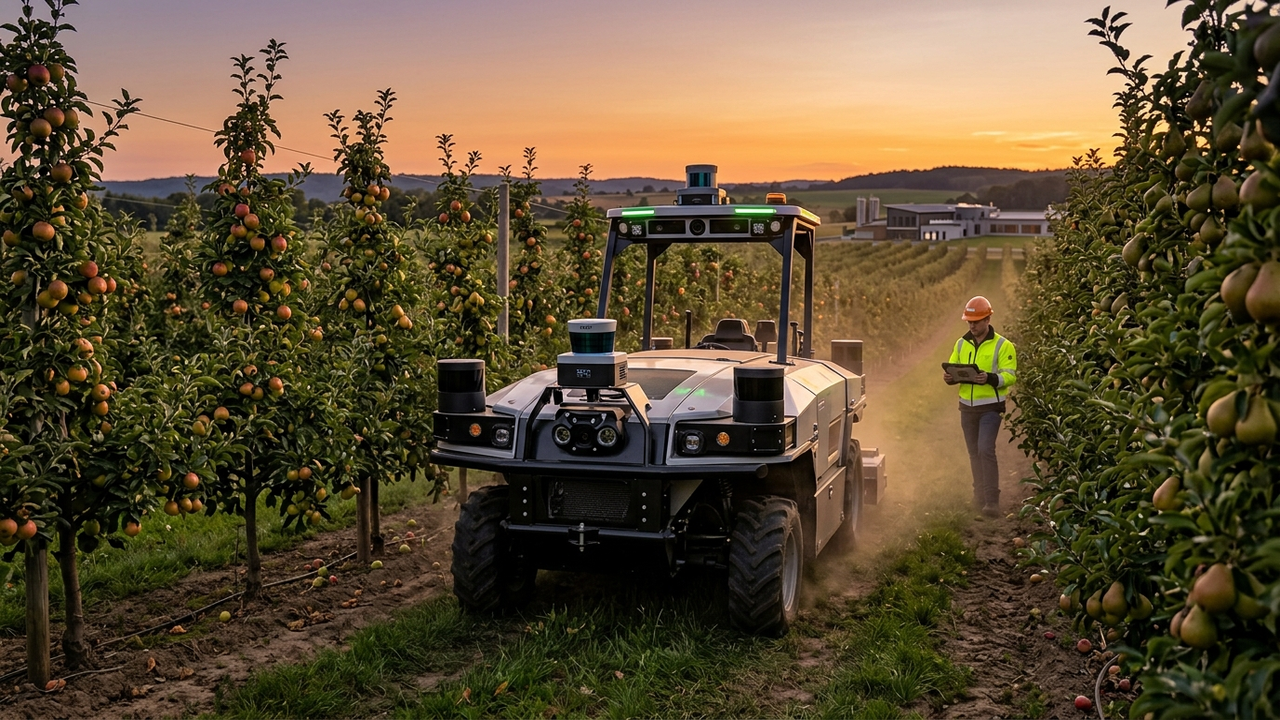
GUSS Automation, a subsidiary of John Deere, has announced its decision to integrate Ouster’s latest Rev8 OS0 digital LiDAR sensors into its next-generation autonomous orchard machines. This partnership marks a significant milestone, illustrating the extensive adoption and deepening industrial application of LiDAR technology within the agricultural robotics and autonomous systems sector.
Technical / Clinical Details
- Ouster Rev8 OS0 Digital LiDAR Sensor: The OS0 sensor is a flagship product in Ouster’s lineup, characterized by its high-performance digital LiDAR technology. The Rev8 iteration offers higher resolution and broader range 3D point cloud data, enabling reliable environmental perception even under challenging conditions. Its digital architecture contributes to superior reliability and ease of manufacturing.
- Integration into Autonomous Orchard Machines: GUSS Automation’s autonomous orchard machines are designed to automate tasks such as spraying and management in orchards. Accurate environmental perception is crucial for these machines to operate safely and efficiently amidst complex tree rows, uneven terrain, and variable environmental factors (e.g., sunlight, shadows, dust). The OS0 sensor provides the necessary 3D mapping and obstacle detection capabilities to address these challenges.
- Enhanced Navigation and Obstacle Detection: LiDAR sensors continuously scan the vehicle’s surroundings in real-time, generating 3D point cloud data with precise distance information. This allows the machines to accurately determine their position, detect obstacles such as trees, equipment, and personnel, and autonomously navigate optimal paths while avoiding collisions.
- Expansion into Industrial Applications: This partnership demonstrates that LiDAR technology is not confined to the automotive sector but is becoming an indispensable tool for driving autonomy in a wider range of industrial fields, including agriculture, construction, and logistics.
Background & Context
The agricultural sector is rapidly adopting autonomous machinery due to labor shortages and the increasing demand for efficiency. Major corporations like John Deere, through GUSS Automation, are actively investing in this area, signaling significant market potential. LiDAR technology is particularly valuable in complex outdoor environments for autonomous systems because it maintains stable performance during nighttime operations and under conditions like dust or fog, where cameras or GPS alone might struggle.
Strategic Significance & Outlook
The collaboration between GUSS Automation and Ouster represents a crucial step in shaping the future of precision agriculture. Autonomous orchard machines equipped with Ouster’s LiDAR sensors will accelerate task automation, enhance the efficiency and accuracy of farm operations, and ultimately contribute to increased agricultural productivity and cost reduction. This success story is likely to encourage other agricultural machinery manufacturers and heavy equipment makers to adopt LiDAR technology, thereby accelerating the digital transformation of the entire agricultural sector. The continuous evolution and industrial proliferation of LiDAR technology will remain an indispensable component in the widespread deployment of robotics and autonomous systems.
Get our weekly technology intelligence — free
Receive an infographic that lets you judge at a glance whether each field’s analysis report is worth reading.
Subscribe Free — Weekly Tech Intelligence
By subscribing, you’ll receive Troy-Technical’s weekly technology intelligence newsletter.
- Your email and selected fields are used only to deliver the newsletter.
- We never share your information with third parties.
- You can unsubscribe anytime via the link in each email.
See our Privacy Policy for details.
Takes about a minute · Unsubscribe anytime





Comments