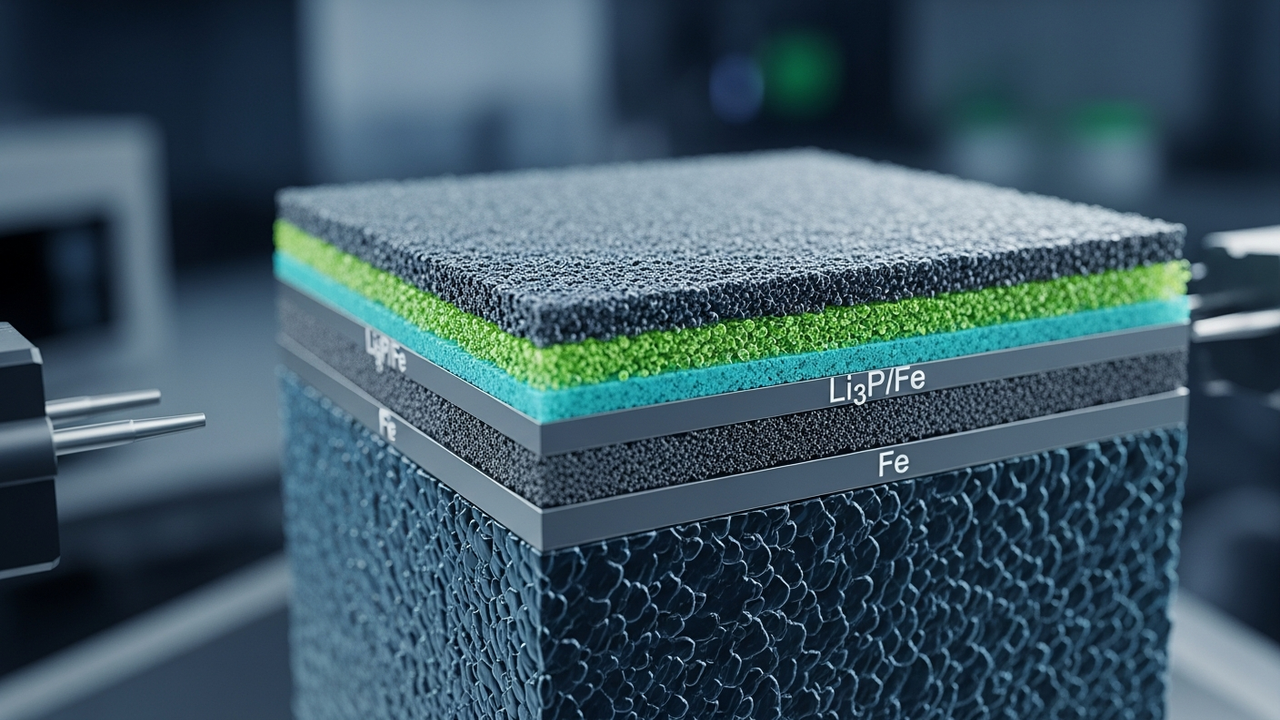
Overcoming Interfacial Challenges in Garnet Solid-State Batteries
All-solid-state batteries (SSBs) are garnering significant attention as a next-generation battery technology due to their potential for high safety and energy density. Garnet-type solid electrolytes, such as Li7La3Zr2O12 (LLZTO), are particularly promising due to their high ionic conductivity. However, direct contact with a lithium metal anode often leads to issues like chemical reactivity and high interfacial resistance. This high interfacial resistance impedes efficient lithium ion transport and significantly degrades battery performance, representing a major hurdle for practical implementation. To address this, novel interfacial engineering approaches are being explored.
Construction and Efficacy of the Li3P/Fe Dual-Conductive Interface
Recent research published in ACS Publications proposes an innovative solution: creating an in-situ Li3P/Fe composite interfacial layer by coating the surface of garnet LLZTO solid electrolytes with FeP (iron phosphide) and subsequently reacting it with molten lithium. This “Li3P/Fe dual-conductive interface” leverages the synergistic effects of ionically conductive Li3P and electronically conductive Fe to dramatically reduce interfacial impedance. Specifically, the impedance was cut from a high of 712.04 Ω cm–2 to a significantly lower 77.52 Ω cm–2, representing an approximate 90% reduction. This low-resistance interface facilitates fast and uniform lithium ion migration, thereby reducing the battery’s internal resistance and improving its overall efficiency.
Dendrite Suppression and Enhanced Long-Term Stability
The innovative interfacial layer has been demonstrated to substantially enhance the stability of the lithium metal anode. Under a relatively high current density of 0.1 mA cm–2, the system achieved stable lithium plating/stripping (charge/discharge) for over 2200 hours. This impressive longevity confirms the effective suppression of lithium dendrite formation and penetration into the electrolyte, a pervasive problem in traditional lithium metal batteries that compromises both safety and cycle life. This research represents a crucial breakthrough for the commercialization of garnet-based solid-state lithium metal batteries, accelerating the realization of next-generation battery technology that combines high energy density with superior safety characteristics.





Comments