Key Findings
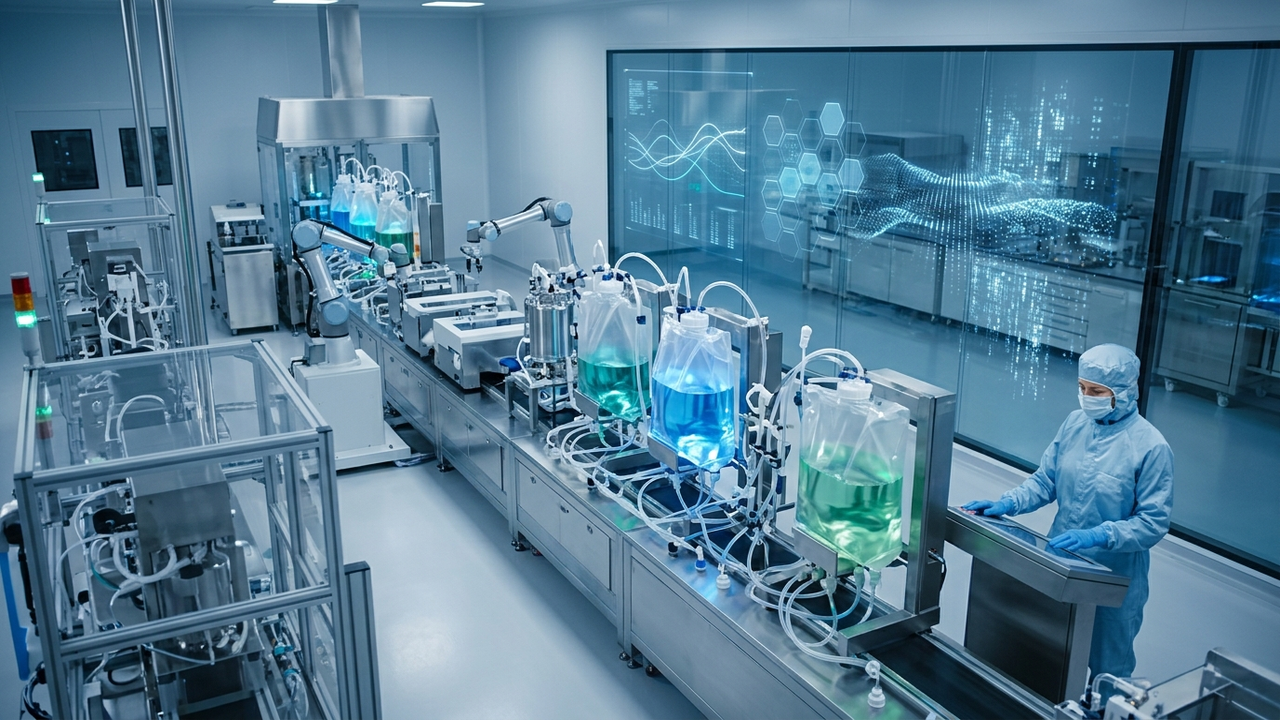
To drastically reduce global development costs in biosimilar manufacturing, an integrated strategy encompassing continuous bioprocessing with high-density cell culture, Quality by Design (QbD) with Process Analytical Technology (PAT), single-use systems with modular facility design, and AI-driven optimization alongside digital twins is being actively pursued. A key highlight is the capability of a 500L perfusion bioreactor to produce the same quantity of drug as a 5,000L fed-batch tank, leading to significant reductions in physical footprint and utility costs.
Technical & Clinical Details
Biosimilars are tasked with demonstrating equivalent quality, safety, and efficacy to their reference biopharmaceutical product while maintaining lower development costs to provide affordable therapies to patients. The following strategies are crucial for achieving this goal:
- Continuous Bioprocessing and High-Density Cell Culture: Compared to traditional batch processes, continuous bioprocessing extends operation time and maximizes productivity. Combining this with high-density cell culture techniques like perfusion culture enables the production of equivalent or greater amounts of product using significantly smaller bioreactor volumes. For example, a 500L perfusion bioreactor is reported to achieve the same annual output as a conventional 5,000L fed-batch system, dramatically reducing capital investment and operational costs.
- Quality by Design (QbD) and Process Analytical Technology (PAT): QbD is an approach where quality is built into the design from the outset, based on thorough product and process understanding. PAT tools (e.g., inline sensors, real-time monitoring) measure and control critical quality attributes in real-time during the process, swiftly identifying and rectifying process deviations to ensure consistent product quality and reduce reliance on final product testing.
- Single-Use Systems and Modular Facility Design: The adoption of single-use bioreactors, bags, and tubing eliminates the need for cleaning and sterilization validation, shortening turnaround times between batches. Modular design allows for rapid construction, expansion, and reconfiguration of production lines, creating manufacturing facilities that can flexibly respond to market demand fluctuations. This reduces capital expenditure and operational costs.
- AI-Driven Optimization and Digital Twins: AI and machine learning are used to analyze vast amounts of process data, identify optimal operating conditions, and predict process anomalies. Digital twins (virtual replicas of physical process systems) reduce physical trial-and-error through simulation and prediction, saving significant development time and cost. This enables the rapid design of more robust and efficient processes.
Background & Industry Context
With the rapid growth of the biopharmaceutical market, governments worldwide recognize the importance of controlling healthcare costs and expanding patient access. Biosimilars are crucial for achieving these goals, but their development and manufacturing remain costly. These integrated strategies represent a new pathway for the industry to address economic challenges while balancing innovation and sustainability.
Strategic Significance & Outlook
These integrated strategies will dramatically improve the efficiency of biosimilar manufacturing and reduce development costs, paving the way for more biosimilars to enter the market. As a result, patients worldwide will gain access to more affordable, high-quality biopharmaceuticals. Researchers and engineers can establish new benchmarks in bioprocess design by mastering these advanced technologies, while investors can anticipate high returns from cost-effective manufacturing platforms.
Get our weekly technology intelligence — free
Receive an infographic that lets you judge at a glance whether each field’s analysis report is worth reading.
Subscribe Free — Weekly Tech Intelligence
By subscribing, you’ll receive Troy-Technical’s weekly technology intelligence newsletter.
- Your email and selected fields are used only to deliver the newsletter.
- We never share your information with third parties.
- You can unsubscribe anytime via the link in each email.
See our Privacy Policy for details.
Takes about a minute · Unsubscribe anytime






Comments