Key Findings
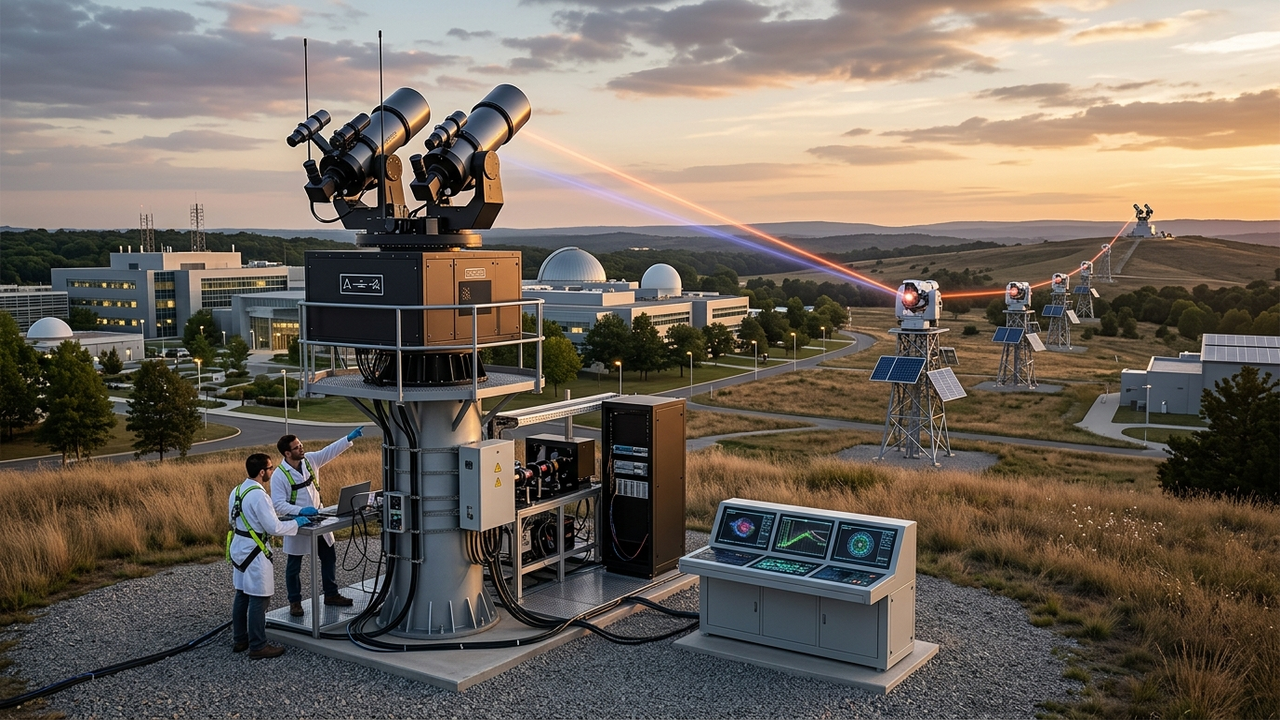
Researchers from Brookhaven National Laboratory (BNL) and Stony Brook University have successfully transmitted quantum information through open air, achieving a critical milestone towards the realization of future “wireless” quantum networks. This innovative technology extended New York’s existing 161-mile (approximately 259 km) fiber-optic quantum network by integrating a free-space optical (FSO) link.
Technical/Clinical Details
- Free-Space Optical (FSO) Link: The experiment utilized FSO technology, where entangled photon pairs were generated and transmitted through the atmosphere rather than optical fibers. FSO is particularly advantageous for connecting quantum nodes in areas where fiber optic cable deployment is difficult or impractical, and for establishing links between mobile quantum entities.
- Maintaining Quantum Information Fidelity: Transmitting quantum information through open air is challenging due to atmospheric turbulence and particles, which can disrupt entanglement. The research team developed techniques to overcome these challenges, enabling sustained and reliable quantum information exchange.
- Integration with Existing Networks: This demonstration showcases the potential for seamlessly integrating wireless components into existing fiber-based quantum networks. Such integration enhances network flexibility, offering broader coverage and supporting a wider array of quantum applications.
Background & Context
Quantum networks are anticipated to form the backbone for ultra-secure communications (e.g., Quantum Key Distribution) and distributed quantum computing. While many current quantum networks rely on optical fibers, their deployment costs and geographical constraints pose significant hurdles. The realization of wireless quantum networks offers a solution to these limitations, paving the way for a more extensive and adaptable quantum internet.
Strategic Significance & Outlook
This wireless quantum network demonstration represents a vital step towards a future “quantum internet” where quantum computers can interconnect. In the long term, this technology could extend beyond terrestrial links to include global quantum communication networks via satellites. This promises a future where highly sensitive communications in sectors like finance, national security, and healthcare data exchange are protected by the fundamental principles of quantum mechanics.
Source: https://www.bnl.gov/newsroom/news.php?a=123096
Get our weekly technology intelligence — free
Receive an infographic that lets you judge at a glance whether each field’s analysis report is worth reading.
Subscribe Free — Weekly Tech Intelligence
By subscribing, you’ll receive Troy-Technical’s weekly technology intelligence newsletter.
- Your email and selected fields are used only to deliver the newsletter.
- We never share your information with third parties.
- You can unsubscribe anytime via the link in each email.
See our Privacy Policy for details.
Takes about a minute · Unsubscribe anytime







Comments