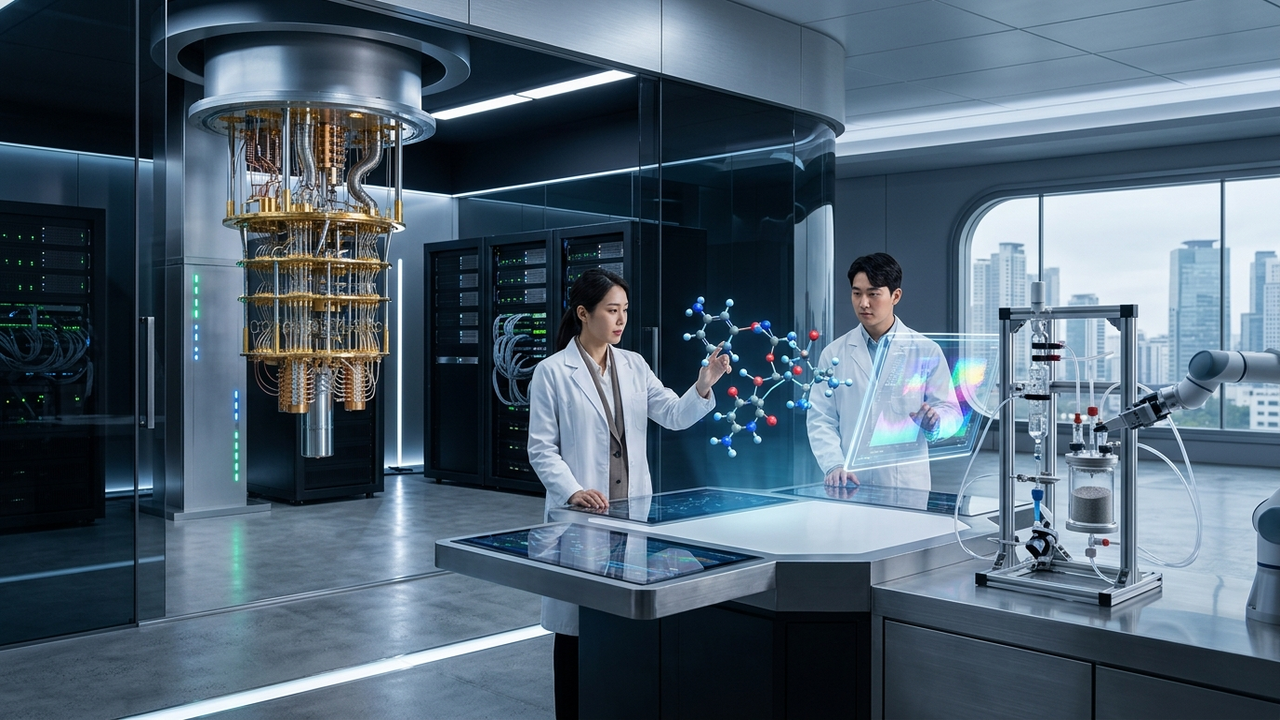
Bridging Classical Gaps with Quantum Reframing
The South Korean Ministry of Science and ICT (MSIT) recently concluded its ‘Quantum Reframing Challenge 2026,’ an ambitious initiative designed to demonstrate and accelerate the practical application of quantum computing across industrial and public sectors. The challenge tasked participating teams with a crucial first step: redefining complex, real-world problems to fit within the unique paradigms of quantum computing. Following this ‘reframing,’ teams then implemented and rigorously verified their proposed solutions on actual quantum processors provided by leading global quantum companies, including IonQ, Pasqal, and Quandela.
Catalyst Optimization Highlights Practical Quantum Impact
A standout success from the challenge was the compelling validation of quantum computing’s efficacy in a critical industrial application: enhancing catalyst efficiency within the chemical industry. Teams addressed a spectrum of challenges, ranging from computational science simulations to complex combinatorial optimization problems. Their work underscored the profound potential for quantum algorithms to efficiently process problems that remain intractable for conventional classical computers due to their prohibitive computational resource demands. The top five performing teams were recognized with awards totaling 20 million KRW (approximately 20,000 USD), alongside invaluable opportunities for collaboration with global quantum technology leaders, paving the way for further industrial integration of their research.
Diverse Quantum Architectures Tackling Intractable Problems
At its core, the ‘Quantum Reframing Challenge 2026’ aimed to push the boundaries of problem-solving by leveraging quantum computing’s intrinsic properties, such as superposition and entanglement, to address issues conventionally considered impractical for classical computation due to resource constraints. A key aspect of the challenge involved participants implementing their solutions across a diverse array of state-of-the-art quantum computing environments:
- IonQ: Ion trap quantum computers, known for their high connectivity and fidelity.
- Pasqal: Neutral atom quantum computers, recognized for scalability and long coherence times.
- Quandela: Photonic quantum computers, offering a path to room-temperature operation and ultrafast processing.
This multi-platform approach provided critical practical insights into how the distinct characteristics of each quantum computing paradigm might be optimally matched to specific industrial challenges. Beyond catalyst optimization, targeted problems included molecular structure optimization in advanced chemical simulations and complex combinatorial optimization scenarios in logistics and supply chain management, underscoring the broad business value inherent in quantum computing’s raw computational power.
Strategic Imperative: Catalyzing a Quantum Ecosystem
Globally, quantum computing technology is advancing at an unprecedented pace, and the South Korean government has strategically identified this field as a cornerstone of its national innovation agenda, actively providing significant support. The ‘Quantum Reframing Challenge’ serves as a critical conduit, bridging the gap between foundational quantum research and tangible industrial applications. The ‘reframing’ process itself—reconceptualizing existing industry “hard problems” through a quantum lens—is paramount for truly identifying and unlocking the value proposition of quantum technology, thereby accelerating its mainstream adoption. Such collaborative public-private-academic initiatives are instrumental in fostering the maturation of the entire quantum technology ecosystem and are pivotal in shaping the nascent global quantum computing market.
Path Forward: Accelerating Industrial Quantum Adoption
The tangible results and profound insights garnered from the ‘Quantum Reframing Challenge 2026’ are poised to significantly accelerate the industrialization of quantum technology throughout South Korea. The demonstrable success in specific industrial applications is expected to act as a powerful catalyst, encouraging more enterprises to invest in quantum technologies and stimulating the creation of novel quantum applications. Looking ahead, MSIT has committed to continuously hosting similar challenges. This sustained effort aims to progressively broaden the scope of quantum technology applications and solidify South Korea’s competitive standing in the rapidly evolving global quantum computing landscape.
Source: https://www.korea.kr/briefing/pressReleaseView.do?newsId=156775513
Get our weekly technology intelligence — free
Receive an infographic that lets you judge at a glance whether each field’s analysis report is worth reading.
Subscribe Free — Weekly Tech Intelligence
By subscribing, you’ll receive Troy-Technical’s weekly technology intelligence newsletter.
- Your email and selected fields are used only to deliver the newsletter.
- We never share your information with third parties.
- You can unsubscribe anytime via the link in each email.
See our Privacy Policy for details.
Takes about a minute · Unsubscribe anytime






Comments