Key Findings
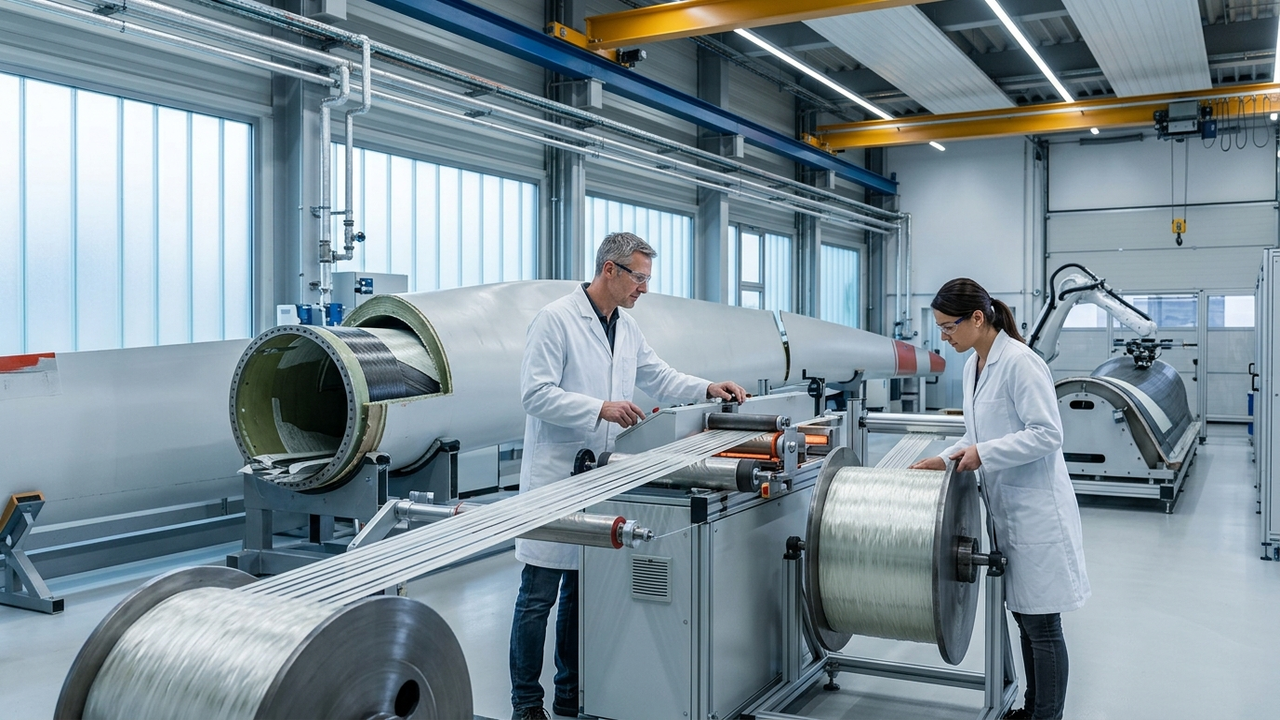
The REWIND project, led by the German Institutes of Textile and Fiber Research Denkendorf (DITF), has achieved significant progress in developing a technology to recover composite materials from end-of-life wind turbine blades and transform them into new, high-performance reinforcements. This innovative approach specifically demonstrates the potential to directly manufacture Long Fiber Debonding (LFD) tapes from fully cured glass fiber reinforced plastic (GFRP) for reuse as reinforcements in novel composite structures.
Technical / Clinical Details
The core technology of the REWIND project lies in its process to effectively separate long fibers from used GFRP and reconfigure them into LFD tapes. While conventional mechanical recycling often damages fiber length and properties, this new technology enables debonding while maintaining the integrity and orientation of the glass fibers. The recovered LFD tapes can then be directly integrated into new composite manufacturing processes, for applications such as automotive parts, building materials, or even secondary structural components for new wind turbine blades. This ‘closed-loop’ recycling approach maximizes material value while reducing waste generation. Furthermore, the technology contributes to optimizing energy consumption and reducing chemical usage, thereby lowering the environmental footprint.
Background & Context
Wind energy is increasingly vital as a clean power source, but the disposal of end-of-life wind turbine blades presents a growing environmental problem. Blades are predominantly made of GFRP and CFRP, and due to their large size and robustness, most are landfilled. This practice not only incurs high environmental costs but also represents a loss of valuable resources. With Europe moving towards banning landfilling of wind turbine blades by 2025, the development of efficient and sustainable recycling technologies has become an urgent priority. The DITF REWIND project is a critical initiative responding to these policy and environmental challenges, contributing to enhancing the overall sustainability of the composite materials industry.
Strategic Significance & Outlook
The technology developed by the DITF REWIND project holds the potential to be a game-changer in wind turbine blade recycling. This LFD tape manufacturing technology will promote the reuse of recovered glass fibers in higher-value applications, serving as a model for resource circulation in the composite materials industry. The focus now shifts to industrial-scale demonstration and commercialization of this technology. DITF aims to strengthen collaborations with industry partners and advance further research and development to ensure widespread adoption of these recovered composite reinforcements across various products, thereby contributing to a sustainable society.
Get our weekly technology intelligence — free
Receive an infographic that lets you judge at a glance whether each field’s analysis report is worth reading.
Subscribe Free — Weekly Tech Intelligence
By subscribing, you’ll receive Troy-Technical’s weekly technology intelligence newsletter.
- Your email and selected fields are used only to deliver the newsletter.
- We never share your information with third parties.
- You can unsubscribe anytime via the link in each email.
See our Privacy Policy for details.
Takes about a minute · Unsubscribe anytime






Comments