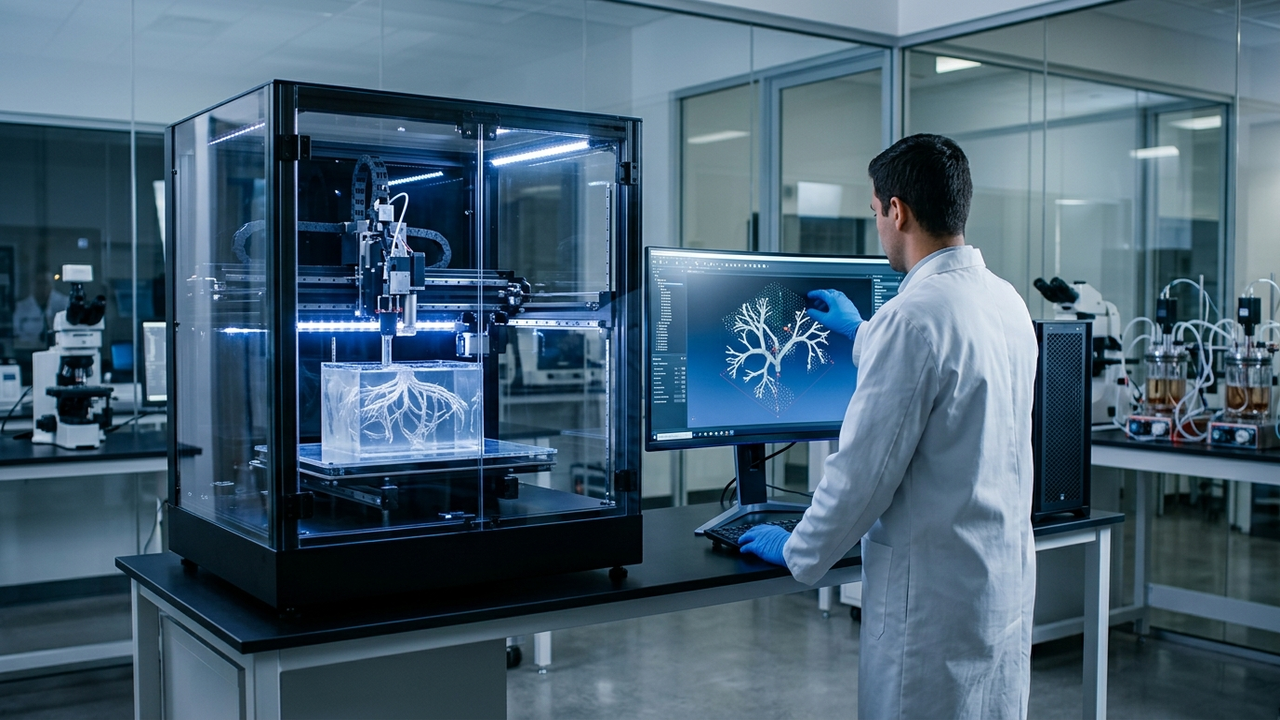
Key Finding: Machine Learning-Integrated 3D Printing Generates Capillary-Scale Vascular Structures
Researchers at the University of Notre Dame have successfully developed an innovative hybrid 3D printing technology integrating machine learning to create intricate vascular structures at the capillary scale. This breakthrough represents a significant step towards constructing functional tissues and organs in the fields of tissue engineering and regenerative medicine.
Technical and Clinical Details: Lining Stable Multi-Dimensional Vascular Networks with Cells
The novel approach demonstrated the ability to generate complex one-, two-, and three-dimensional stable vascular structures, proving these networks could be successfully lined with living cells. While conventional 3D bioprinting has succeeded in creating larger vessels and simpler tissues, replicating the extremely fine and complex networks of capillaries has remained a challenge. By incorporating machine learning algorithms, the printing precision, resolution, and reproducibility have been significantly enhanced. Combined with biocompatible bio-inks, this allows for a more accurate mimicry of the in vivo microenvironment, leading to improved cell viability and functionality, and enabling the creation of more realistic tissue models.
Background and Industry Context: Addressing a Bottleneck in Organ Engineering and Regenerative Medicine
Vascularization is one of the most critical challenges in tissue engineering and regenerative medicine. Even with the construction of large artificial tissues or organs, without an adequate vascular network for nutrient supply and waste removal, cells rapidly undergo necrosis. Previous research has explored methods of supplying vasculature externally or directly printing larger blood vessels, but none have successfully replicated the density and complexity of in vivo capillary networks. The University of Notre Dame’s research addresses this long-standing bottleneck, providing an essential foundation for generating larger, more functional biological tissues and organs.
Future Outlook: Applications in Drug Discovery and Organ-on-a-Chip Models
This technology opens a promising avenue for developing “organ-on-a-chip” models that can accelerate drug discovery processes. By utilizing functional vascularized tissues as disease models, researchers can more accurately assess drug efficacy and toxicity. Furthermore, in the future, it holds the potential to construct patient-specific tissues and organs in vitro, ultimately leading to the development of transplantable artificial organs. This advancement is expected to move regenerative medicine into a new phase, significantly contributing to addressing organ shortages and realizing personalized medicine.
Source: https://www.regmednet.com/3d-printing-at-capillary-scale-using-a-hybrid-approach/
Get our weekly technology intelligence — free
Receive an infographic that lets you judge at a glance whether each field’s analysis report is worth reading.
Subscribe Free — Weekly Tech Intelligence
By subscribing, you’ll receive Troy-Technical’s weekly technology intelligence newsletter.
- Your email and selected fields are used only to deliver the newsletter.
- We never share your information with third parties.
- You can unsubscribe anytime via the link in each email.
See our Privacy Policy for details.
Takes about a minute · Unsubscribe anytime



Comments