Key Findings
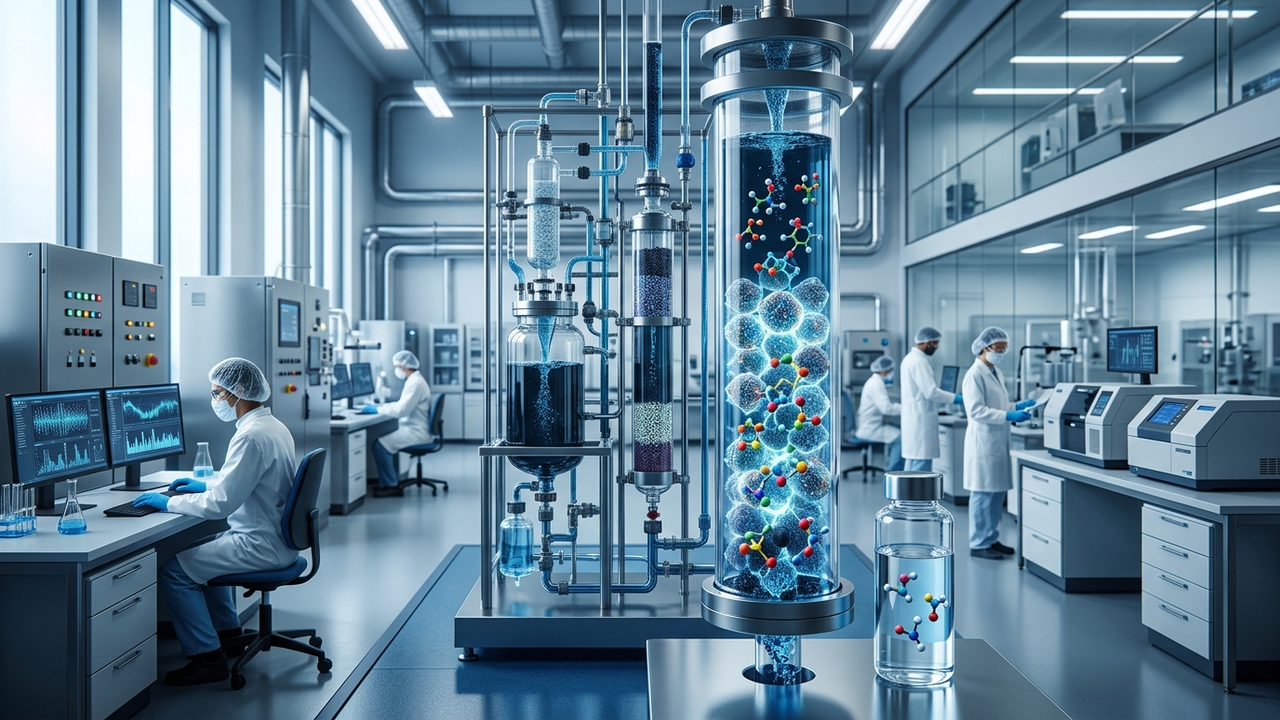
Adsorption technology utilizing Metal-Organic Frameworks (MOFs) has demonstrated superior removal efficiencies and stability for Per- and Polyfluoroalkyl Substances (PFAS) in water, significantly outperforming conventional adsorbents. Specifically, amine-functionalized MOFs have achieved remarkable removal efficiencies ranging from 75% to 98% even under challenging water conditions.
Technical / Clinical Details
MOFs are porous crystalline materials composed of metal ions and organic linkers, distinguished by their exceptionally high specific surface area and molecularly designable porous structures. These characteristics enable them to efficiently capture and adsorb trace contaminants such as PFAS. The review particularly emphasizes amine-functionalized MOFs. The introduction of amine groups enhances electrostatic interactions and hydrogen bonding between the MOF surface and PFAS molecules, dramatically boosting adsorption capacity. Furthermore, amine-functionalized MOFs have shown excellent stability in complex water matrices, including variations in pH and the presence of competing substances, without compromising their performance. This superior adsorption capability and stability strongly suggest MOFs as a practical solution for PFAS-contaminated water treatment.
Background & Context
PFAS, often termed “forever chemicals,” are globally recognized as severe water contaminants due to their extreme persistence in the environment and long-term risks to ecosystems and human health. Existing PFAS removal technologies, such as activated carbon adsorption and reverse osmosis membranes, face limitations in effectiveness or incur high operational costs. MOFs are garnering significant attention as next-generation adsorbents capable of overcoming these challenges, making their development crucial in the field of environmental remediation technology.
Strategic Significance & Outlook
PFAS removal technology utilizing MOFs, owing to its high efficiency and sustainability, is anticipated for widespread adoption in various environmental remediation applications, including drinking water treatment, industrial wastewater treatment, and groundwater purification. Future research will focus on scaling up MOF synthesis processes, reducing production costs, and further optimizing adsorption selectivity for different PFAS compounds. Additionally, evaluating the recyclability and long-term durability of MOFs will be critical. Commercialization of this technology is expected to contribute significantly to solving the global PFAS contamination problem and ensuring access to safe water resources worldwide.
Source: https://www.mdpi.com/2073-4441/18/17/2138
Get our weekly technology intelligence — free
Receive an infographic that lets you judge at a glance whether each field’s analysis report is worth reading.
Subscribe Free — Weekly Tech Intelligence
By subscribing, you’ll receive Troy-Technical’s weekly technology intelligence newsletter.
- Your email and selected fields are used only to deliver the newsletter.
- We never share your information with third parties.
- You can unsubscribe anytime via the link in each email.
See our Privacy Policy for details.
Takes about a minute · Unsubscribe anytime





Comments