Key Findings
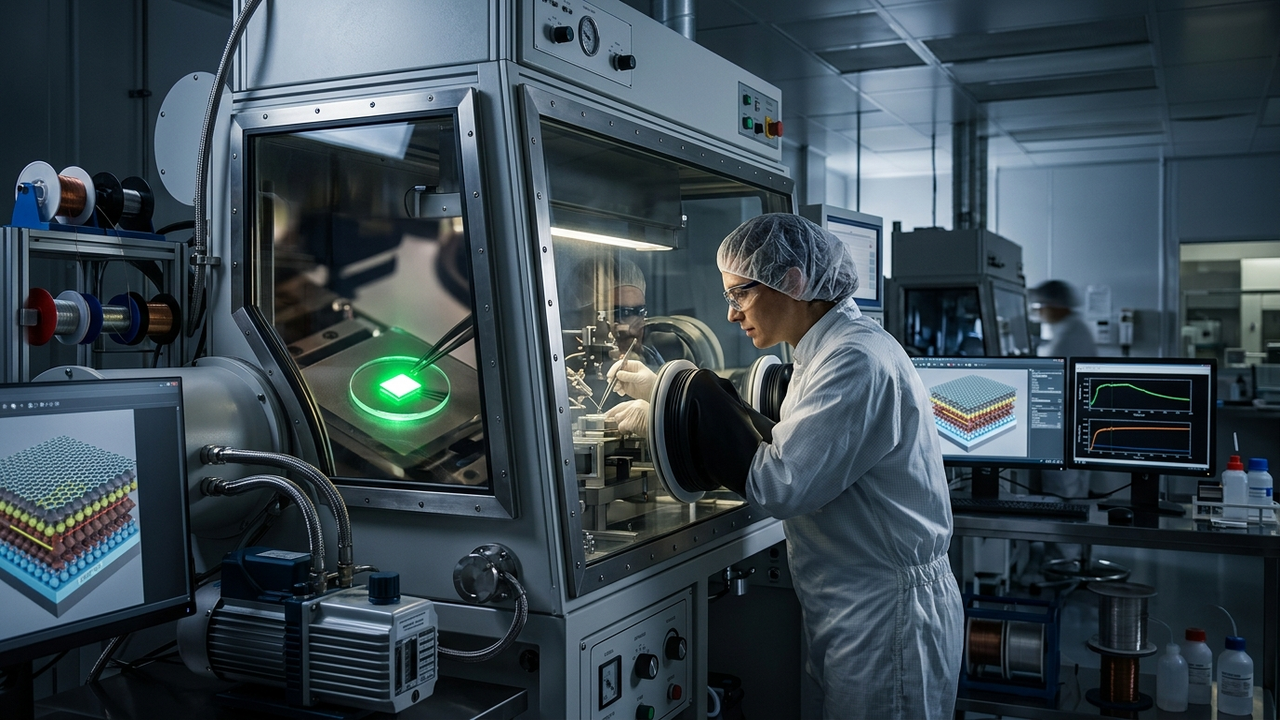
A groundbreaking technological advancement significantly enhancing the performance of perovskite quantum dot light-emitting diodes (QLEDs) has been announced. A team of researchers successfully integrated ultrathin nano-layered boron nitride (BN) into the QLED device structure, dramatically boosting both its stability and efficiency. This innovative approach allowed BN-optimized QLEDs to achieve a significantly extended T50 lifetime (time to half initial brightness) of 102 hours at an initial luminance of 2,000 cd m⁻². Furthermore, accelerated aging tests predict an astonishing T50 lifetime of 25,263 hours at a more practical luminance of 100 cd m⁻², addressing a major barrier to commercial application: device longevity.
Technical & Clinical Details
Boron nitride (BN), with its excellent insulating, thermal conductive, and chemical stability properties, serves as an ideal material for interfacial engineering in perovskite QLEDs. The research team introduced nano-layers of BN between the perovskite layer and other functional layers, simultaneously solving multiple challenges. Firstly, BN effectively passivates defects on the perovskite surface, suppressing non-radiative recombination and thereby increasing external quantum efficiency (EQE). Secondly, it physically blocks ion migration, a major factor in perovskite degradation, dramatically enhancing device stability. Additionally, BN’s superior thermal conductivity efficiently dissipates heat generated during operation, improving the device’s thermal stability. These synergistic effects led to the 102-hour T50 lifetime at a peak luminance of 2,000 cd m⁻², and the projected long-term lifetime of 25,263 hours represents a multi-order magnitude improvement compared to conventional perovskite QLEDs, signifying a major leap forward in display technology.
Background & Context
Perovskite QLEDs have garnered significant anticipation as a next-generation display and lighting technology due to their high color purity, wide color gamut, and potential for low-cost manufacturing. However, while organic LEDs (OLEDs) and quantum dot LEDs (QLEDs) are already prevalent in the market, the primary challenge for perovskite QLEDs has been their long-term device stability. Specifically, the inherent susceptibility of perovskite materials to moisture, oxygen, and heat has been a limiting factor for practical application. This breakthrough in stability enhancement using BN represents a critical step for perovskite QLEDs to genuinely compete with OLED technology or to carve out new niche markets by leveraging their high performance. This will accelerate technological innovation in the display industry and encourage the advent of more high-performance and efficient devices.
Strategic Significance & Outlook
The enhanced stability of perovskite QLEDs through ultrathin BN layers will significantly impact the future of display technology. The projected lifetime exceeding 25,000 hours suggests that perovskite QLEDs could be suitable not only for consumer electronics like smartphones, TVs, and wearables but also for more demanding environments such as automotive displays and flexible displays. Future research will likely focus on further optimization of the BN layer, improving manufacturing scalability, and homogenizing QLED performance across various color gamuts. If this technology gains widespread market penetration, it could provide consumers with brighter, longer-lasting, and more energy-efficient display products, potentially triggering a paradigm shift in the display industry.
Source: https://www.azonano.com/news.aspx?newsID=41815
Get our weekly technology intelligence — free
Receive an infographic that lets you judge at a glance whether each field’s analysis report is worth reading.
Subscribe Free — Weekly Tech Intelligence
By subscribing, you’ll receive Troy-Technical’s weekly technology intelligence newsletter.
- Your email and selected fields are used only to deliver the newsletter.
- We never share your information with third parties.
- You can unsubscribe anytime via the link in each email.
See our Privacy Policy for details.
Takes about a minute · Unsubscribe anytime




Comments