Key Findings
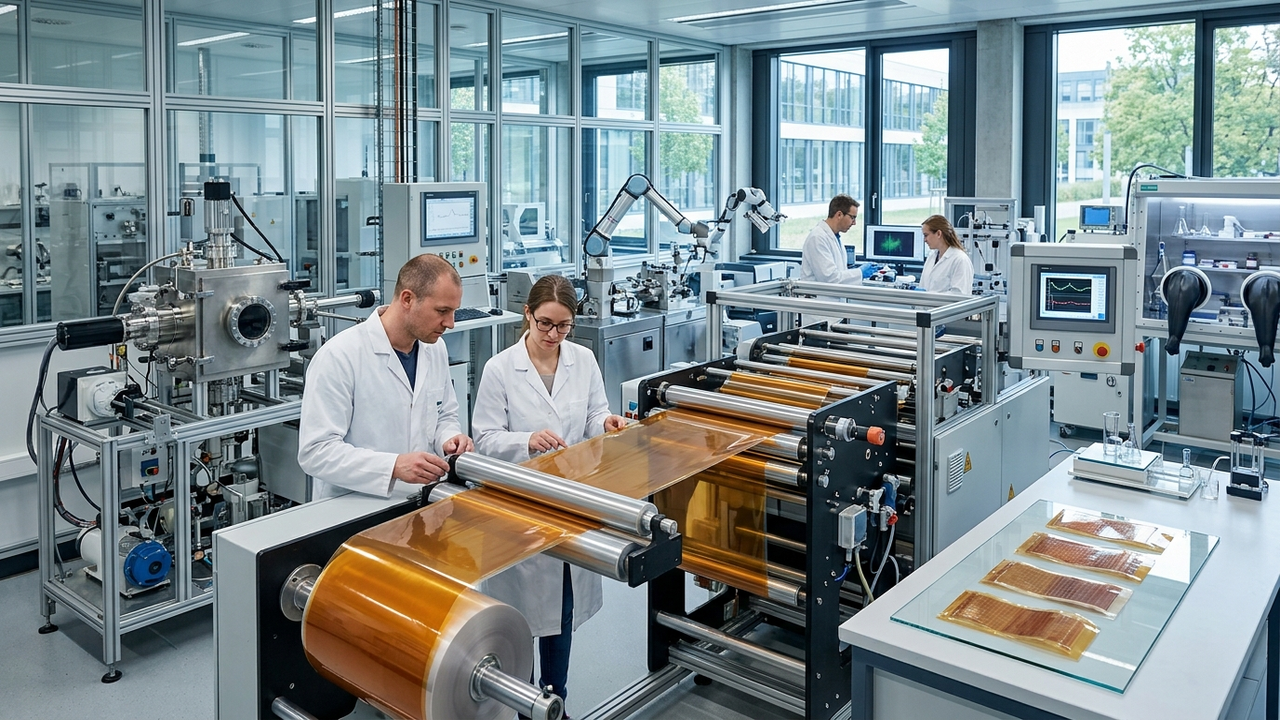
Researchers from the University of Freiburg and the Fraunhofer Institute for Solar Energy Systems (ISE) have successfully developed semi-transparent organic photovoltaic (OPV) modules with excellent properties by combining industrially relevant manufacturing processes. Specifically, they utilized established techniques of sputtering and slot-die coating to produce 14.5×14.5cm OPV modules, achieving a maximum power conversion efficiency of 9.26% while maintaining an average transparency of 43.2%. This achievement demonstrates progress in OPV technology and, given the involvement of Fraunhofer ISE’s Organic and Perovskite Photovoltaics division, suggests that similar manufacturing approaches could be effective for large-scale production of perovskite technology.
Technical & Clinical Details
The developed semi-transparent OPV modules were realized by integrating two key manufacturing processes: sputtering and slot-die coating. Sputtering is a vacuum process used for uniform and precise deposition of electrodes, such as transparent conductive oxide (TCO) layers, and is widely recognized in industry for its high reproducibility and film quality. Slot-die coating, on the other hand, is a high-speed and scalable wet process for applying functional layers from solution, capable of forming precise thin films over large-area substrates. By combining these technologies, they achieved a balanced performance of 43.2% average transparency and 9.26% peak efficiency on a relatively large module area of 14.5×14.5cm. This manufacturing method operates at relatively low process temperatures and has high applicability to flexible substrates, making it promising for future applications in building-integrated photovoltaics (BIPV) and transparent solar cell manufacturing processes.
Background & Context
Amidst growing demand for renewable energy, there is a need to develop new types of solar cells that offer transparency, flexibility, and aesthetic appeal, in addition to conventional opaque modules, to expand the range of solar cell applications. Semi-transparent OPVs are particularly promising for BIPV applications, transforming building surfaces such as windows and facades into power generation sources. Fraunhofer ISE has long been at the forefront of research in organic and perovskite photovoltaics. This achievement in OPV suggests that their knowledge and experience can also be applied to the mass production of perovskite solar cells. Similar to OPV, perovskite solar cells can be manufactured using solution processes, and establishing large-area coating techniques is crucial for accelerating perovskite commercialization.
Strategic Significance & Outlook
The development of this semi-transparent OPV module by the University of Freiburg and Fraunhofer ISE demonstrates that large-area, industrially scalable processes are applicable to the manufacturing of next-generation solar cells. The future outlook includes directly applying this combined sputtering and slot-die coating approach to perovskite solar cell manufacturing processes, with expectations for developing high-efficiency and stable semi-transparent perovskite modules. Transparency is a critical property that enhances perovskites’ competitive advantage in specific markets (e.g., smart windows, greenhouses). Advancements in these manufacturing technologies will pave the way for widespread adoption of perovskite solar cells in the BIPV market and other specialized applications. This represents a strategic achievement that expands the diverse application possibilities of solar power and contributes to the future of sustainable architecture and energy supply.
Get our weekly technology intelligence — free
Receive an infographic that lets you judge at a glance whether each field’s analysis report is worth reading.
Subscribe Free — Weekly Tech Intelligence
By subscribing, you’ll receive Troy-Technical’s weekly technology intelligence newsletter.
- Your email and selected fields are used only to deliver the newsletter.
- We never share your information with third parties.
- You can unsubscribe anytime via the link in each email.
See our Privacy Policy for details.
Takes about a minute · Unsubscribe anytime




Comments