Key Findings
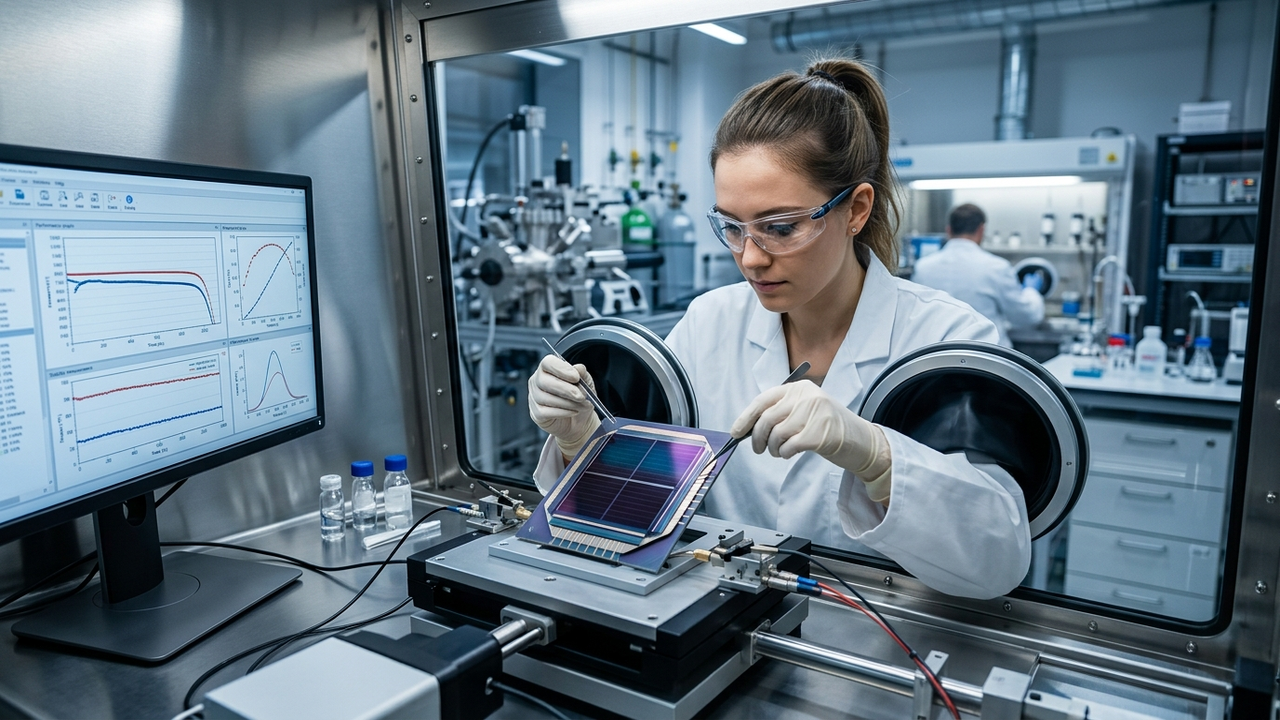
To dramatically enhance the performance and stability of perovskite/silicon tandem solar cells, a novel ‘surface-initiated gradient doping’ strategy using RbF treatment has been developed for wide-bandgap mixed-halide perovskites. This innovative approach has enabled tandem devices to achieve an exceptionally high power conversion efficiency of 32.66%. Furthermore, the technology significantly improves operational stability, demonstrating remarkable durability with 91% retention of initial efficiency after 1000 hours of continuous maximum power point tracking (MPPT) operation under 1 sun illumination. This breakthrough addresses one of the most critical barriers to the practical application of perovskite solar cells.
Technical Details
Wide-bandgap mixed-halide perovskites are essential for achieving high efficiency as the top cell in perovskite/silicon tandem solar cells, but they have faced two major challenges: halide phase segregation and the formation of unstable δ-phase impurities under illumination. The RbF (rubidium fluoride) treatment-based gradient doping developed by the research team creates a rubidium ion concentration gradient from the surface to the interior of the perovskite layer, fundamentally resolving these instability mechanisms. Rubidium ions passivate defects within the crystal lattice and suppress halide ion migration, thereby preventing phase segregation. Additionally, the stabilization of the crystal structure inhibits δ-phase formation caused by photodegradation. This ensures the stable maintenance of the device’s open-circuit voltage (Voc) and fill factor (FF), leading to a harmonious achievement of high efficiency and long-term stability.
Background and Context
Perovskite/silicon tandem solar cells are globally recognized as the most promising next-generation photovoltaic technology capable of surpassing the theoretical efficiency limits of current silicon solar cells. However, for their widespread commercialization, maintaining high efficiency while ensuring long-term operational stability in outdoor environments has been imperative. Specifically, wide-bandgap perovskites used in the top cell have been prone to instability due to their complex composition, which has been a major bottleneck for the practical deployment of tandem cells. This research offers a highly effective solution to this core challenge through precise material engineering and interface control, generating significant anticipation and impact within the solar industry.
Strategic Significance and Outlook
The 32.66% efficiency and outstanding stability achieved through this surface gradient doping strategy possess significant potential to accelerate the commercialization of perovskite/silicon tandem solar cells. The next step will involve scaling up this technology to large-area modules and conducting long-term outdoor field tests. If this breakthrough is successfully established, the cost-effectiveness of solar power generation systems will dramatically improve, fostering broader adoption of renewable energy in a wider range of regions. In the long term, it is expected to revolutionize the existing solar market and contribute substantially to the creation of a more energy-efficient and sustainable society.
Get our weekly technology intelligence — free
Receive an infographic that lets you judge at a glance whether each field’s analysis report is worth reading.
Subscribe Free — Weekly Tech Intelligence
By subscribing, you’ll receive Troy-Technical’s weekly technology intelligence newsletter.
- Your email and selected fields are used only to deliver the newsletter.
- We never share your information with third parties.
- You can unsubscribe anytime via the link in each email.
See our Privacy Policy for details.
Takes about a minute · Unsubscribe anytime






Comments