Key Findings
TSMC Vice President K.C. Hsu announced that silicon photonics is projected to become the dominant technology by 2027, driven by surging AI demand, with the company on track to begin production of chip-level Co-Packaged Optics (CPO) packaging in the second half of 2026. This aggressive timeline underscores the industry’s rapid shift to address the unprecedented power and bandwidth requirements of advanced AI workloads, providing a concrete solution to the escalating challenges in data center infrastructure.
Technical / Clinical Details
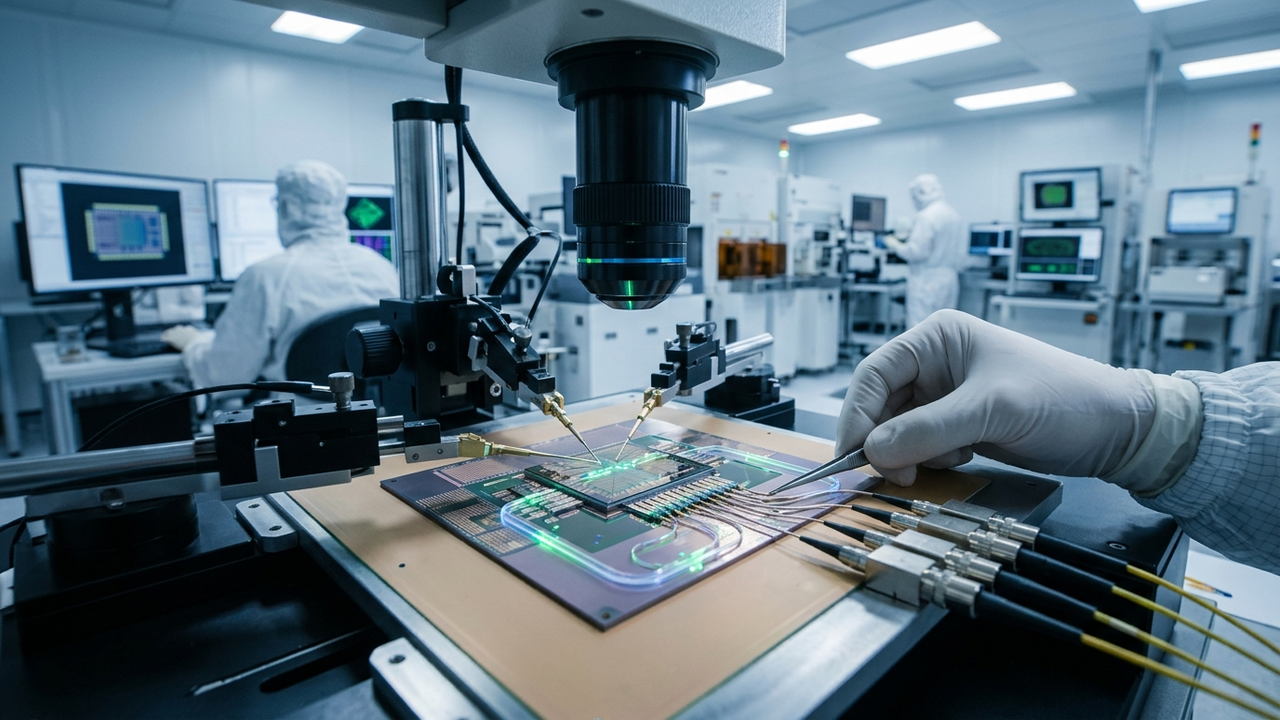
Co-Packaged Optics integrates optical engines directly into the same package as the processing unit, drastically shortening the electrical signal path from centimeters to millimeters. This proximity significantly reduces power consumption and boosts data transmission speeds, overcoming the limitations of traditional electrical interconnects. Hsu emphasized that CPO adoption is progressing at a faster pace than initial forecasts, signaling TSMC’s readiness to mass-produce this transformative packaging technology. By minimizing signal loss and power draw, CPO enables the construction of higher-bandwidth, more energy-efficient AI clusters, which are essential for next-generation 800G and 1.6T optical networks.
Background & Context
The relentless growth of AI has pushed conventional data transmission technologies to their limits, leading to increased power consumption and thermal management issues in data centers. Silicon photonics, combined with CPO, offers a viable path forward by replacing power-hungry electrical interconnects with high-speed, low-power optical links. TSMC’s commitment to CPO production, as a leading semiconductor foundry, is a crucial development that will catalyze widespread adoption across the industry, reshaping the supply chain and positioning CPO as a foundational technology for AI infrastructure. This strategic direction aligns with major players like Nvidia and Marvell, who are also heavily investing in CPO solutions.
Strategic Significance & Outlook
TSMC’s entry into CPO mass production represents a paradigm shift for AI infrastructure design, promising to unlock new levels of performance and efficiency. By alleviating computational and bandwidth bottlenecks, CPO will enable the development and deployment of more complex and larger-scale AI models. Beyond data centers, the technology is expected to extend its influence into High-Performance Computing (HPC) and edge AI devices, accelerating digital transformation across various sectors. This widespread adoption will also create significant opportunities for optical component manufacturers and advanced packaging providers, driving further innovation in the photonics ecosystem.
Source: https://www.taipeitimes.com/News/biz/archives/2026/09/01/2003863454
Get our weekly technology intelligence — free
Receive an infographic that lets you judge at a glance whether each field’s analysis report is worth reading.
Subscribe Free — Weekly Tech Intelligence
By subscribing, you’ll receive Troy-Technical’s weekly technology intelligence newsletter.
- Your email and selected fields are used only to deliver the newsletter.
- We never share your information with third parties.
- You can unsubscribe anytime via the link in each email.
See our Privacy Policy for details.
Takes about a minute · Unsubscribe anytime




Comments