Key Findings
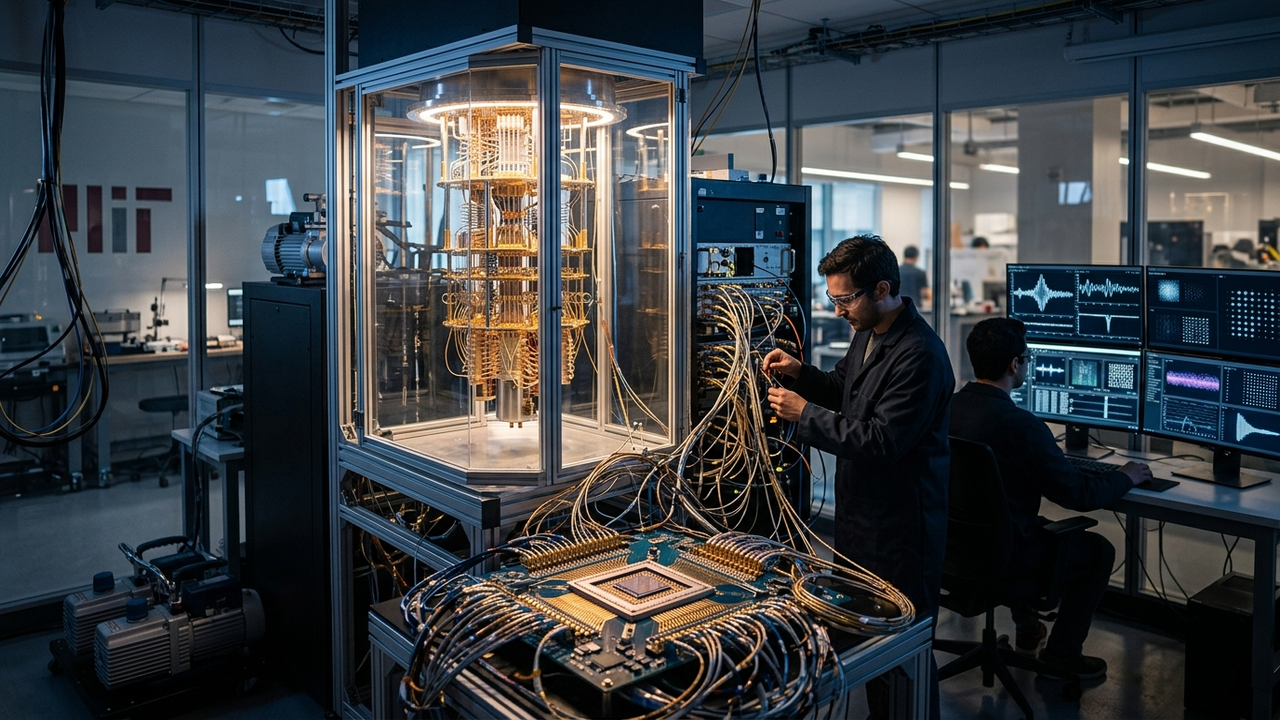
Researchers at the Massachusetts Institute of Technology (MIT) have developed a new qubit architecture that promises to dramatically improve the performance of quantum computers. This novel design is expected to enable both faster and higher-fidelity quantum gate operations simultaneously. Given the traditional trade-off between speed and accuracy in qubit operations, this advancement marks a significant breakthrough in the field of quantum computing.
Technical Details
The new qubit architecture is optimized to maintain quantum coherence for longer durations in specific physical systems while enhancing responsiveness to external control signals. The research team introduced more sophisticated control mechanisms and interaction designs that are applicable to existing leading qubit modalities, such as superconducting qubits and ion-trap qubits. This approach reduces the time required for quantum gate operations and simultaneously decreases the error rate, thereby improving the overall efficiency and reliability of quantum computations. While specific quantitative metrics have not been disclosed, a substantial improvement over existing technologies is anticipated, contributing directly to the development of scalable quantum processors.
Background & Context
One of the greatest challenges to the practical realization of quantum computing has been ‘scaling’ the number of qubits while maintaining computational ‘fidelity.’ Low-fidelity operations, in particular, exacerbate the need for quantum error correction, making the implementation of practical logical qubits extremely difficult. MIT’s latest achievement directly addresses this fundamental challenge, pushing the boundaries of quantum hardware performance. Such advances in foundational technology are indispensable for accelerating the commercialization and broad application of quantum computing.
Strategic Significance & Outlook
This newly designed qubit architecture by MIT is expected to significantly influence the design of future quantum computers. Faster and higher-fidelity quantum gate operations provide a robust foundation for executing deeper quantum circuits and complex quantum algorithms with greater resilience to errors. Consequently, this will accelerate the development of quantum solutions for problems intractable for classical computers, including drug discovery, materials science, financial modeling, and optimization challenges. This technology represents a crucial step towards achieving quantum advantage and ultimately, fault-tolerant quantum computing.
Source: https://news.mit.edu/2026/new-qubit-architecture-enables-faster-more-accurate-operations-0903
Get our weekly technology intelligence — free
Receive an infographic that lets you judge at a glance whether each field’s analysis report is worth reading.
Subscribe Free — Weekly Tech Intelligence
By subscribing, you’ll receive Troy-Technical’s weekly technology intelligence newsletter.
- Your email and selected fields are used only to deliver the newsletter.
- We never share your information with third parties.
- You can unsubscribe anytime via the link in each email.
See our Privacy Policy for details.
Takes about a minute · Unsubscribe anytime








Comments