Key Findings
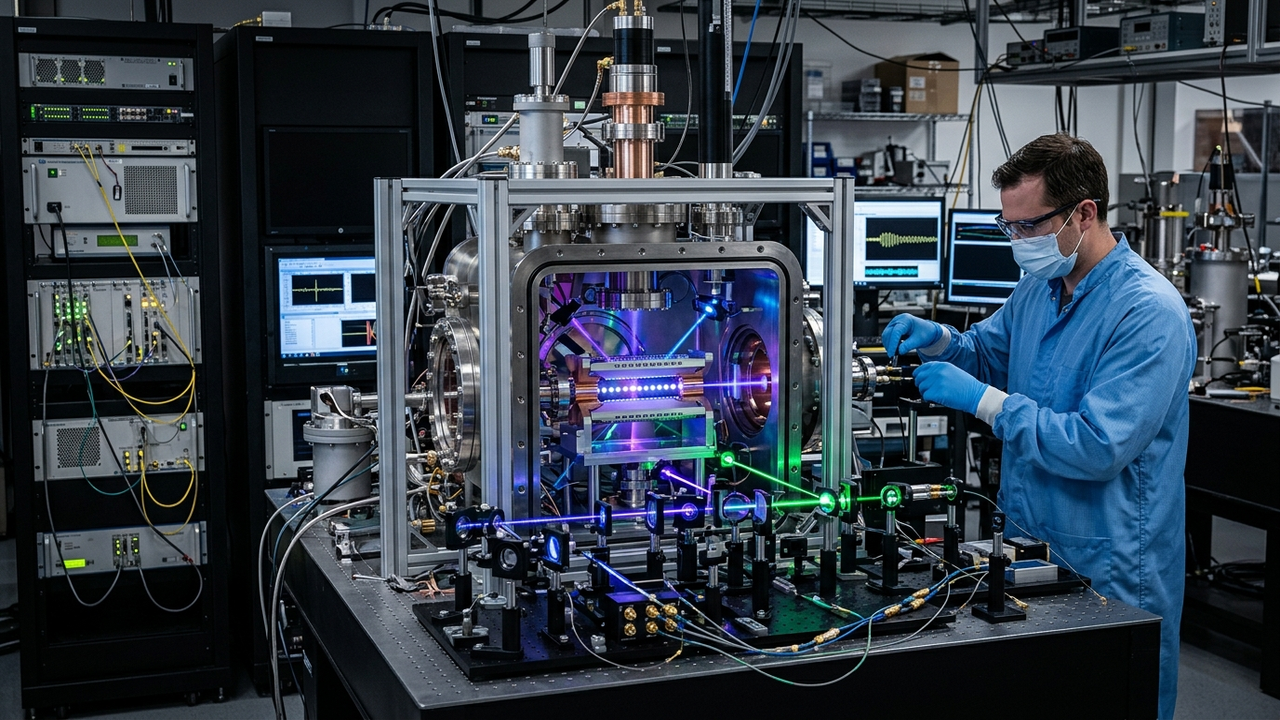
Researchers at the Lawrence Livermore National Laboratory (LLNL) have announced the development of new techniques that dramatically extend the coherence time of trapped-ion qubits. This breakthrough signifies a substantial increase in the duration quantum information can be held without succumbing to noise, thereby enabling more stable quantum computations and overcoming a significant hurdle towards the practical deployment of quantum computers.
Technical Details
Trapped-ion qubits utilize the electronic states of individual ions, confined by electromagnetic fields, as quantum bits. LLNL’s research focuses on novel trap designs and control techniques that minimize interactions between ions and their external environment. Specific technical approaches include higher-precision laser cooling, enhanced shielding against external electromagnetic noise, and improved pulse sequences to optimize inter-qubit interactions. These refinements have considerably prolonged the time before qubits decohere, laying the groundwork for executing a greater number of quantum gate operations without error. This improves the feasibility and reliability of quantum algorithms, opening doors for practical applications.
Background & Context
Extending coherence time has been a long-standing research goal in quantum computing, representing one of the greatest challenges alongside scaling the number of qubits. While trapped-ion systems are known for their high qubit fidelity, coherence time has remained a limiting factor for system size and complexity. LLNL’s achievement is a significant technical breakthrough in this domain, expected to enhance the performance of ion-trap quantum computers and boost their competitiveness against other modalities like superconducting qubits. Furthermore, such advancements by national scientific research institutions underscore the country’s leadership in quantum technology.
Strategic Significance & Outlook
The substantial extension of coherence time will enable the execution of more complex quantum algorithms and provide an indispensable foundation for achieving fault-tolerant quantum computing. This will accelerate the application of quantum computing in a wide range of fields, including drug discovery, novel materials development, and energy-efficient computation. LLNL’s technology is poised to play a crucial role in future quantum computer designs, enhancing confidence in the reliability and stability of quantum computers and further paving the way for commercialization.
Source: #
Get our weekly technology intelligence — free
Receive an infographic that lets you judge at a glance whether each field’s analysis report is worth reading.
Subscribe Free — Weekly Tech Intelligence
By subscribing, you’ll receive Troy-Technical’s weekly technology intelligence newsletter.
- Your email and selected fields are used only to deliver the newsletter.
- We never share your information with third parties.
- You can unsubscribe anytime via the link in each email.
See our Privacy Policy for details.
Takes about a minute · Unsubscribe anytime








Comments