Key Findings
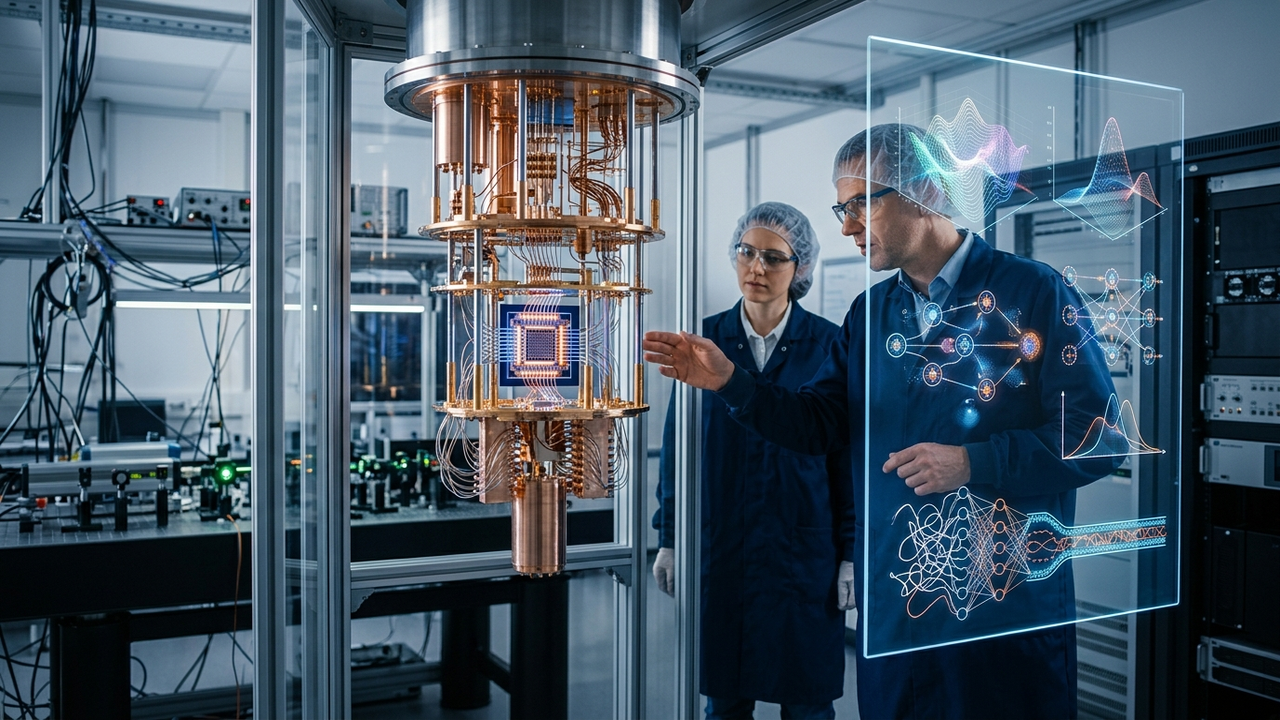
A group of German physicists has achieved a significant breakthrough in quantum error correction, a long-standing challenge in quantum computing. They experimentally demonstrated ‘sub-threshold quantum error correction,’ showing that errors can be exponentially reduced as the number of qubits is scaled. This accomplishment represents substantial progress towards building practical fault-tolerant quantum computers and dramatically enhances the reliability of quantum information.
Technical Details
Sub-threshold quantum error correction refers to the phenomenon where, if the error rate of individual physical qubits falls below a certain threshold, forming logical qubits by combining more physical qubits results in a logical qubit error rate that is exponentially lower than that of the physical qubits. The German research team demonstrated this principle using either a superconducting or ion-trap qubit platform. By entangling multiple physical qubits and applying specific error correction codes (e.g., surface codes or CSS codes), they showed the ability to detect and correct errors caused by environmental noise or intrinsic qubit defects. The experiments confirmed that, for instance, a logical qubit composed of five physical qubits exhibited a significantly lower error rate compared to a single physical qubit.
Background & Context
One of the biggest challenges in quantum computing is that qubits are extremely delicate and prone to errors from environmental noise. Therefore, error correction is considered indispensable for building large-scale quantum computers. However, traditional error correction techniques require a large number of physical qubits and can themselves introduce new sources of error. The demonstration of sub-threshold error correction offers a promising solution to this challenge, and is expected to accelerate the commercialization of quantum computing. This advancement will further intensify the technological competition among major hardware platforms, such as superconducting and ion-trap qubits.
Strategic Significance & Outlook
This experimental demonstration of sub-threshold quantum error correction marks a critical milestone towards the realization of fault-tolerant quantum computers. The ability to exponentially reduce error rates paves the way for combining hundreds to thousands of physical qubits to form a smaller number of high-fidelity logical qubits. This will enable the execution of reliable quantum algorithms for problems currently intractable for classical computers, spanning financial modeling, materials science, drug discovery, and artificial intelligence. This research is poised to be a powerful driving force for quantum computing to transition into a more practical phase.
Source: https://www.sciencedaily.com/releases/2026/08/260829035219.htm
Get our weekly technology intelligence — free
Receive an infographic that lets you judge at a glance whether each field’s analysis report is worth reading.
Subscribe Free — Weekly Tech Intelligence
By subscribing, you’ll receive Troy-Technical’s weekly technology intelligence newsletter.
- Your email and selected fields are used only to deliver the newsletter.
- We never share your information with third parties.
- You can unsubscribe anytime via the link in each email.
See our Privacy Policy for details.
Takes about a minute · Unsubscribe anytime




Comments