Key Findings
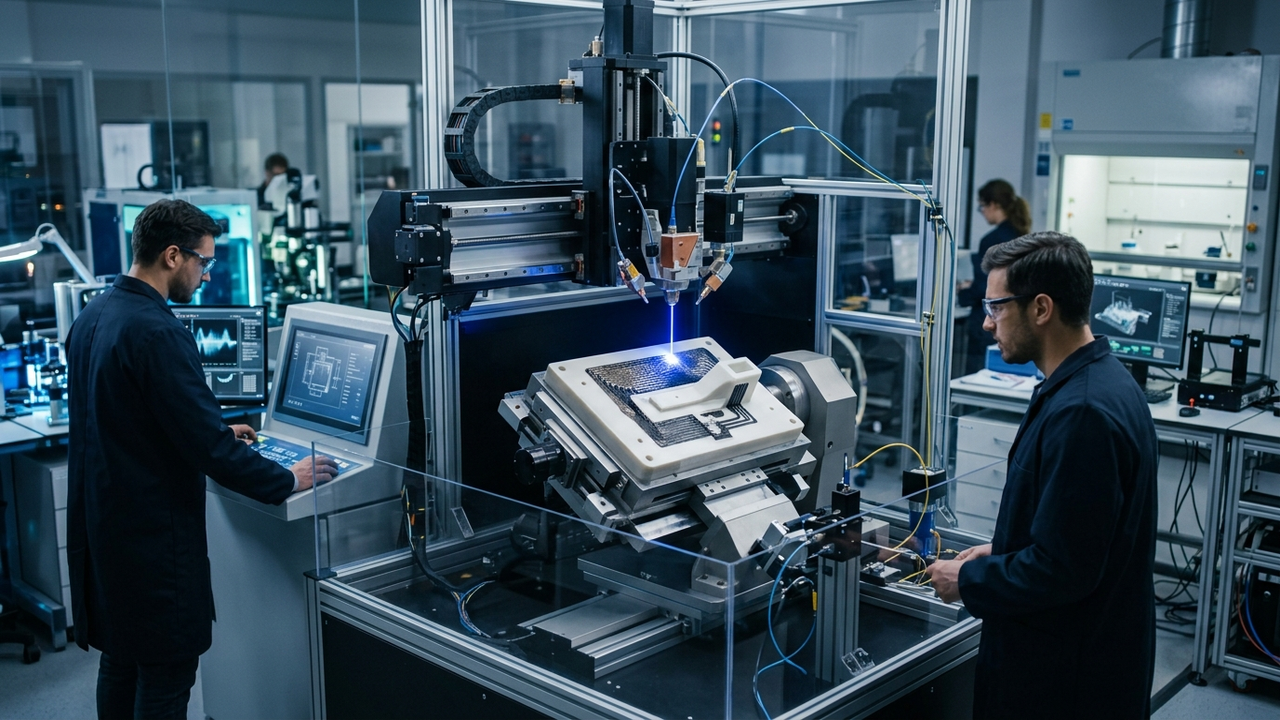
A recent study published in Materials Horizons by the Royal Society of Chemistry details a groundbreaking platform that enables the in-situ additive manufacturing of multifunctional Laser-Induced Graphene (LIG) within Polyether Ether Ketone (PEEK). This innovative approach seamlessly integrates Fused Filament Fabrication (FFF) with Direct Laser Scribing (DLS) technology, achieving automated fabrication of highly functional PEEK devices with embedded sensing, actuation, and electronic capabilities. Targeted for aerospace and biomedical applications, this technology allows for the direct incorporation of complex electronic circuitry and sensor networks into high-performance polymer structures, offering a level of functional integration previously challenging with conventional manufacturing methods.
Technical / Clinical Details
The core of this platform lies in its ability to leverage the excellent mechanical properties and thermal resistance of PEEK, a thermoplastic polymer, while simultaneously transforming selected surface areas into graphene (LIG) using a laser. LIG retains many of graphene’s unique properties, including high electrical conductivity, superior thermal conductivity, and a large surface area. The research team developed an integrated process:
- Fused Filament Fabrication (FFF): Initially, a basic part geometry is constructed layer-by-layer using commercially available PEEK filaments in a 3D printer. PEEK is renowned for its high-temperature performance, high strength-to-weight ratio, and chemical stability.
- Direct Laser Scribing (DLS): Either during or after the FFF process, a specific laser wavelength and power are employed to convert selected regions of the PEEK surface into LIG. This laser treatment causes the carbon atoms in the polymer to reorganize into a graphitic structure, forming a highly conductive graphene layer.
- In-Situ Integration: A key advantage of this technology is the ability to embed the LIG network precisely within or on the surface of the PEEK structure, spatially registered and programmable. This allows for the simultaneous creation of structural components and functional electronic parts within a single manufacturing process.
This integrated process enables the direct formation of LIG networks with diverse functionalities—such as sensors, heaters, electrodes, or even flexible circuits—on or within PEEK components. This opens up a wide range of applications, including structural health monitoring sensors in aerospace or biosensors for biocompatible implants. Traditional manufacturing methods would require multiple fabrication steps and assembly for such functional integration, whereas this technology achieves it in a single process, significantly reducing manufacturing complexity and cost.
Background & Context
The integration of high-performance polymers with functional materials is a crucial research area for numerous advanced technology sectors, including smart devices, aerospace components, and medical implants. High-performance thermoplastics like PEEK are in high demand due to their exceptional properties, but imparting conductivity or sensing capabilities has traditionally required complex post-processing or the integration of separate components. Laser-Induced Graphene (LIG) has emerged as a promising method for direct surface modification to add functionality, and this research addresses a significant gap by combining LIG technology with 3D printing.
Strategic Significance & Outlook
The development of this in-situ LIG additive manufacturing platform for PEEK represents a major advancement in materials science and additive manufacturing technology. In aerospace, it promises the realization of smart structural components with real-time monitoring capabilities and lightweight, high-performance electronics. In the biomedical field, it opens possibilities for innovative functional devices, such as biosensors directly integrated into customized medical implants or drug delivery systems. Future research will likely focus on optimizing LIG network performance, improving the scalability of the manufacturing process, and expanding its application to other polymer materials. This technology has the potential to establish new standards in the design and manufacturing of future composites and smart devices.
Get our weekly technology intelligence — free
Receive an infographic that lets you judge at a glance whether each field’s analysis report is worth reading.
Subscribe Free — Weekly Tech Intelligence
By subscribing, you’ll receive Troy-Technical’s weekly technology intelligence newsletter.
- Your email and selected fields are used only to deliver the newsletter.
- We never share your information with third parties.
- You can unsubscribe anytime via the link in each email.
See our Privacy Policy for details.
Takes about a minute · Unsubscribe anytime








Comments