Background
Modern computing and communication systems are increasingly constrained by limits in speed and energy efficiency. Electronic components, in particular, struggle with heat generation and fundamental speed barriers, making light-based solutions crucial for developing next-generation ultra-high-speed data processing and quantum technologies. Photonic time crystals, characterized by their unique ability to modulate photon propagation through temporal periodicity, have long been theoretically envisioned for transformative applications in ultra-fast optical computing, novel laser designs, and highly sensitive sensors. The successful realization of an all-optical control mechanism marks a significant advance in translating these theoretical concepts into practical, deployable technologies.
Key Findings
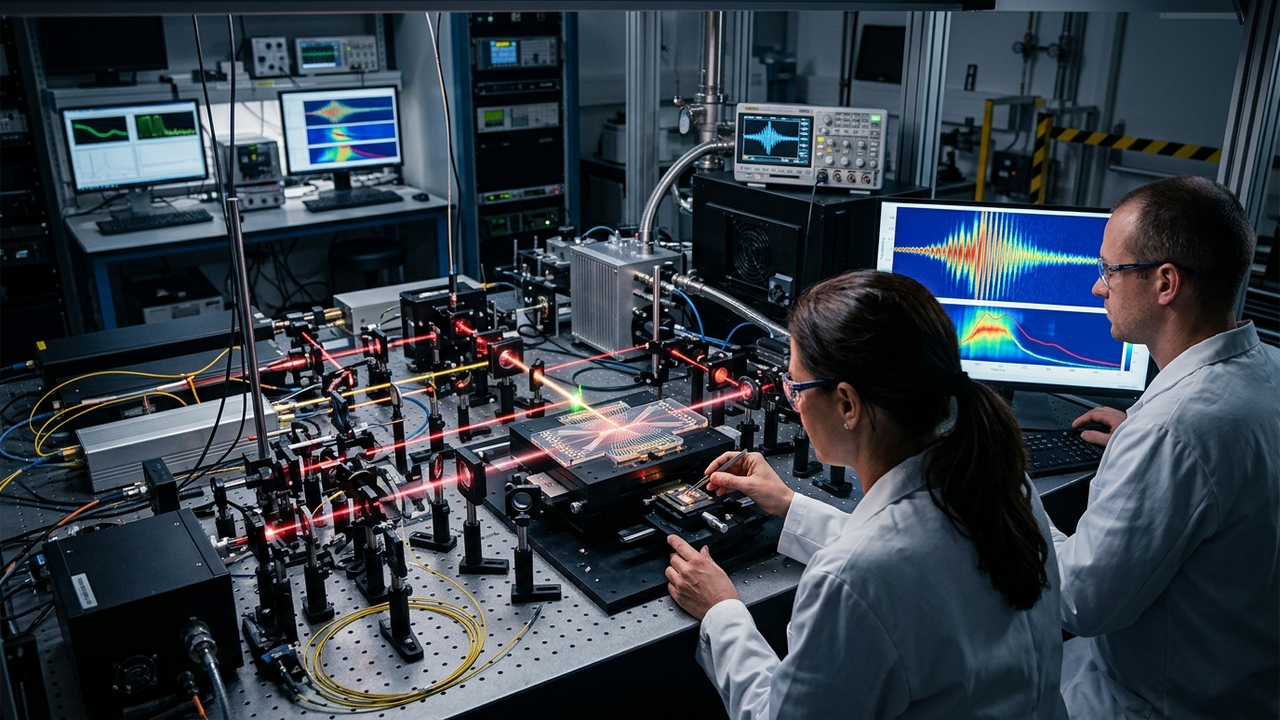
Scientists have successfully engineered the world’s first all-optical photonic time crystal, a device whose light manipulation is entirely controlled by optical signals rather than electronics. This innovative system operates effectively at terahertz frequencies, demonstrating a groundbreaking efficiency improvement by reducing energy loss by over 50% during operation.
Technical Details
This all-optical photonic time crystal is fundamentally a photonic structure whose dielectric constant is periodically modulated in the time domain. This temporal modulation causes photons to propagate with properties that vary periodically over time, a stark contrast to traditional photonic crystals which control light through spatial periodicity. The key innovation in this research lies in achieving this temporal modulation directly via light itself, completely eliminating the need for electronic components, which is critical for enabling its operation in the challenging terahertz frequency range.
A paramount advantage of this device is its superior energy efficiency, drastically reducing the power consumption required for optical signal processing by cutting energy losses by more than 50%. The terahertz band (0.1 THz to 10 THz) is often referred to as the ‘terahertz gap,’ a frontier region with immense potential for applications spanning high-speed data communication, advanced imaging, and security scanning. However, progress in this band has long been impeded by a scarcity of effective light control technologies. This all-optical time crystal offers a powerful solution to overcome this long-standing technological hurdle.
Outlook
The successful demonstration of this all-optical photonic time crystal holds the potential to profoundly revolutionize light manipulation, accelerating the development of next-generation faster data processing, truly adaptive communication systems, and ultra-sensitive detectors. Crucially, by paving the way for novel laser technologies operating in the previously underserved terahertz band, this innovation is expected to find widespread applications across diverse fields such as high-resolution medical imaging, advanced materials science, and enhanced security technology. The research team aims to further refine and scale this technology, working towards the realization of practical optical devices and systems that could significantly transform the future landscape of information and communication technologies.
Get our weekly technology intelligence — free
Receive an infographic that lets you judge at a glance whether each field’s analysis report is worth reading.
Subscribe Free — Weekly Tech Intelligence
By subscribing, you’ll receive Troy-Technical’s weekly technology intelligence newsletter.
- Your email and selected fields are used only to deliver the newsletter.
- We never share your information with third parties.
- You can unsubscribe anytime via the link in each email.
See our Privacy Policy for details.
Takes about a minute · Unsubscribe anytime




Comments