Key Findings
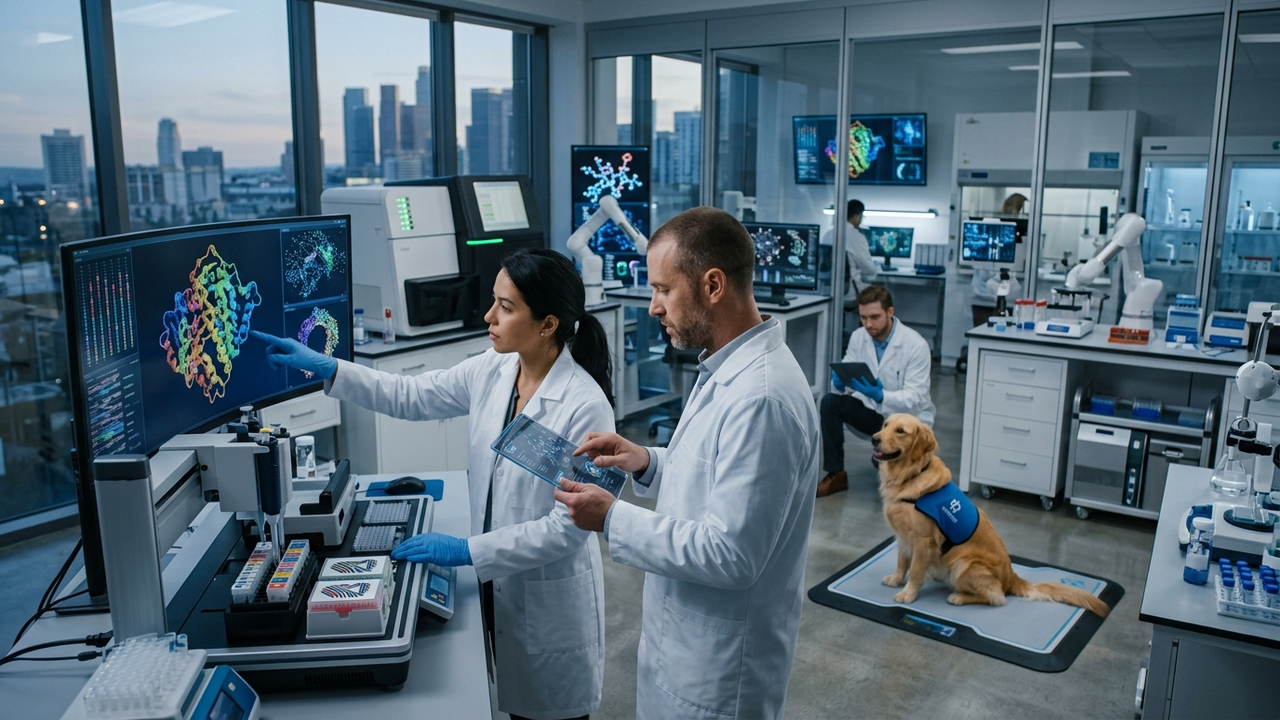
Artificial Intelligence (AI) is demonstrating its potential to dramatically accelerate every stage of pharmaceutical development, particularly in clinical trials. A notable advancement comes from Gamgee, which has leveraged advanced AI models, specifically ChatGPT and AlphaFold, to design a personalized mRNA cancer vaccine for dogs, with its clinical trials now underway. This case illustrates how AI can optimize the entire drug development pipeline, from drug discovery to trial design, patient selection, and outcome prediction, thereby enabling faster and more efficient market entry for novel therapeutics.
Technical / Clinical Details
In Gamgee’s development of the canine mRNA cancer vaccine, ChatGPT facilitated the analysis of vast scientific literature and clinical data, aiding in information extraction and hypothesis generation crucial for personalized oncology. Concurrently, AlphaFold accurately predicted the structures of specific proteins found in canine cancer cells, which then informed the optimal mRNA sequence design. This personalized vaccine aims to induce a potent immune response by targeting antigens unique to the individual dog’s cancer, thereby inhibiting tumor growth. Clinical trials are evaluating the vaccine’s safety, immunogenicity, and anti-tumor efficacy. The integration of AI significantly shortened the time from vaccine candidate design to clinical trial readiness compared to traditional veterinary drug development timelines.
Background & Context
The application of AI in clinical trials spans multiple areas, including optimizing patient recruitment, enabling real-time data monitoring, and providing more accurate predictions of trial success. Historically, clinical trials have been characterized by substantial time and cost investments, coupled with high failure rates. AI offers a potential solution to these challenges by analyzing complex datasets to identify hidden patterns and correlations. Large Language Models (LLMs) like ChatGPT augment human capabilities in information retrieval and report generation, while structural prediction AI like AlphaFold deepen the understanding of target proteins, leading to more effective drug design. Gamgee’s endeavor serves as an important proof-of-concept for accelerating AI applications in human medicine, opening new horizons for personalized healthcare.
Strategic Significance & Outlook
The success of AI in developing a canine cancer vaccine has broad implications for the development of personalized mRNA vaccines for human cancer and other diseases. By addressing bottlenecks in the clinical trial process, AI can expedite the delivery of promising new therapies to patients. In the future, AI is expected to enable more sophisticated predictive modeling and virtual clinical trials, further enhancing the efficiency and success rates of new drug development. For investors and researchers, the synergy of AI and biotechnology represents the vanguard of disruptive innovation in healthcare, with future developments keenly watched.
Get our weekly technology intelligence — free
Receive an infographic that lets you judge at a glance whether each field’s analysis report is worth reading.
Subscribe Free — Weekly Tech Intelligence
By subscribing, you’ll receive Troy-Technical’s weekly technology intelligence newsletter.
- Your email and selected fields are used only to deliver the newsletter.
- We never share your information with third parties.
- You can unsubscribe anytime via the link in each email.
See our Privacy Policy for details.
Takes about a minute · Unsubscribe anytime









Comments