Key Findings
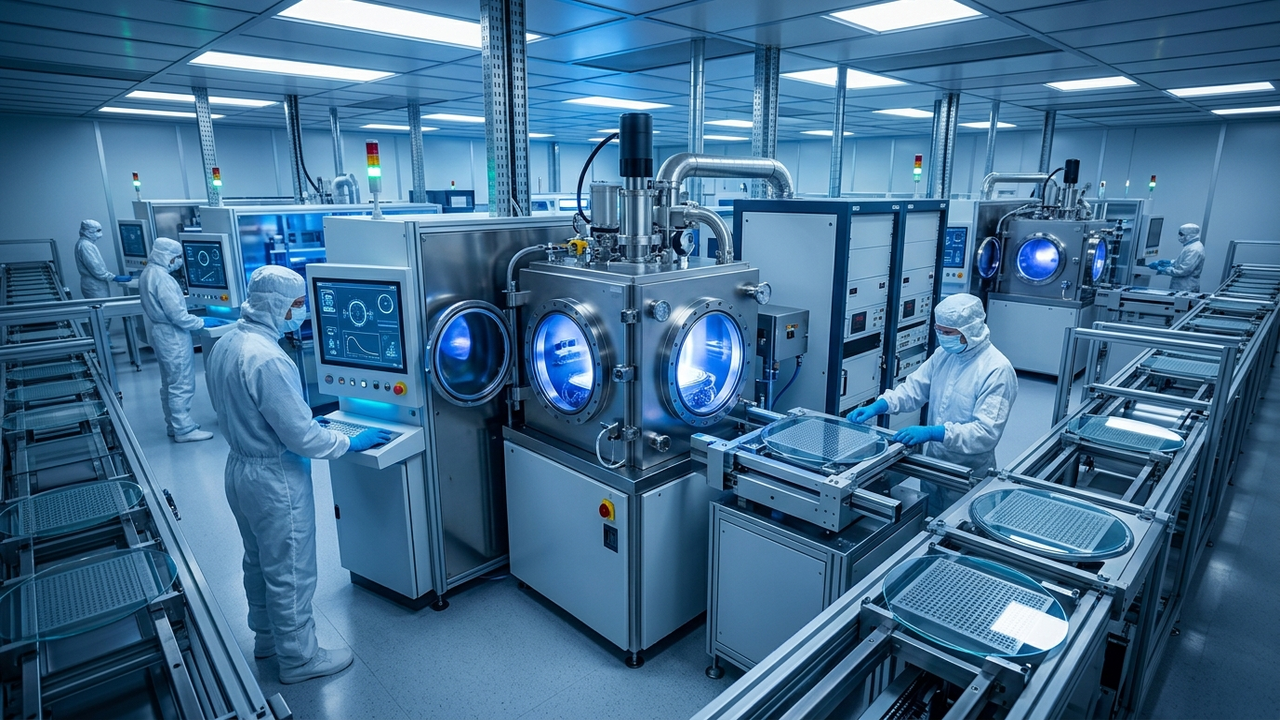
TRUMPF has announced a significant breakthrough in the Through Glass Via (TGV) coating process for glass substrates, a foundational element in next-generation AI chip packaging. Utilizing its proprietary high-power HiPIMS (High Power Impulse Magnetron Sputtering) technology, TRUMPF has successfully eliminated a long-standing bottleneck, which is anticipated to dramatically boost the mass production capabilities for high-density, high-performance AI chips and have a profound impact across the industry.
Technical / Clinical Details
TGVs are microscopic electrical pathways that penetrate glass substrates, indispensable for achieving both high-frequency performance and high-density interconnections. However, uniformly applying a high-quality conductive coating to the inner walls of these TGVs has been extremely challenging, presenting a significant bottleneck in the manufacturing process. TRUMPF’s high-power HiPIMS technology achieves a higher ionization rate and deposition speed compared to conventional sputtering methods, enabling the formation of uniform and highly adhesive metallic films deep within the TGVs. This advancement leads to reduced electrical resistance, enhanced signal transmission reliability, and a substantial improvement in manufacturing throughput. Glass substrates offer compelling advantages over silicon, including lower dielectric loss, superior coefficient of thermal expansion matching, and potentially lower cost, positioning them as an ideal platform for multi-layer AI chip packaging.
Background & Context
The relentless pursuit of higher AI chip performance increasingly relies not just on traditional miniaturization techniques but also on advanced packaging technologies like 3D stacking and multi-chiplet integration. Especially in AI accelerators incorporating High Bandwidth Memory (HBM), the data transfer speed between chips becomes a bottleneck, making low-dielectric-loss materials like glass substrates and high-density TGVs indispensable. Previously, the difficulty of TGV coating had hindered the broader adoption of glass substrates. TRUMPF’s latest technological innovation removes this barrier, paving the way for more widespread implementation of high-performance AI packaging based on glass substrates.
Strategic Significance & Outlook
TRUMPF’s resolution of the TGV coating bottleneck introduces new degrees of freedom in the design and manufacturing of next-generation AI chips. This will accelerate the trend towards higher performance, greater integration density, and lower power consumption for AI chips, driving AI innovation in diverse applications such as data centers, edge AI, and autonomous driving. Leveraging this technology, TRUMPF is expected to strengthen its leadership in the semiconductor manufacturing equipment market and create new market opportunities through collaborations with glass substrate suppliers and AI chip manufacturers. This technology will be critical in improving the cost-efficiency and production scale of AI chips, providing an essential foundation for the overall advancement of the AI industry.
Source: https://asianews.network/trumpf-makes-glass-substrates-ready-for-the-next-generation-of-ai-chips/
Get our weekly technology intelligence — free
Receive an infographic that lets you judge at a glance whether each field’s analysis report is worth reading.
Subscribe Free — Weekly Tech Intelligence
By subscribing, you’ll receive Troy-Technical’s weekly technology intelligence newsletter.
- Your email and selected fields are used only to deliver the newsletter.
- We never share your information with third parties.
- You can unsubscribe anytime via the link in each email.
See our Privacy Policy for details.
Takes about a minute · Unsubscribe anytime





Comments