Key Findings
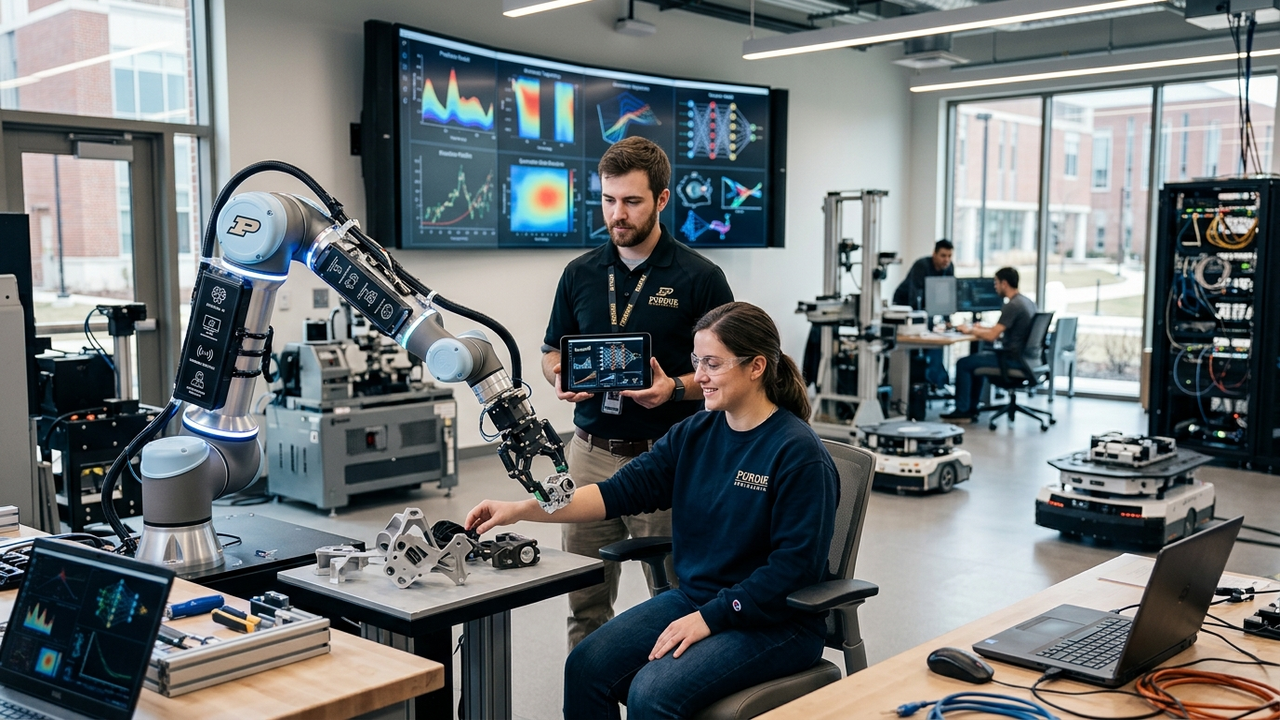
Purdue University’s research project aims to develop next-generation ‘Physical AI’ and trustworthy autonomous systems by fusing model-based control with foundation models and generative AI. This initiative focuses on creating novel algorithms that enable robots to generate human-compatible behaviors while simultaneously meeting stringent safety and dynamic constraints, a critical advancement for real-world AI deployment.
Technical / Clinical Details
At the heart of this research is the significant enhancement of reliability and safety for AI systems operating in dynamic physical environments. The project explores several key technological areas:
- Integration of Model-Based Control with Generative AI: This approach combines the predictability and rigor of traditional control theory with the flexibility and environmental adaptability of foundation models and generative AI. This allows for safe and effective decision-making even in complex, unforeseen situations.
- Motion Planning and Decision-Making Algorithms: New algorithms are being developed to enable robots and autonomous systems to plan optimal paths and actions while satisfying multiple constraints, such as collision avoidance, energy efficiency, and real-time adaptation to environmental changes.
- Human-Autonomous System Collaboration: Algorithms are designed to enhance AI systems’ ability to understand, predict, and collaborate with human intentions. This fosters ‘human-centered’ autonomy, where humans can more naturally comprehend and trust AI actions.
- Rigorous Safety and Dynamic Constraints: All developed algorithms aim to achieve theoretically rigorous safety guarantees and compliance with real-world dynamic constraints simultaneously. This is indispensable for safety-critical applications like autonomous vehicles and industrial robots.
The developed framework is slated for validation on actual robotic and autonomous vehicle platforms. This empirical validation is crucial for ensuring the practicality and generalizability of the research findings, moving beyond theoretical constructs to applied solutions.
Background & Context
The rapid advancement of AI, particularly generative AI, has demonstrated astonishing capabilities in generating text, images, and audio. However, applying these models to robots and autonomous systems that interact with the physical world introduces new challenges concerning safety, predictability, and human collaboration. Traditional data-driven AI models often struggle with unpredictable behaviors in novel or unforeseen environments. Purdue University’s research seeks to bridge this gap, laying the foundation for AI to become a more reliable and safer partner in our physical world, thereby addressing a critical need in the broader AI landscape.
Strategic Significance & Outlook
The technologies developed through this research hold the potential for generalization across multiple embodied AI domains, including autonomous driving, collaborative robotics, and intelligent manufacturing. This could lead to safer and more efficient human-robot collaboration in manufacturing, or increased public acceptance and reliability of autonomous vehicles. Ultimately, this work is poised to play a vital role in accelerating the adoption of AI in daily life and industry by fostering trust and enabling humans to perceive AI as a ‘reliable partner.’ The progress of this research will deepen our understanding of how AI interacts with our physical world and how it can enhance safety and efficiency within it, contributing significantly to the future of AI deployment.
Get our weekly technology intelligence — free
Receive an infographic that lets you judge at a glance whether each field’s analysis report is worth reading.
Subscribe Free — Weekly Tech Intelligence
By subscribing, you’ll receive Troy-Technical’s weekly technology intelligence newsletter.
- Your email and selected fields are used only to deliver the newsletter.
- We never share your information with third parties.
- You can unsubscribe anytime via the link in each email.
See our Privacy Policy for details.
Takes about a minute · Unsubscribe anytime








Comments