Key Findings
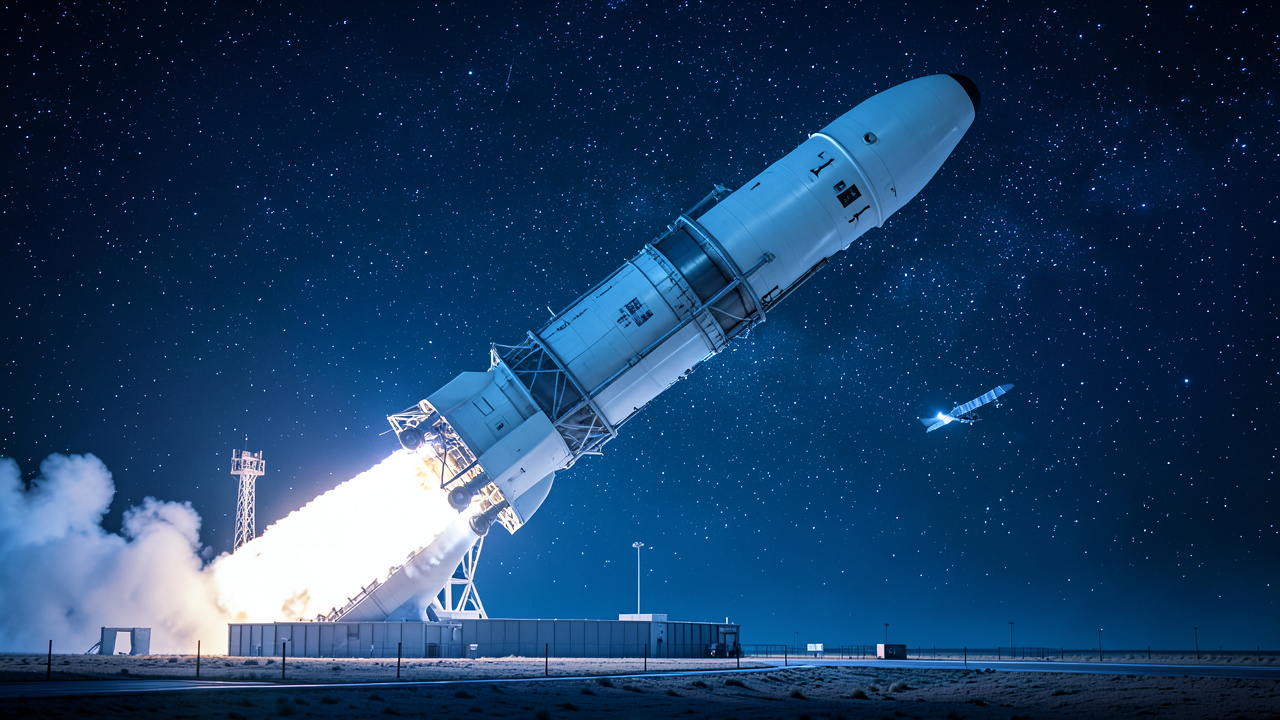
The Japan Aerospace Exploration Agency (JAXA) successfully executed a takeoff and landing test of its RV-X experimental vehicle on September 11, 2026, marking a pivotal advancement in its pursuit of reusable rocket technology. The RV-X, a prototype measuring 7.3 meters in length and weighing 3.1 tons, demonstrated autonomous flight by ascending 11 meters, traversing 16 meters horizontally, and landing precisely within 40 seconds. This success represents a crucial milestone in establishing engine reuse technology for the successor to the H3 rocket. Concurrently, JAXA also finalized a re-test of the second-stage combustion for its Epsilon S small rocket, successfully overcoming material procurement challenges by implementing alternative binder and insulation materials.
Technical Details
The RV-X experimental vehicle was developed to validate Vertical Takeoff and Vertical Landing (VTVL) technology, essential for enabling rocket engine reuse. This prototype, sized and weighted to mimic a real rocket stage, performed its complex VTVL sequence through highly precise thrust vectoring and attitude control, facilitated by advanced flight control software and integrated hardware. The ability to ensure stable and accurate landing is paramount for reducing recovery costs and enhancing operational efficiency for future large-scale reusable rockets. In parallel, the re-test of the Epsilon S second-stage engine addressed initial material procurement difficulties by successfully testing alternative components. This demonstrates a strengthened supply chain and increased manufacturing flexibility, significantly mitigating risks in ongoing rocket development.
Background and Industry Context
The global space industry is rapidly transitioning towards reusable rocket technology, pioneered by systems like SpaceX’s Falcon 9. This shift dramatically reduces launch costs, democratizing access to space and fueling the rapid expansion of the satellite launch market. JAXA’s successful RV-X test is a vital step for Japan to establish its presence in this competitive international landscape of reusable rocket development. Integrating reusability into the H3 rocket’s successor is expected to enhance Japan’s space transportation capabilities, making them more competitive and adaptable to diverse space missions. Furthermore, the successful material replacement in the Epsilon S re-test highlights Japan’s commitment to ensuring the sustainability and stability of its indigenous rocket development, a critical aspect given current geopolitical risks and supply chain volatilities.
Strategic Significance and Outlook
The success of the RV-X experimental vehicle provides significant momentum for JAXA’s goal of realizing reusable technology for the ‘H3 rocket successor.’ Future plans likely involve tests at higher altitudes, more complex flight profiles, and ultimately, demonstrating re-entry and landing capabilities from space. This progression is expected to make Japan’s launch services more competitive in the international market. The completion of the Epsilon S material replacement and re-combustion test secures a stable launch capability for the small satellite market, reinforcing Japan’s autonomous space activities in scientific missions and national security. These technological advancements are strategic elements for Japan’s space industry to establish its unique position and achieve sustainable growth amidst global collaboration and competition.
Source: https://sj.jst.go.jp/stories/2026/s0916-01p.html
Get our weekly technology intelligence — free
Receive an infographic that lets you judge at a glance whether each field’s analysis report is worth reading.
Subscribe Free — Weekly Tech Intelligence
By subscribing, you’ll receive Troy-Technical’s weekly technology intelligence newsletter.
- Your email and selected fields are used only to deliver the newsletter.
- We never share your information with third parties.
- You can unsubscribe anytime via the link in each email.
See our Privacy Policy for details.
Takes about a minute · Unsubscribe anytime





Comments