Key Findings
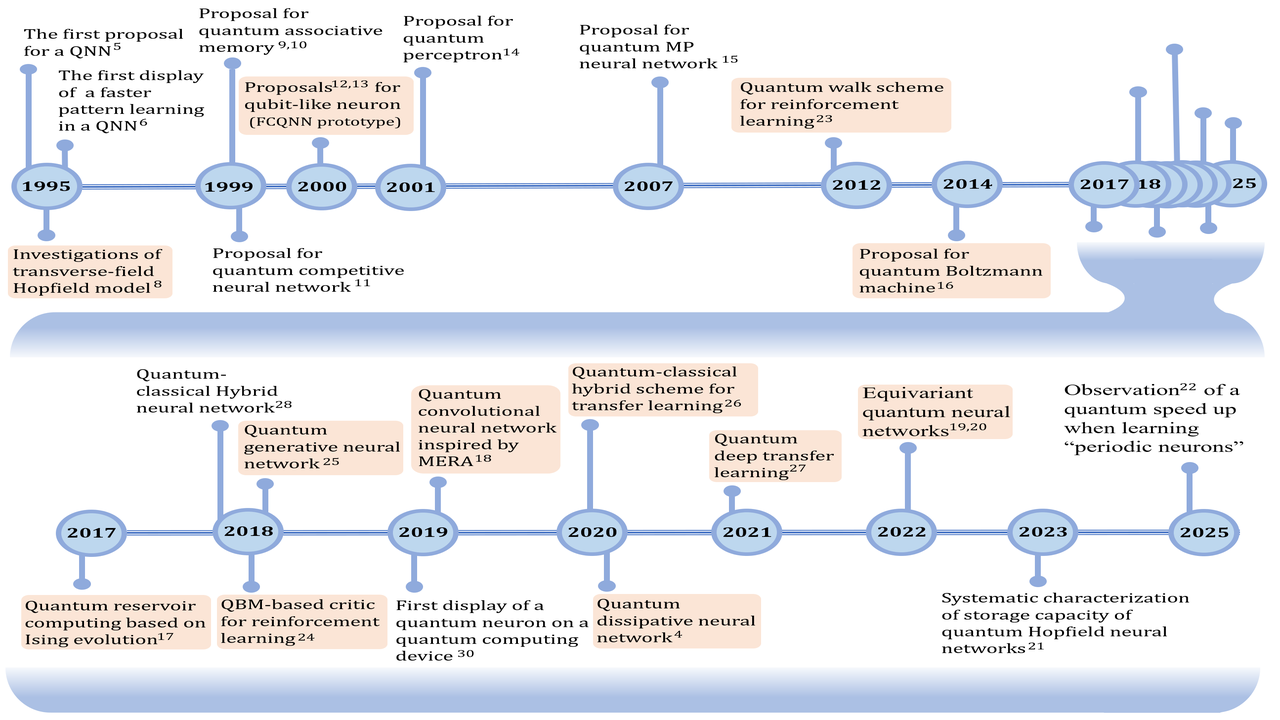
A recently published arXiv paper provides an extensive survey on Quantum Neural Networks (QNNs), an emerging field that harnesses quantum mechanics to significantly enhance machine learning capabilities. The research concludes that QNNs have the potential to process vast amounts of data more efficiently by leveraging qubits, offering dramatically faster training times and improved accuracy in complex applications such as drug discovery and financial modeling. This study marks a crucial milestone in the development of quantum AI.
Technical / Clinical Details
- QNN Fundamental Principles: QNNs integrate quantum mechanical principles like superposition and entanglement into the architecture and learning processes of neural networks. This allows them to explore high-dimensional feature spaces unattainable by classical neural networks, leading to more efficient learning of complex data patterns.
- Efficient Data Processing: By exploiting the exponential information storage capacity of qubits, QNNs hold the potential to represent and process large datasets with significantly fewer resources than classical computers. This translates into substantial computational efficiency gains, particularly for big data analytics.
- Application Domains:
- Drug Discovery: QNNs can accelerate the screening and optimization of new drug candidates by performing more accurate and rapid quantum chemistry simulations of molecular structures, thereby reducing the time and cost associated with drug development.
- Financial Modeling: They can enhance the accuracy of risk factor extraction from complex financial market data, improving portfolio optimization, high-frequency trading strategies, and fraud detection.
- Paper’s Evaluation Scope: The paper meticulously compares and evaluates various QNN architectures, including Variational Quantum Circuits (VQC)-based QNNs, Quantum Convolutional Neural Networks (QCNNs), and Quantum Boltzmann Machines (QBMs), detailing their performance, accuracy, training times, and required quantum resources.
Background & Context
Artificial Intelligence (AI) and Machine Learning (ML) are at the core of modern technology, yet classical computers face inherent limitations in computational power when dealing with increasingly large and complex datasets. To overcome this challenge, quantum computing is gaining significant attention, with QML emerging as a primary approach. QNN research demonstrates how quantum computing can contribute to practical AI applications, holding the potential to drive the next generation of AI breakthroughs. Academic research into the theoretical foundations and implementation possibilities of QNNs is currently very active.
Strategic Significance & Outlook
While QNNs are still in an early research phase, their development is crucial for shaping the future of quantum AI. As quantum hardware advances and QNN algorithms become more refined, it is anticipated that QNNs will enable the solution of complex problems currently considered intractable. Particularly with the realization of fault-tolerant quantum computers, QNNs are expected to further unleash their capabilities, leading to revolutionary applications in pharmaceuticals, finance, materials science, and image recognition, among other fields. This research accelerates the timeline for quantum computing to demonstrate a “quantum advantage” in real-world challenges, attracting significant attention from researchers and investors alike.