Key Findings
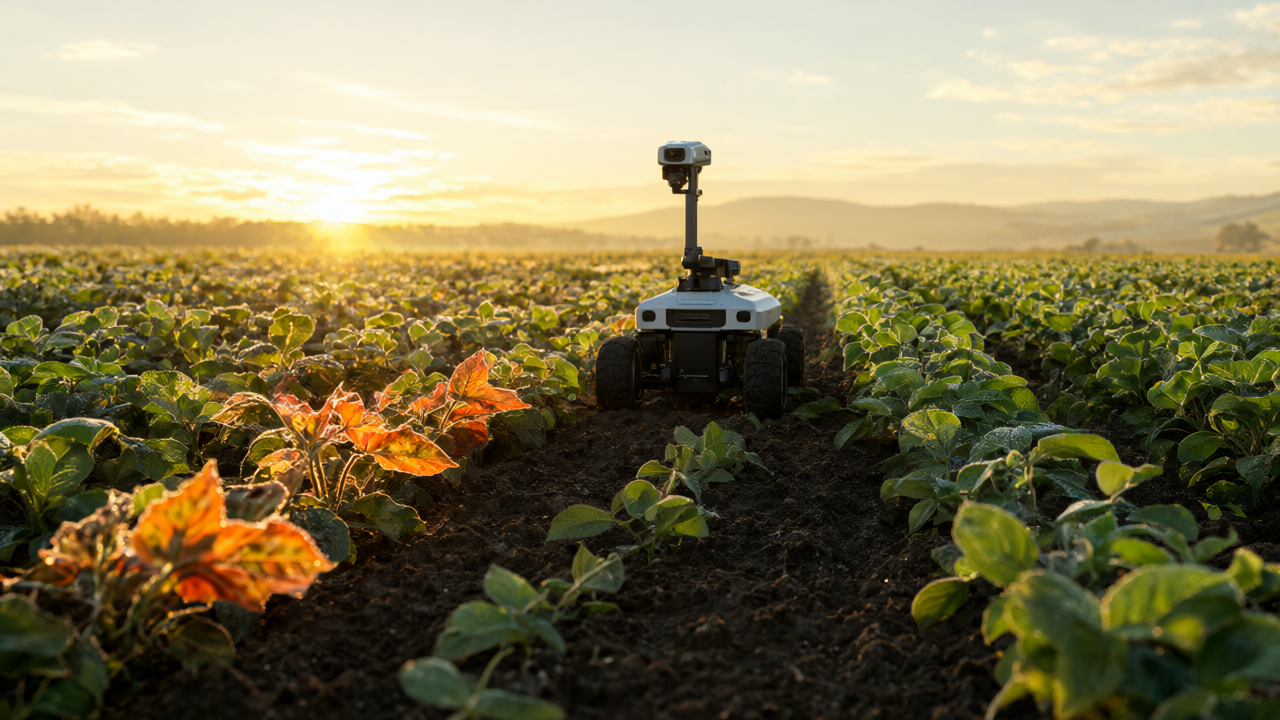
A research team at Southern Illinois University Carbondale has successfully developed an autonomous robot and an accompanying AI model that can detect soybean diseases with high accuracy even before visible symptoms emerge. This breakthrough enables farmers to implement more effective and sustainable crop protection strategies by facilitating earlier intervention.
Technical / Clinical Details
The developed robot incorporates advanced sensors and sophisticated image processing technologies, allowing it to autonomously navigate soybean fields and meticulously monitor the health status of individual plants. The data collected is then analyzed by a pre-trained AI model, which can identify the presence and specific type of soybean disease with an accuracy exceeding 90%. A key innovation is its ability to capture subtle, early-stage indicators such as minute color changes or morphological abnormalities in leaves that are imperceptible to the human eye. This AI model can distinguish between specific diseases, for instance, ‘brown spot’ or ‘rust,’ and provide real-time reports to farmers on the prevalence of diseased crops within their fields.
Background & Context
Soybeans are a vital global commodity, and their production is directly linked to food security. However, diseases can cause devastating yield losses, while traditional pesticide application carries environmental risks and increases costs. Conventional disease management often occurs after symptoms are well advanced, necessitating extensive prophylactic spraying. This research aligns with the principles of Precision Agriculture, offering a more efficient and environmentally friendly approach that involves intervention only where necessary. This holds the potential to reduce pesticide use while maintaining or even improving crop yields.
Strategic Significance & Outlook
This AI robot system empowers farmers to identify disease “hotspots” early, allowing for precise fungicide application to specific infected areas rather than indiscriminate spraying across entire fields. This significantly reduces both the cost of pesticides and their environmental impact, while optimally preserving crop health. The research team aims to further refine this technology, explore its application to other crops, and enhance its adaptability to new diseases emerging due to climate change. In the future, data-driven autonomous disease management is expected to become standard, dramatically improving the sustainability and efficiency of global agricultural production.
Get our weekly technology intelligence — free
Receive an infographic that lets you judge at a glance whether each field’s analysis report is worth reading.
Subscribe Free — Weekly Tech Intelligence
By subscribing, you’ll receive Troy-Technical’s weekly technology intelligence newsletter.
- Your email and selected fields are used only to deliver the newsletter.
- We never share your information with third parties.
- You can unsubscribe anytime via the link in each email.
See our Privacy Policy for details.
Takes about a minute · Unsubscribe anytime





Comments