

Key Findings
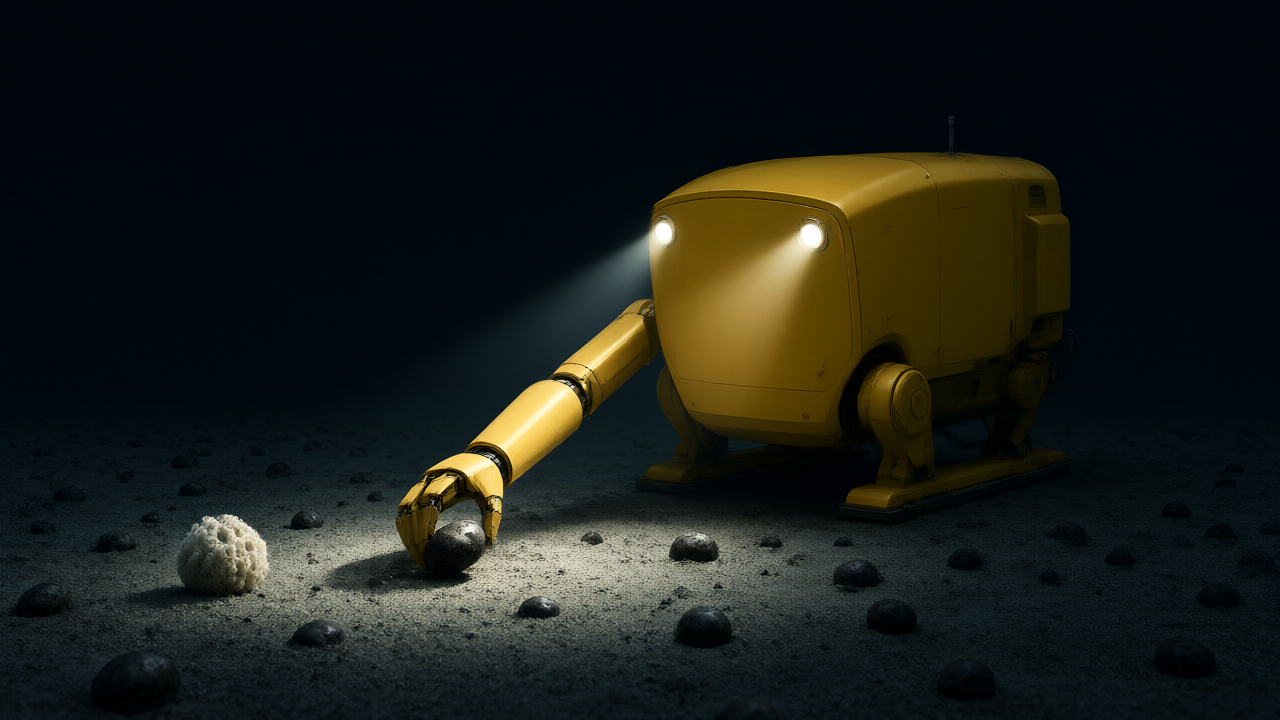
Impossible Metals has completed a scientific dive in the Clarion-Clipperton Zone, recovering approximately 450 grams of polymetallic nodules from a depth of over 4,000 meters (2.5 miles). Unlike traditional deep-sea collection methods that indiscriminately harvest material using riser systems, the Eureka Collection System™ selectively recovers targeted nodules while leaving others undisturbed to preserve the habitat.
Technical Details
The Eureka system employs several distinct technical innovations to minimize environmental impact and reduce infrastructure costs:
- Hovering Capability: The vehicle hovers above the seabed rather than driving across it, avoiding direct contact with the seafloor.
- Buoyancy Engine: The system uses a buoyancy engine to lift payloads via water displacement physics, eliminating the need for riser pipes and the associated process-water discharge.
- Perception Layer: An AI-driven perception system identifies visible life on and around nodules, allowing the robotic arms to select only those without visible fauna.
- Intellectual Property: These elements are protected by US patent 12,704,065, granted on August 11, 2026.
Background & Context
The recovered material will be used by research partner Viridian Biometals to study bacterial populations and develop metal recovery methods that avoid acids and reduce water and energy consumption. The company is backed by significant investors, including In-Q-Tel (IQT) and the Smith family of FedEx. All scientific data from the dive will be published openly, following a similar transparency protocol used during Eureka II dives on the Blake Plateau two years prior.
Significance & Outlook
Impossible Metals intends to provide a “robots-as-a-service” solution, partnering with licensed resource holders to operate the system. Because the technology scales by adding individual robots rather than building massive fixed infrastructure, the company claims a fundamentally different cost structure than riser-based systems. In 2027, the scaled-up Eureka III will undergo an environmental impact study by Germany’s Federal Institute for Geosciences and Natural Resources (BGR) aboard the RV SONNE.
Get our weekly technology intelligence — free
Receive an infographic that lets you judge at a glance whether each field’s analysis report is worth reading.
Subscribe Free — Weekly Tech Intelligence
By subscribing, you’ll receive Troy-Technical’s weekly technology intelligence newsletter.
- Your email and selected fields are used only to deliver the newsletter.
- We never share your information with third parties.
- You can unsubscribe anytime via the link in each email.
See our Privacy Policy for details.
Takes about a minute · Unsubscribe anytime