Key Findings
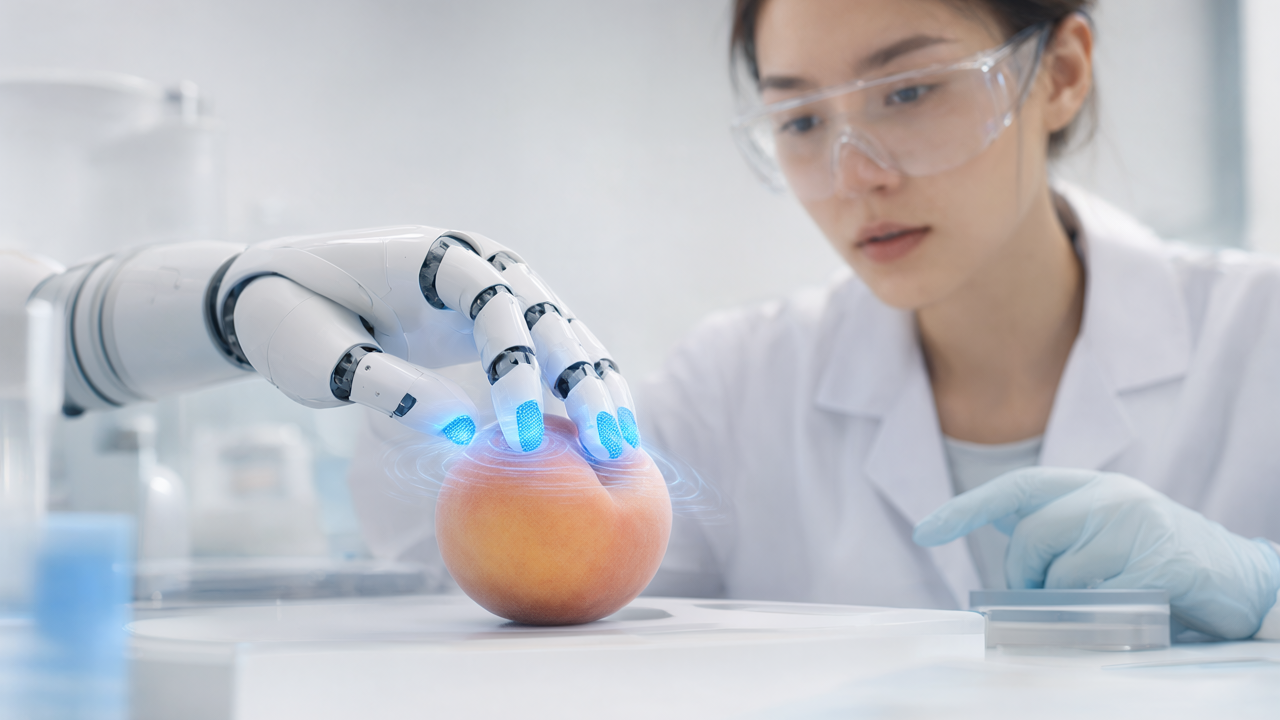
Researchers have developed “DexTouch-WM,” a novel framework that learns predictive models for dexterous robot manipulation directly from scalable human tactile data. This system enables robots to jointly forecast future visual (RGB) observations and bimanual tactile dynamics, demonstrating substantial performance improvements in human-to-robot skill transfer and significantly enhancing robotic dexterity in contact-rich tasks.
Technical / Clinical Details
The distinguishing feature of DexTouch-WM is its efficient collection and utilization of human tactile data. By ensuring hardware and action-level compatibility between human and robot tactile data, the framework allows for seamless transfer of learned models from humans to robots. Specifically, the model learns from human tactile feedback and visual information during object manipulation, enabling robots to mimic these actions. This approach allows robots to anticipate subtle force changes and slippage upon contact, leading to more stable and dexterous manipulation. The paper reports significant performance gains in human-to-robot scaling experiments compared to traditional single-modality learning methods, highlighting its superiority in complex contact tasks.
Background & Context
Achieving dexterous manipulation capabilities in robots is a critical challenge for a wide range of applications, from industrial sectors (precision assembly, quality inspection) to service domains (cooking, elderly care). While robots traditionally relied heavily on visual information for object interaction, the absence of nuanced tactile feedback often hindered human-like delicate manipulation. Transferring complex human tactile information to robots efficiently has been a long-standing research problem. DexTouch-WM addresses this by proposing a novel solution that leverages large-scale, scalable human tactile data, paving the way for robots to develop a deeper understanding of physical world interactions.
Strategic Significance & Outlook
The success of DexTouch-WM suggests the potential for future robots to manipulate objects with dexterity comparable to, or even surpassing, human capabilities. Further development of this technology could accelerate robot deployment in diverse areas previously difficult to automate, such as precision surgery in medicine, delicate component handling in manufacturing, and complex household chores. Notably, the ability to efficiently transfer human expertise to robots could alleviate bottlenecks in knowledge and skill acquisition within robotics, promoting the development of more general-purpose and adaptive robots. In the long term, this could contribute to creating more intuitive robot training systems where robots can instantly learn and execute new tasks simply by human demonstration.
Source: https://arxiv.org/abs/2609.20649
Get our weekly technology intelligence — free
Receive an infographic that lets you judge at a glance whether each field’s analysis report is worth reading.
Subscribe Free — Weekly Tech Intelligence
By subscribing, you’ll receive Troy-Technical’s weekly technology intelligence newsletter.
- Your email and selected fields are used only to deliver the newsletter.
- We never share your information with third parties.
- You can unsubscribe anytime via the link in each email.
See our Privacy Policy for details.
Takes about a minute · Unsubscribe anytime




Comments