
Key Findings
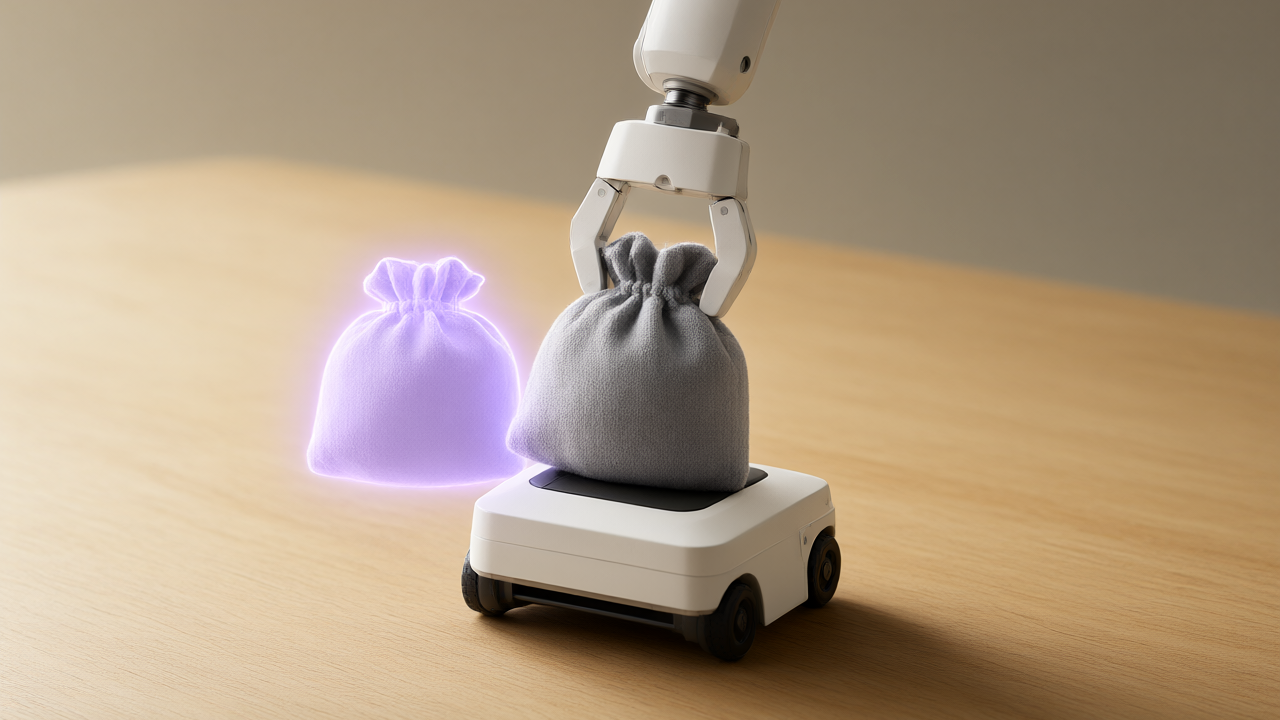
NTT has developed a physical AI technology that allows robots to simulate multiple future outcomes before executing an action, enabling the selection of the path with the lowest probability of failure. In a practical application involving the stacking of items by a small robot, the success rate improved from 73.1% to 92.3% by evaluating five action candidates and avoiding those leading to object drops.
Technical Details
The system utilizes a “world model” that predicts how the environment changes based on robot actions. To overcome the tendency of standard video generation models to produce “plausible” but physically impossible results (such as disappearing objects), NTT integrated a proprietary physical control adapter. This adapter estimates physical quantities—including position, posture, velocity, angular velocity, mass, and moment of inertia—and calculates future states based on laws of motion and equations of movement.
The workflow operates as follows:
- Action candidates are generated by a Vision-Language-Action (VLA) model or motion planner.
- The world model generates these candidates as videos to evaluate risks like collisions or collapses.
- The physical control adapter provides explainability by outputting physical values as intermediate data, unlike black-box neural networks.
In the “OBJ3D” benchmark for physical prediction accuracy, the NTT model achieved an LPIPS×100 score of 7.81, compared to 7.92 for the “OCK” method and 21.90 for NVIDIA Cosmos Predict 2.5.
Background and Context
While general-purpose vision-language models have expanded robot capabilities, achieving high success rates remains difficult for tasks involving objects with varying shapes, weights, and friction, such as airport luggage. NTT’s approach combines the empirical strengths of video generation (e.g., predicting biological movement) with the precision of physics-based calculations.
Significance and Outlook
NTT plans to implement this technology in airport luggage loading and unloading in collaboration with Mujin. A primary remaining challenge is processing speed; currently, predicting a 5-second future takes 2 to 3 seconds. NTT intends to use model distillation to reduce latency and ensure robots can operate without stopping.
Source: https://news.mynavi.jp/techplus/article/20261111-5296066/
Get our weekly technology intelligence — free
Receive an infographic that lets you judge at a glance whether each field’s analysis report is worth reading.
Subscribe Free — Weekly Tech Intelligence
By subscribing, you’ll receive Troy-Technical’s weekly technology intelligence newsletter.
- Your email and selected fields are used only to deliver the newsletter.
- We never share your information with third parties.
- You can unsubscribe anytime via the link in each email.
See our Privacy Policy for details.
Takes about a minute · Unsubscribe anytime