Key Findings
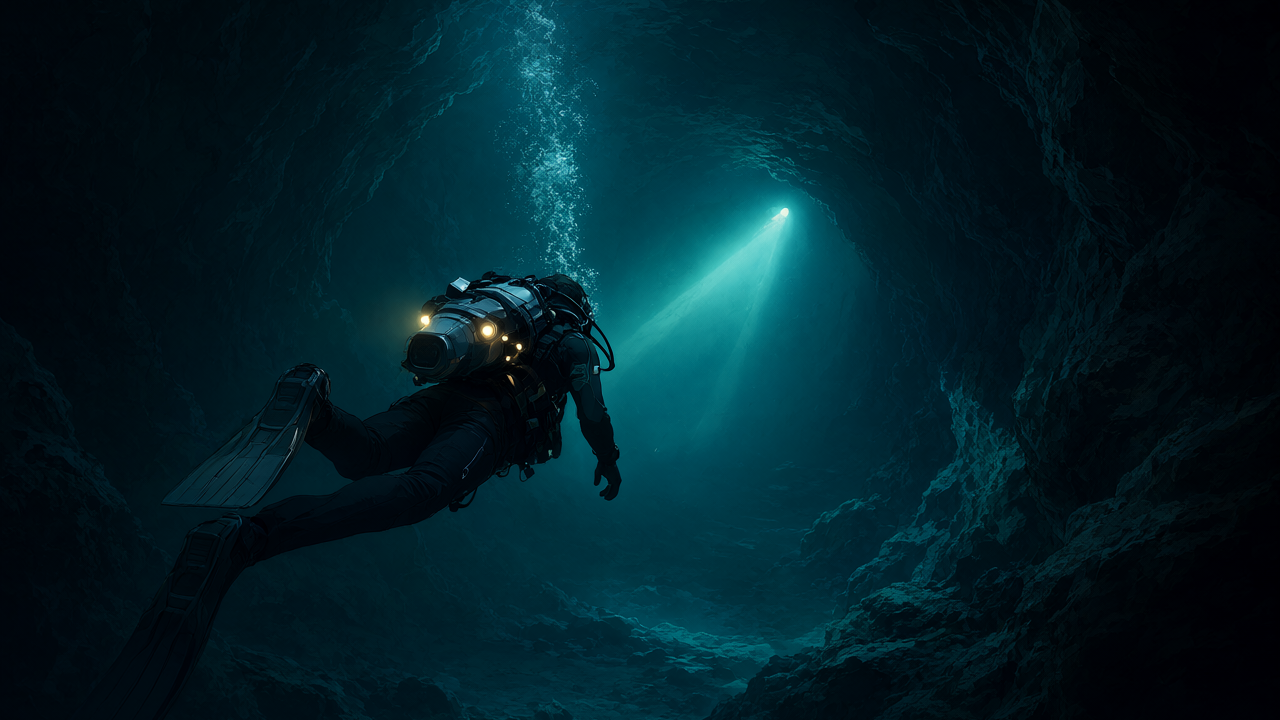
An innovative wearable underwater robotic system, named RADMCS (Robotic Assisted Diver Movement in Confined Spaces), has been developed to assist scuba divers operating in confined or hazardous underwater environments. Its efficacy has been demonstrated through human-participant trials conducted underwater, proving its capability to enable precise diver movement while maintaining safe distances from submerged structures.
Technical / Clinical Details
- RADMCS integrates perception technology, specifically monocular depth estimation from a single camera, with haptic feedback derived from underwater thrusters. This allows divers to navigate the underwater environment receiving not only visual information but also tactile guidance.
- The robot provides directional assistance to divers, enabling them to smoothly translate and rotate while maintaining a consistent distance from specific underwater structures (e.g., several centimeters from an inspection target). This is critically important for the inspection and maintenance of complex subsea infrastructure.
- In underwater trials with human participants, approved by an Institutional Review Board (IRB), RADMCS demonstrated its ability to effectively guide human movement using relatively low thrust values, approximately 10% of its maximum thrust. This confirms the system’s efficacy in supporting precise positioning while minimizing diver exertion.
Background & Context
Working in confined or dangerous underwater environments, such as oil and gas platforms, submarine cables, or nuclear power plant cooling pools, poses significant risks to divers. Poor visibility, strong currents, complex structures, and physical fatigue severely impact diver safety and operational efficiency. Robotic assistance systems like RADMCS are designed to overcome these challenges, enabling divers to perform tasks more safely and accurately. They are particularly expected to complement human capabilities in inspection tasks requiring precise positioning and steady movement.
Strategic Significance & Outlook
Wearable underwater robots like RADMCS hold the potential to dramatically improve the safety and efficiency of underwater operations. In the future, applications are anticipated across a wide range of fields, including marine archaeology, underwater construction, environmental monitoring, and rescue missions. Specifically, by combining enhanced autonomous navigation features with advancements in battery technology for extended operation, the system can further reduce diver burden and support more complex missions. This technology ushers in a new era of human-robot collaboration for underwater exploration.
Source: https://arxiv.org/html/2610.01906v1
Get our weekly technology intelligence — free
Receive an infographic that lets you judge at a glance whether each field’s analysis report is worth reading.
Subscribe Free — Weekly Tech Intelligence
By subscribing, you’ll receive Troy-Technical’s weekly technology intelligence newsletter.
- Your email and selected fields are used only to deliver the newsletter.
- We never share your information with third parties.
- You can unsubscribe anytime via the link in each email.
See our Privacy Policy for details.
Takes about a minute · Unsubscribe anytime