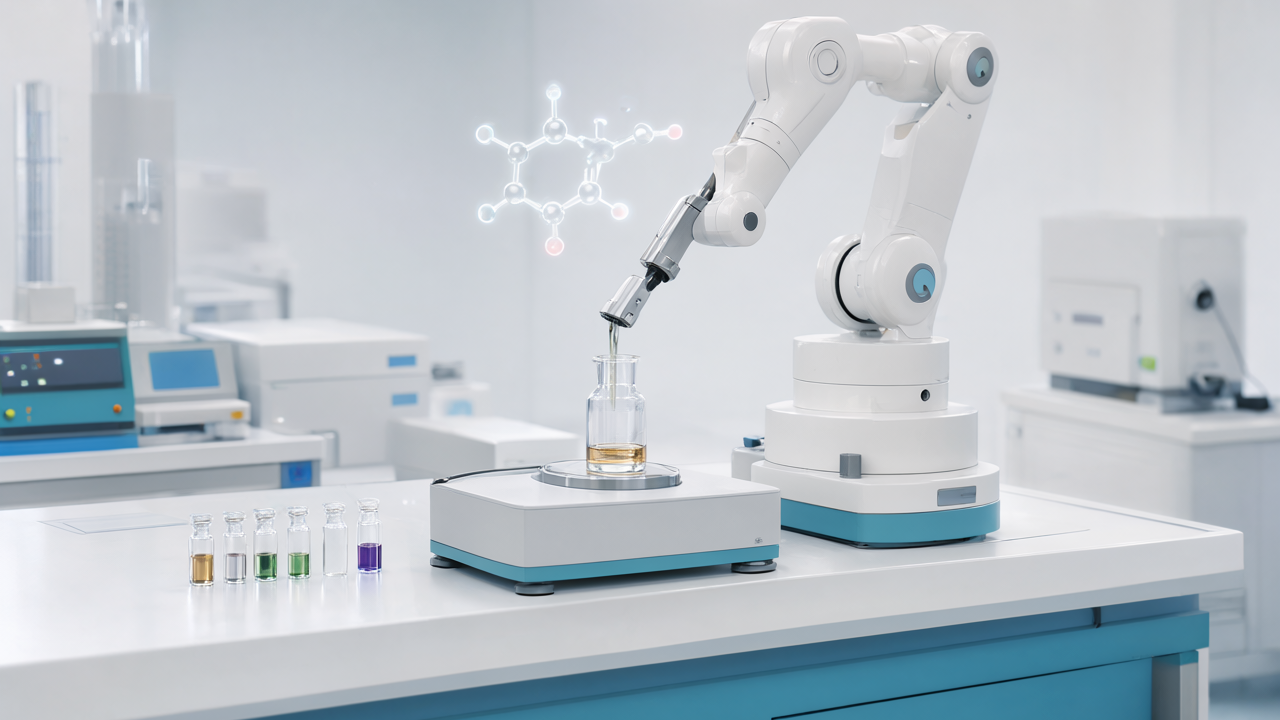
Key Findings: AI Optimizes Chemical Synthesis Pathways, Resolving Drug Discovery Bottlenecks
A collaborative research team from ETH Zurich and Roche Pharma Research and Early Development has developed a groundbreaking closed-loop workflow capable of predicting chemical reactions with extremely high accuracy, even when relying on limited experimental data. This system integrates three cutting-edge AI technologies—active learning, geometric deep learning, and self-supervised learning—to dramatically accelerate the exploration and optimization of reaction pathways, a long-standing bottleneck in medicinal synthesis. By autonomously identifying the most valuable next experiment, AI empowers drug discovery chemists to devise synthesis strategies far more efficiently.
Technical and Clinical Details: The Fusion of AI, Geometric Deep Learning, and Self-Supervised Learning
At the heart of this novel workflow is a sophisticated combination of the following technologies:
- Active Learning: The AI model autonomously identifies areas of high uncertainty or the most informative data points, proposing which experiments to conduct next. This significantly reduces the number of experiments required compared to random exploration.
- Geometric Deep Learning: This technique directly learns the three-dimensional geometric features of molecular structures, enabling more precise modeling of molecular shapes and spatial relationships between bonds. Consequently, it allows for more accurate prediction of stereochemical effects and transition state energies in reactions.
- Self-Supervised Learning: Features are extracted from large, unlabeled datasets (e.g., existing chemical databases), enhancing the model’s generalization capabilities. This allows for high predictive accuracy even with small amounts of experimental data for specific reactions.
This system particularly aids in complex organic synthesis reactions by assisting in decisions such as which bonds to cleave or form, and which reagents are optimal. By reducing experimental failure rates, it contributes to decreasing the number of synthesis steps and improving yields.
Background and Industry Context: Challenges in Synthetic Chemistry and the Promise of AI in Drug Discovery
The synthesis of new molecules in drug discovery often represents a time-consuming and costly bottleneck. Particularly when exploring novel chemical spaces, researchers must navigate an immense number of possibilities to find optimal synthetic routes. Traditional trial-and-error approaches are inefficient and heavily reliant on the experience of skilled medicinal chemists. Advances in AI technology offer powerful solutions to these challenges. Applying AI to areas such as chemical reaction prediction, molecular design, and synthesis pathway planning is expected to streamline the entire drug discovery process. The active involvement of a major pharmaceutical company like Roche in this technology development underscores the growing industry-wide expectation for AI in drug discovery.
Future Outlook: Accelerating Drug Discovery and Establishing Competitive Advantage
This active learning-driven AI chemistry workflow will significantly shorten the time from discovery to optimization of new drug candidates, providing pharmaceutical companies with a substantial competitive advantage. By guiding laboratory work with AI-powered simulations and informed decision-making, it is expected to reduce R&D costs and increase success rates. In the future, as this technology becomes more refined and potentially integrates with autonomous robotic chemists, it could lay the foundation for fully automated drug discovery platforms. This would enable the delivery of innovative medicines to patients at unprecedented speeds and scales. Investors will likely focus on the potential for high returns from investments in such AI-driven drug discovery technologies.
Get our weekly technology intelligence — free
Receive an infographic that lets you judge at a glance whether each field’s analysis report is worth reading.
Subscribe Free — Weekly Tech Intelligence
By subscribing, you’ll receive Troy-Technical’s weekly technology intelligence newsletter.
- Your email and selected fields are used only to deliver the newsletter.
- We never share your information with third parties.
- You can unsubscribe anytime via the link in each email.
See our Privacy Policy for details.
Takes about a minute · Unsubscribe anytime