Key Findings
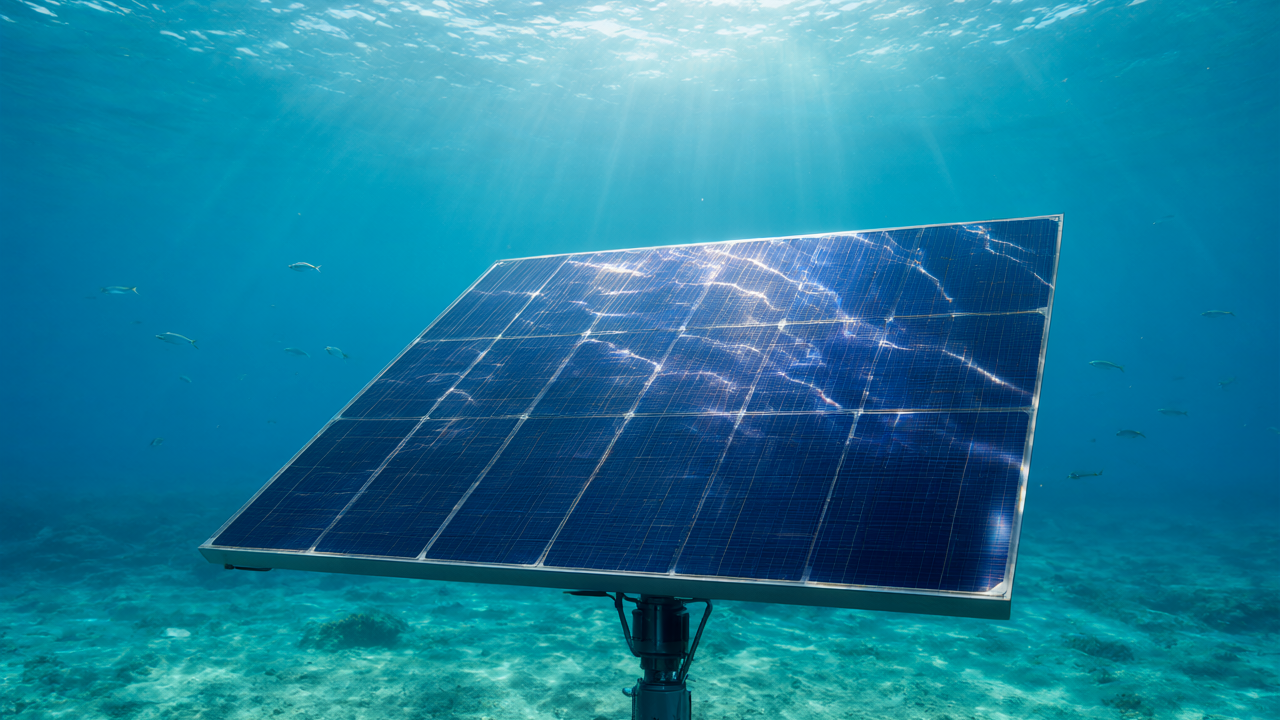
A polymer-tuned wide-bandgap perovskite solar cell has achieved an unprecedented 34.71% power conversion efficiency in an underwater environment, significantly surpassing all previous records. This groundbreaking achievement was particularly demonstrated under simulated conditions corresponding to a depth of 10 meters, opening new possibilities for solar cell applications in aquatic settings. This technology is expected to serve as a sustainable power source for ‘blue economy’ related applications such as marine monitoring, underwater sensor networks, and aquaculture.
Technical / Clinical Details
This innovative perovskite solar cell maximizes light absorption and charge carrier extraction efficiency in underwater environments by precisely tuning the bandgap of the perovskite material and passivating its surface with a specific polymer layer. The polymer layer acts as a protective barrier, shielding the perovskite from moisture degradation and ensuring long-term stability. The research team successfully suppressed charge carrier trapping by water and prevented a decrease in photoelectric conversion efficiency through optimizing this polymer-perovskite interface. Experiments confirmed that high efficiency could be maintained even under the attenuated solar spectrum at 10 meters depth, overcoming the challenge where conventional terrestrial solar cells rapidly degrade in underwater conditions.
Background & Context
The ocean, covering over 70% of the Earth’s surface, offers vast untapped energy potential, yet efficient and durable power sources capable of operating underwater have been limited. Conventional underwater solar cells have faced challenges such as light attenuation due to water absorption, hydrostatic pressure, and corrosion, resulting in relatively low conversion efficiencies. Perovskite solar cells, known for their high efficiency and low manufacturing costs, are considered next-generation solar cells but have been plagued by significant vulnerability to moisture. This research dramatically improves the underwater stability and efficiency of perovskite materials, making their utilization in marine environments a reality and providing an indispensable technological foundation for the blue economy’s advancement.
Strategic Significance & Outlook
Polymer-tuned perovskite underwater solar cells have the potential to revolutionize power supply for autonomous underwater vehicles (AUVs), data buoys, environmental sensors, and underwater communication devices in the marine sector. They can also contribute to sustainable food production by meeting the power needs of coastal aquaculture facilities. Future efforts will focus on evaluating performance at greater depths, verifying long-term stability, and developing cost-effective manufacturing methods for large-scale production. If commercialized, this technology is expected to create new industries that balance effective utilization of marine resources with environmental protection.
Get our weekly technology intelligence — free
Receive an infographic that lets you judge at a glance whether each field’s analysis report is worth reading.
Subscribe Free — Weekly Tech Intelligence
By subscribing, you’ll receive Troy-Technical’s weekly technology intelligence newsletter.
- Your email and selected fields are used only to deliver the newsletter.
- We never share your information with third parties.
- You can unsubscribe anytime via the link in each email.
See our Privacy Policy for details.
Takes about a minute · Unsubscribe anytime