Key Findings
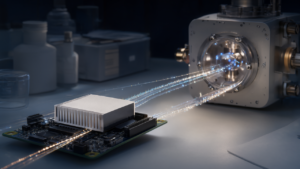
IonQ has advanced to Stage C, the final phase of DARPA’s Quantum Benchmarking Initiative (QBI). This selection entails IonQ providing multiple generations of its “Superion” quantum computers for rigorous independent verification by DARPA through 2029. A highlight of IonQ’s achievements is the world record established in October 2025, demonstrating over 99.99% fidelity for its trapped-ion 2-qubit gates. This outstanding fidelity is a clear indicator of IonQ’s technical maturity and significant progress towards achieving fault-tolerant quantum computing (FTQC).
Technical / Clinical Details
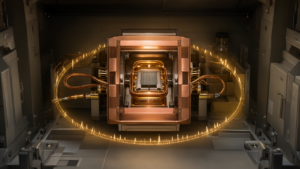
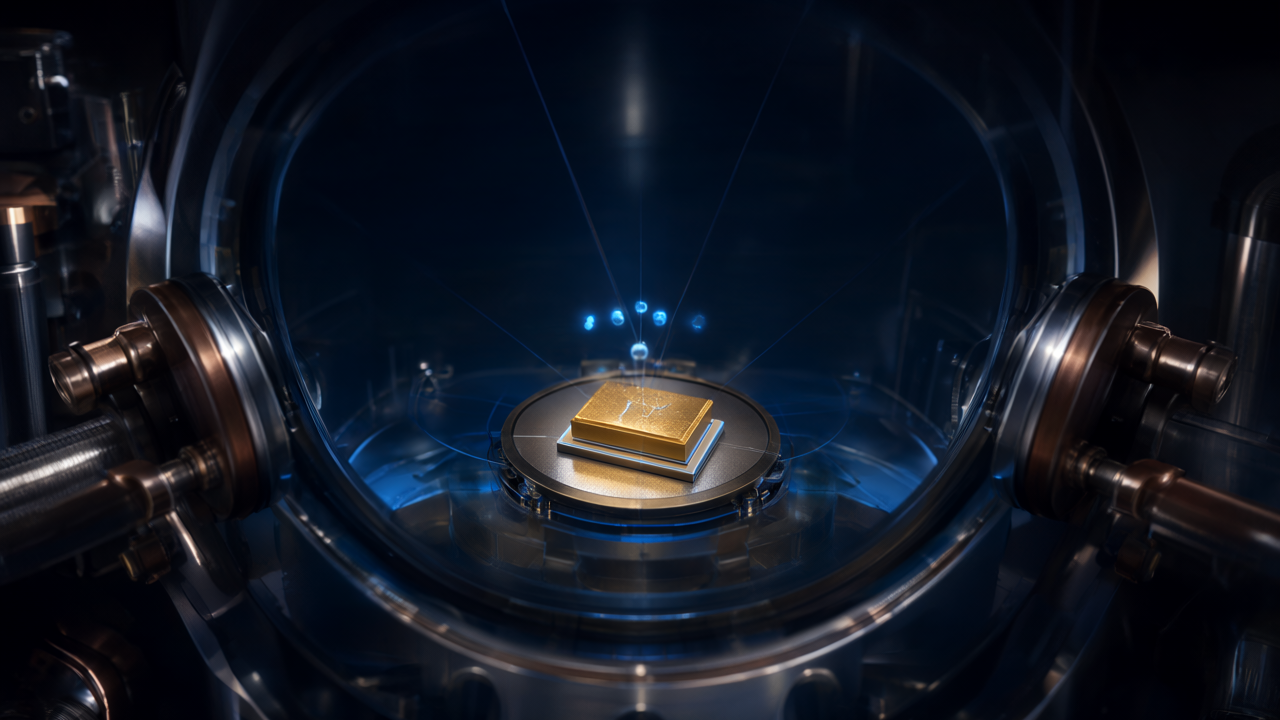
The verification in QBI Stage C will focus on evaluating the actual performance of IonQ’s quantum computers and their fault-tolerant characteristics. IonQ’s trapped-ion approach forms qubits by manipulating individual atoms and uses lasers to perform quantum gate operations. A significant advantage of this method is the high uniformity of qubits and their relatively high resistance to external interference.
The demonstrated 2-qubit gate fidelity of over 99.99% in October 2025 significantly surpasses the threshold required for practical quantum error correction. This high fidelity implies that the rate of errors in quantum computations can be kept extremely low, providing a robust foundation for executing more complex algorithms with greater reliability. DARPA will continuously assess the performance of subsequent Superion systems provided by IonQ, in line with its roadmap, to verify the feasibility of utility-scale FTQC systems.
Background & Context
In the quantum computing landscape, noisy intermediate-scale quantum (NISQ) devices are currently predominant, but truly useful applications necessitate fault-tolerant quantum computers. Fault tolerance refers to the ability of quantum bits to autonomously detect and correct errors caused by noise. DARPA’s QBI is a national initiative aimed at accelerating the development and benchmarking of FTQC technology, with the goal of solidifying U.S. leadership in quantum technologies. IonQ’s technical advancements suggest that the trapped-ion approach is one of the most promising avenues for achieving FTQC.
Strategic Significance & Outlook
IonQ’s participation in QBI Stage C provides an opportunity for its technology to be evaluated at the forefront of national security and advanced scientific computation. The continuous verification through 2029 will be a critical process for IonQ to demonstrate consistent execution of its FTQC roadmap. The high gate fidelity of trapped-ion technology makes the implementation of large-scale quantum error correction codes a realistic prospect. In the future, this is expected to contribute to achieving quantum advantage in a wide range of fields, including drug and materials discovery, solving complex optimization problems, and cryptography. This achievement will undoubtedly have a positive impact on the entire industry, accelerating the commercialization and practical deployment of quantum computing.
Source: https://www.ionq.com/blog/what-it-means-to-put-a-quantum-roadmap-to-the-test
Get our weekly technology intelligence — free
Receive an infographic that lets you judge at a glance whether each field’s analysis report is worth reading.
Subscribe Free — Weekly Tech Intelligence
By subscribing, you’ll receive Troy-Technical’s weekly technology intelligence newsletter.
- Your email and selected fields are used only to deliver the newsletter.
- We never share your information with third parties.
- You can unsubscribe anytime via the link in each email.
See our Privacy Policy for details.
Takes about a minute · Unsubscribe anytime