Key Findings: Breakthrough in Real-Time Quantum Error Decoding and Significant Logical Error Reduction
IonQ has achieved a pioneering demonstration of the industry’s first real-time quantum error decoder, efficiently operating on a single standard CPU. This milestone represents a significant leap forward for practical quantum error correction. The decoder successfully processed over 31.5 million quantum operations on 408 logical qubits with a minimal computational overhead of just 0.02%. Simultaneously, the Google Quantum AI team reported a 3.5-fold improvement in logical stability within surface codes, further reducing the logical error rate by 20%, achieving a record-breaking low logical error of less than one part per thousand per error correction cycle. These combined achievements critically advance the feasibility of building large-scale, reliable quantum computers.
Technical Details: Efficient Decoding and Enhanced Surface Code Performance
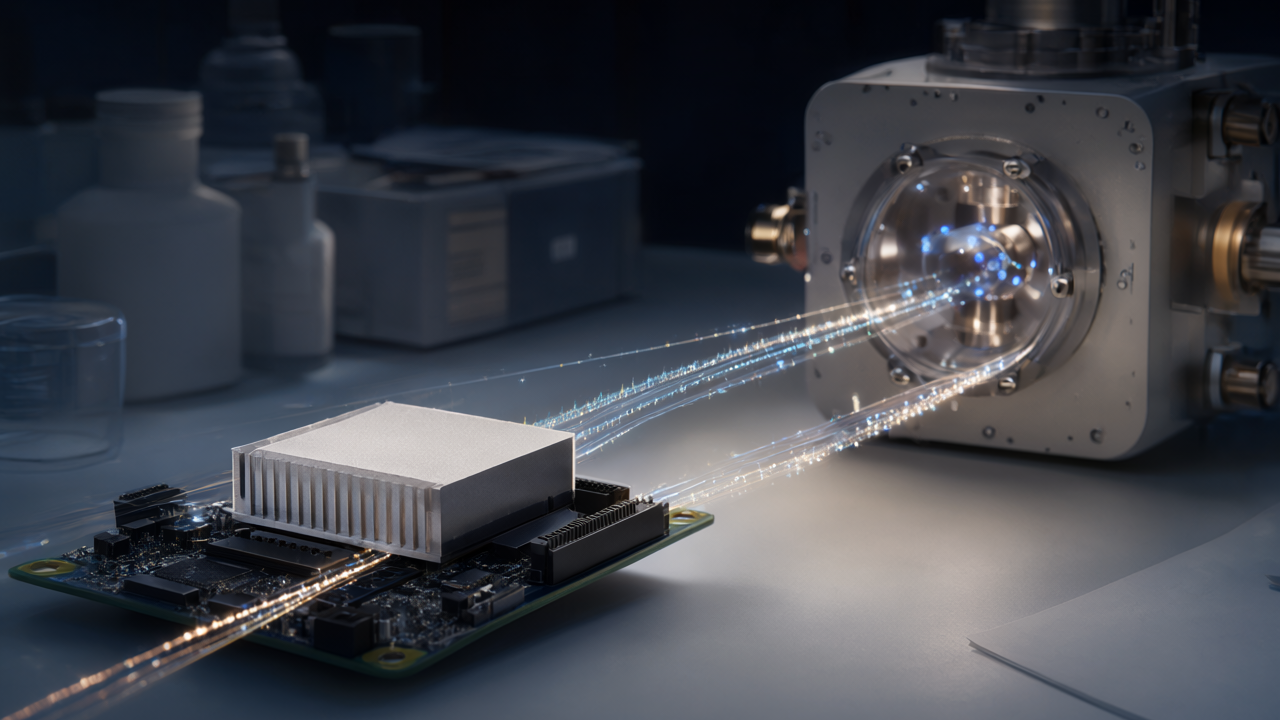
- IonQ’s Real-Time Decoder: Historically, quantum error correction decoding has been computationally intensive, often slowing down quantum operations. IonQ’s new decoder resolves this bottleneck by enabling real-time processing on a single CPU. The decoder detects noise originating from physical qubits and swiftly determines optimal correction procedures with negligible overhead (0.02% of computation time), allowing for efficient maintenance of a large number of logical qubits.
- Google Quantum AI’s Surface Code Improvements: Google’s research team has dramatically enhanced the performance of surface codes, a leading technique for quantum error correction. The 3.5x improvement in logical stability signifies a substantial extension of quantum information retention periods. Coupled with a 20% reduction in logical error rates and an error rate of less than one part per thousand per error correction cycle, this indicates that the reliability of error correction is approaching practical levels. This progress is paramount for improving the trustworthiness of logical qubits, even amidst high levels of physical qubit noise.
Background & Context: The Path to Fault-Tolerant Quantum Computing
Current quantum computers are highly susceptible to noise, leading to rapid decoherence—the loss of quantum states. Overcoming this challenge to build practical ‘fault-tolerant’ quantum computers necessitates Quantum Error Correction (QEC). QEC utilizes multiple physical qubits to construct stable ‘logical qubits,’ thereby protecting quantum information from noise. However, QEC itself is resource-intensive, and its real-time implementation has been a significant technical hurdle. The recent achievements by IonQ and Google, addressing both decoding efficiency and error reduction, are pivotal in accelerating the journey towards fault-tolerant quantum computing.
Strategic Significance & Outlook: Next Phase of Quantum Advantage and Accelerated Commercialization
These breakthroughs will expedite the transition from the Noisy Intermediate-Scale Quantum (NISQ) era to larger, more reliable quantum computing systems. IonQ’s real-time decoder provides a foundation for efficiently scaling up logical qubits—critical for future fault-tolerant systems requiring thousands to millions of physical qubits—while minimizing computational overhead. Google’s advancements in surface codes will enable the execution of more efficient and reliable quantum algorithms, contributing to the demonstration of quantum advantage in fields such as materials science, drug discovery, and financial modeling. These technologies are essential steps towards enabling quantum computers to solve complex problems intractable for classical computers, paving the way for genuine industrial applications.
Get our weekly technology intelligence — free
Receive an infographic that lets you judge at a glance whether each field’s analysis report is worth reading.
Subscribe Free — Weekly Tech Intelligence
By subscribing, you’ll receive Troy-Technical’s weekly technology intelligence newsletter.
- Your email and selected fields are used only to deliver the newsletter.
- We never share your information with third parties.
- You can unsubscribe anytime via the link in each email.
See our Privacy Policy for details.
Takes about a minute · Unsubscribe anytime