Key Findings
In a collaborative effort, Quantinuum and HQS Quantum Simulations have successfully demonstrated the ‘most accurate large-scale digital NMR simulation’ ever performed on quantum hardware. Utilizing Quantinuum’s System Model H2 quantum computer, the team simulated an effective 21-spin Hamiltonian with 42 qubits and executing over 1,400 two-qubit gates. This breakthrough faithfully reproduced key spectral features that previous quantum hardware demonstrations had failed to recover, marking a significant advancement towards practical quantum chemistry computations.
Technical / Clinical Details
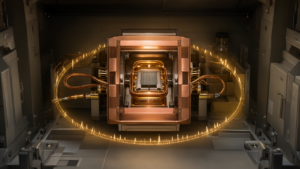
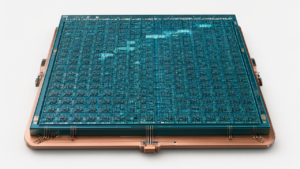
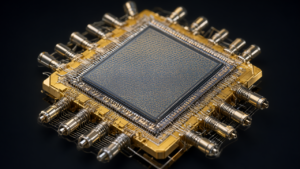
This research harnessed the advanced capabilities of Quantinuum’s System Model H2, a trapped-ion quantum computer renowned for its high fidelity and extended coherence times, making it well-suited for executing complex quantum circuits. The research team mapped a 21-spin effective Hamiltonian, which describes the many-body interactions observed in NMR spectroscopy, onto the qubits and gate operations of the quantum computer. They designed and executed a large-scale quantum circuit involving 42 qubits and more than 1,400 two-qubit gate operations to digitally simulate the NMR spectrum of a molecule. The simulation accurately captured the transitions between molecular energy levels, successfully reproducing complex spectral lines that reflect intricate interactions, which are often computationally prohibitive for classical computers. This level of precision provides compelling evidence for the practical value of quantum computers in the field of quantum chemistry.
Background & Context
Nuclear Magnetic Resonance (NMR) spectroscopy is an indispensable tool in chemistry, biology, and medicine for determining molecular structures and analyzing molecular dynamics. However, as molecular size increases, high-fidelity NMR spectral simulations become computationally intractable for classical computers due to the exponential complexity of quantum states. Quantum computers, by their very nature of operating on quantum mechanical principles, are expected to surpass classical computers in simulating such quantum many-body systems. While prior attempts at NMR simulations on quantum hardware have been made, achieving both scale and accuracy has been limited. The collaboration between Quantinuum and HQS Quantum Simulations bridges academic research and industrial application, pushing the frontiers of quantum chemistry. The combination of high-performance hardware like System Model H2 and specialized quantum algorithm development is accelerating progress in this critical area.
Strategic Significance & Outlook
This achievement highlights the potential for quantum computers to accurately model the behavior of complex molecules, promising innovations in diverse fields such as drug discovery, materials design, and catalytic reaction research. Specifically, the improved accuracy of NMR simulations using quantum computers will bridge the gap between experimental data and theoretical calculations, enhancing the efficiency and reliability of molecular structure analysis. As the capability to simulate larger and more intricate molecular systems develops, quantum chemistry research could accelerate, potentially enabling the exploration of previously inaccessible chemical spaces. Quantinuum and HQS Quantum Simulations are expected to continue their collaboration, aiming to expand the practical application range in quantum chemistry and ultimately deliver quantum-advantage solutions.
Get our weekly technology intelligence — free
Receive an infographic that lets you judge at a glance whether each field’s analysis report is worth reading.
Subscribe Free — Weekly Tech Intelligence
By subscribing, you’ll receive Troy-Technical’s weekly technology intelligence newsletter.
- Your email and selected fields are used only to deliver the newsletter.
- We never share your information with third parties.
- You can unsubscribe anytime via the link in each email.
See our Privacy Policy for details.
Takes about a minute · Unsubscribe anytime