Key Findings
Researchers have successfully engineered a novel cross-linked poly(tetrahydrofuran) electrolyte that enables lithium metal batteries to operate safely and effectively at high voltages across an exceptionally broad temperature spectrum, from -40°C to 55°C. This breakthrough addresses critical long-standing challenges in achieving both high oxidation stability and sufficient ionic conductivity for next-generation energy storage systems.
Technical / Clinical Details
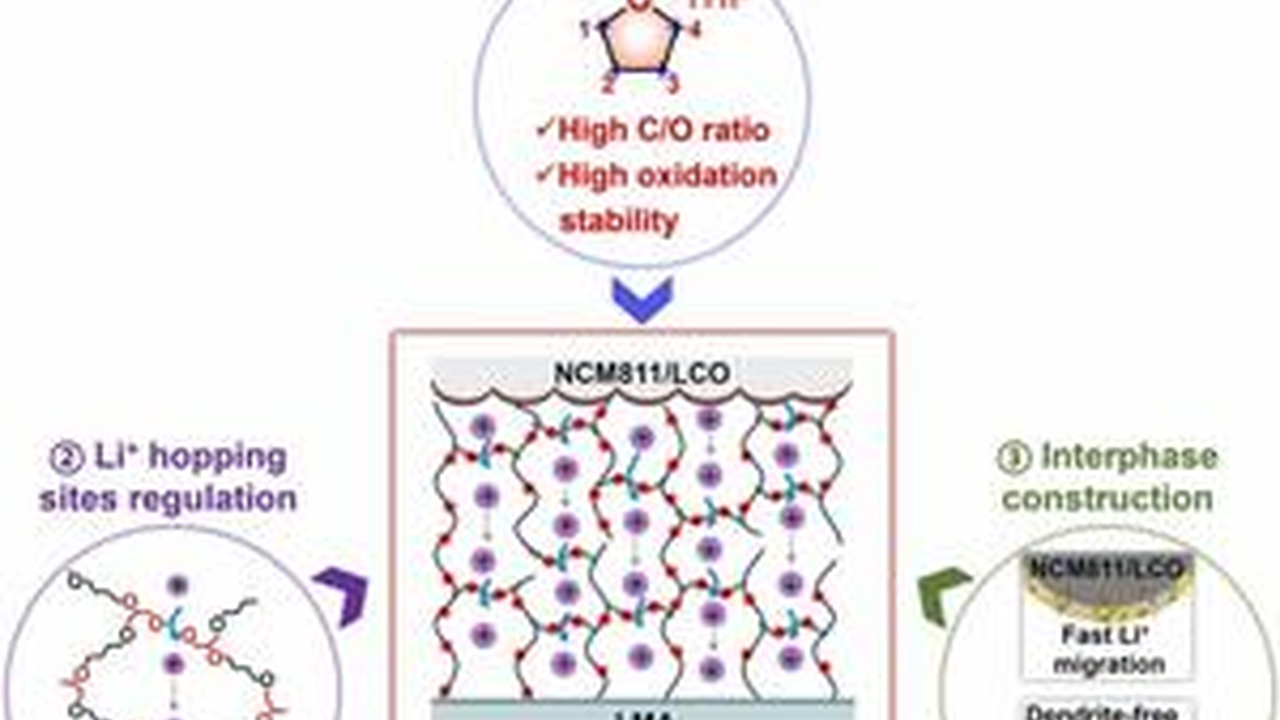
The newly developed polyether electrolyte significantly enhances the performance of lithium metal batteries through its unique molecular architecture. Unlike conventional electrolytes that struggle with ionic conductivity at low temperatures or stability at high voltages, this cross-linked poly(tetrahydrofuran) electrolyte overcomes both hurdles. It maintains robust ionic conductivity even at extreme cold of -40°C and exhibits exceptional oxidation stability, operating reliably at voltages exceeding 5V without significant degradation. This superior performance is attributed to the optimized polymer network of the electrolyte, which facilitates efficient lithium ion transport while simultaneously suppressing undesirable side reactions at the electrode surfaces. This innovative approach allows for the creation of a safe and high-performance battery system compatible with both lithium metal anodes and high-voltage cathodes.
Background & Context
Lithium metal batteries are highly anticipated as a successor to conventional lithium-ion batteries, offering theoretically up to ten times the energy density. This makes them ideal for demanding applications such as electric vehicles (EVs), portable electronics, and aerospace, where high performance is critical. However, the high reactivity of lithium metal anodes, prone to dendrite formation during charging and discharging, has historically posed significant safety and cycle life challenges. Furthermore, achieving stable operation across a wide range of temperatures has been a major barrier. The introduction of this polyether electrolyte represents a groundbreaking advancement, resolving these fundamental issues and significantly accelerating the practical deployment of lithium metal batteries. Its stable operation in extreme cold, in particular, could dramatically improve EV performance in frigid climates and enable new possibilities for space exploration and other specialized applications.
Strategic Significance & Outlook
The development of this new polyether electrolyte marks a crucial milestone towards the commercialization of high-energy-density batteries. Future efforts will focus on further enhancing cycle life, reducing production costs, and establishing scalable manufacturing processes. Once commercialized, this technology is expected to revolutionize a wide array of industries, enabling significantly extended range for electric vehicles, smaller and more powerful electronic devices, and improved efficiency in renewable energy storage systems. This achievement represents an indispensable step in the evolution of energy storage technologies essential for realizing a sustainable future. It demonstrates a critical advancement that could redefine the landscape of battery technology for extreme conditions and high-performance demands.