TECHNOLOGY EXPLAINER
Coherence and Fidelity
— How to read the yardsticks of a qubit: T1 and T2, error rates, randomized benchmarking
Announcements of quantum hardware are full of numbers such as "T1 of so many microseconds" or "two-qubit gate fidelity of 99.9%". Those numbers cannot be read correctly unless you know what they measure and what they leave out. This article assumes no physics background. With figures and small calculations it explains decoherence, the meaning of T1 and T2, the relation between fidelity and error rate, and how randomized benchmarking (RB) works. The second half covers why numbers from different technologies must not be ranked against each other and what materials cause qubits to lose their lifetime. It is the article to read after "Quantum Computing Fundamentals" and "Quantum Gates and Quantum Circuits".
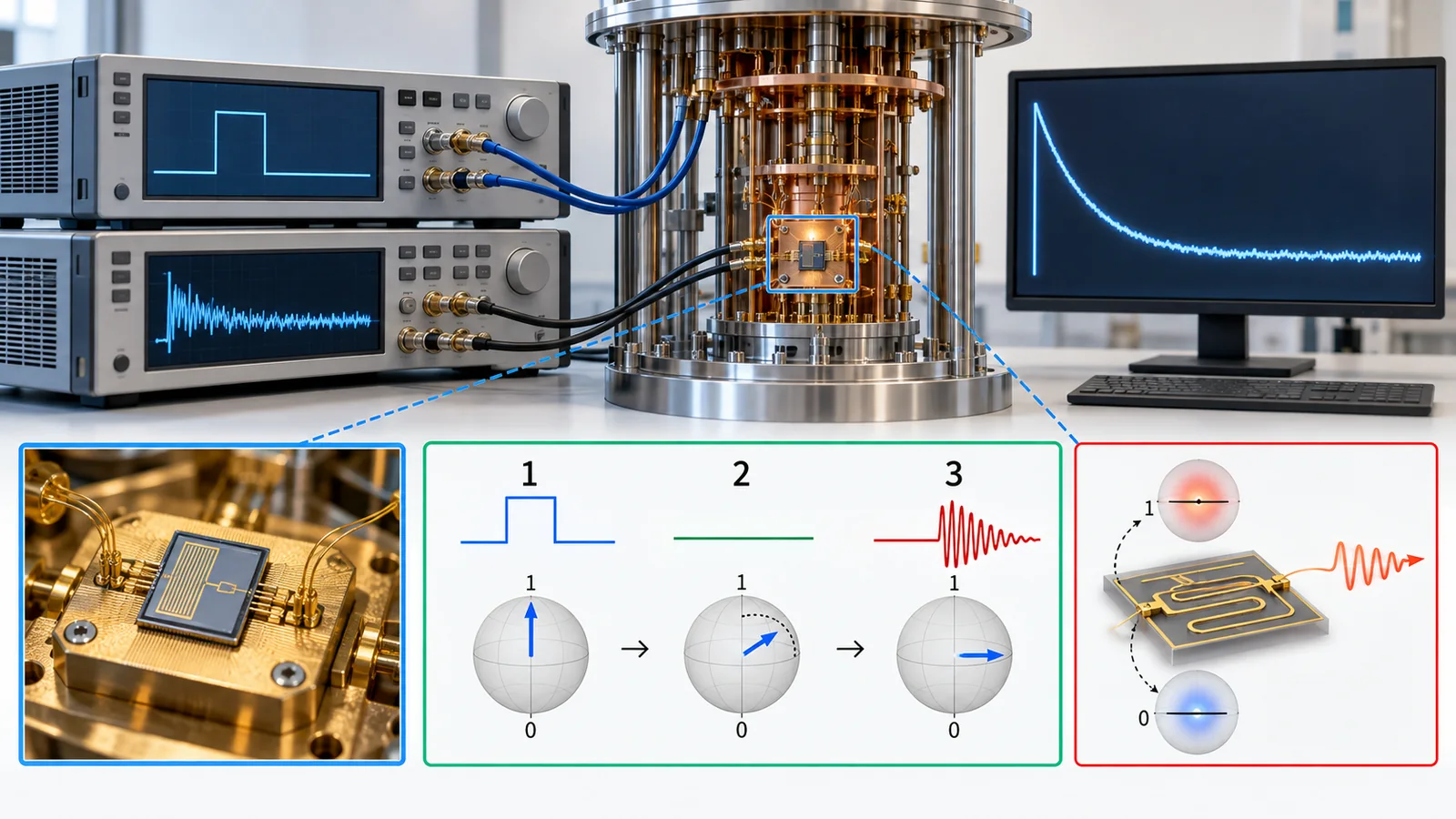
- Three-line summary / what to know first / where this sits in the series
- The big picture: four yardsticks, what each measures
- What is decoherence?
- T1: the energy relaxation time
- T2: how long the phase survives (T2*, T2E and CPMG)
- Time and error: the longer a gate takes, the more finite lifetime adds error
- Fidelity and error rate: how to read "99.9%"
- Reported values, and cautions for reading them
- Randomized benchmarking (RB) and its limits
- A materials engineer's view: what shortens a qubit's life
- How to read evaluations and standards
- Glossary
- References (primary sources)
- Claim-to-source audit
Sourced = stated in a published source (link given)
Our calculation = a value this article computed or checked from stated assumptions
Not yet confirmed = standards under development, company plans and other items that are not settled
Our own reading for materials engineers is marked as commentary; inference is shown in bold. Every analogy comes with a note on where the analogy breaks down.
The curves, tables and simulated data in Chapters 3 to 7 and 9 are our own illustrative calculations (with fixed random seeds), not measurements from a real device. The reported values in Chapters 5 and 8 are values each paper reported under its own conditions; they are not meant for ranking devices of different technologies. For standards (ISO/IEC, IEEE) we confirmed only the title, scope and status, not the text. This field moves fast, so standards carry a check date (16 October 2026).
1. Three-line summary / what to know first / where this sits in the series
- The lifetime yardsticks (T1, T2): T1 is the time for a qubit to lose energy and fall from "1" to "0"; T2 is how long the heading (phase) of the arrow stays in step. T2 cannot exceed 2×T1. A T2 value changes with how it is measured (T2*, T2E, CPMG), so check the kind Sourced [Ref. 1]
- The accuracy yardsticks (fidelity, error rate): how close one operation is to the ideal. "99.9%" is a rough "one error in 1000". But you cannot read it without knowing which operation, how it was measured, and whether it is an average or the best Sourced [Refs. 2, 3]
- The conditions behind each yardstick differ between technologies: you cannot rank "microseconds" for superconducting qubits against "minutes" for ions or "seconds" for silicon. A floor on gate error is set by the ratio of gate time to lifetime Our calculation
We use the arrow picture (north pole = 0, south pole = 1, tilted = superposition) and interference (adding waves) from "Quantum Computing Fundamentals", and the gate (an operation that rotates the arrow) from "Quantum Gates and Quantum Circuits". If you have not read them, the necessary parts are briefly explained again. Formulas are kept to a minimum, and harder material is tucked into folded "More detail" sections.
This is the article to read after "Quantum Gates and Quantum Circuits". Next, "Quantum Algorithms" shows why "how many gates can be run in a row" matters so much for algorithms. Technology-specific articles, quantum error correction, and cryogenics and control are covered in their own articles in the series.
2. The big picture: four yardsticks, what each measures
There is no single yardstick for the "quality" of a quantum computer. It helps to sort them into four.
This article mainly covers 1 (lifetime) and 2 (gate accuracy). Items 3 and 4 are touched on in later chapters and in "How to read the yardsticks and standards". What matters is knowing what each yardstick leaves out. For example, even with a long lifetime (1), inaccurate gate control gives low gate accuracy (2). Conversely, even if the numbers in 2 are good, large preparation and readout errors (3) will spoil the result.
As with cars, "top speed" alone does not tell you whether a car is good (you also need fuel economy, brakes, comfort). A quantum computer is similar: the "number of qubits" or "T1" alone does not tell you whether it is usable. Where the analogy breaks down: a car's properties can be measured nearly independently, but a qubit's lifetime, gate errors and readout errors are related to one another (Chapter 6) (our commentary).
3. What is decoherence?
As we saw in the Fundamentals article, interference needs the qubit's arrow to be correct even in its heading (phase). Real qubits, however, are slightly affected by their surroundings (heat, fluctuating electromagnetic fields, defects in materials, nearby atomic nuclei and so on). The resulting degradation of the arrow is called decoherence.
There are two main ways it happens.
- T1 (energy relaxation): the qubit loses energy and falls from "1" (the high-energy state) to "0" (the low-energy state). The arrow leans from south to north
- T2 (phase relaxation): even if the tilt stays the same, the heading around the north pole (the phase) falls out of step. Arrows on the equator point in scattered directions and the average arrow shrinks
These two are measured with separate times (T1 and T2). The review describes relaxation by a longitudinal rate (Γ1 = 1/T1) and a transverse rate (Γ2 = 1/T2), the latter having an extra contribution from "pure dephasing" Sourced [Ref. 1].
It is often said that "a quantum state breaks when it is looked at", but decoherence happens even when no one is looking, through exchange with the environment. Measurement (Chapter 4 of the Fundamentals article) is an operation by a person or instrument that deliberately reads out the state; decoherence is information about the state leaking into the environment unintentionally. Both leave the arrow unable to return, but they are different things (our commentary).
In principle, a qubit completely isolated from its environment does not degrade. In practice you must connect it to the outside to operate it with gates and read out the result. Wherever you open a connection, noise can come in. Balancing "isolation" against "control and readout" is the hard part of design (our commentary; see our article on cryogenics and control).
4. T1: the energy relaxation time
T1 is a time that expresses how fast a qubit falls from "1" to "0". Measuring it is simple. Put the qubit in "1", wait a time τ, and measure. Repeat for various τ, each many times, and count the fraction that is "still 1". That fraction falls off exponentially.
The time at which the "still 1" fraction reaches 1/e (about 37%) is T1. At twice T1 it is about 14%, and at three times about 5% Our calculation (e−1 = 0.368, e−2 = 0.135, e−3 = 0.050). The review shows a measured example of a transmon qubit with T1 = 85 µs Sourced [Ref. 1].
| Waiting time τ | Ratio to T1 | Fraction still "1" |
|---|---|---|
| 0.1·T1 | 0.1 | 90.5% |
| 0.5·T1 | 0.5 | 60.7% |
| 1·T1 | 1 | 36.8% |
| 2·T1 | 2 | 13.5% |
| 5·T1 | 5 | 0.7% |
Our calculation. We evaluated the exponential e−τ/T1.
T1 is not an "average lifetime" but the time for the fraction to fall to 1/e. Even a qubit with T1 = 100 µs has already lost about 10% by 10 µs, yet about 37% remains at 100 µs. Individual qubits also decay at unpredictable moments (probabilistically), so "lifetime" is an analogy (our commentary).
5. T2: how long the phase survives (T2*, T2E and CPMG)
T2 is how long the arrow's heading (phase) stays in step. A single measurement cannot show the phase, so we measure it with a little cleverness. There are three typical ways, each sensitive to a different kind of "fluctuation", so the values differ too.
| Name | Procedure | What it measures | Typical trend |
|---|---|---|---|
| T2* (Ramsey) | π/2 pulse, wait, π/2 pulse, measure | The phase drift, including slow (static) fluctuations | Tends to be the shortest |
| T2E (Hahn echo) | π/2, wait τ/2, π (flip), wait τ/2, π/2, measure | Slow fluctuations are cancelled by the mid-way flip; fast ones remain | Longer than T2* |
| CPMG / dynamical decoupling | Insert many π pulses | Cancels still more slow fluctuations (the range cancelled depends on the protocol) | Longer still |
The procedures follow the explanation in the review [Ref. 1] Sourced. The trend (T2* < T2E < CPMG) is the general tendency from cancelling slow fluctuations; in an individual device the order need not hold (our commentary).
In the review's measured example (one transmon qubit), T1 = 85 µs, T2* from a Ramsey measurement = 95 µs, and T2E from a Hahn echo = 120 µs. These do not reach the limit set by T1 (2×T1 = 170 µs) Sourced [Ref. 1].
The relation between T1 and T2: T2 cannot exceed 2×T1
The phase relaxation always includes a contribution from energy relaxation (T1). So there is a relation 1/T2 = 1/(2·T1) + 1/Tφ (Tφ is the time for the phase alone to be disturbed). Even if Tφ is infinite, T2 only reaches 2·T1 Sourced [Ref. 1].
| T1 | Tφ (phase-only disturbance) | T2 (calculated) | How to read it |
|---|---|---|---|
| 100 µs | infinite (no disturbance) | 200 µs | The maximum T2 (2×T1) |
| 100 µs | 200 µs | 100 µs | Shortened by the phase disturbance |
| 100 µs | 100 µs | 67 µs | A large phase disturbance makes T2 shorter than T1 |
Our calculation. We evaluated 1/T2 = 1/(2·T1) + 1/Tφ with illustrative values (T1 = 100 µs), not values of any real device. In real devices the phase disturbance may decay in a form other than an exponential, and this formula assumes an exponential decay [Ref. 1].
T2 changes a lot with how it is measured (T2*, T2E, CPMG), so a T2 without its kind cannot be compared. A value obtained with dynamical decoupling (repeated π pulses) is a value for "protecting an idle qubit", not a value during a gate. To know the quality of a qubit used for gates, you must also check the gate error rates (Chapters 7 and 9) (our commentary).
6. Time and error: the longer a gate takes, the more finite lifetime adds error
What a long lifetime (T1, T2) means becomes clear only against the gate time. During a gate the qubit also decays, following its lifetimes. For a gate that takes time t, the error set by lifetime alone (a floor) is roughly given by the formula below.
ε ≈ t/(3·T2) + t/(6·T1) (when the gate time t is well below T1 and T2). Meaning: the error from lifetime is "the fraction of the lifetime that the gate takes", times factors of 1/3 and 1/6. With T1 = T2 = 100 µs and a 25 ns gate (1/4000 of the lifetime), ε ≈ 1.3×10⁻⁴ Our calculation.
| Lifetimes (illustrative) | 25 ns gate | 100 ns gate | 1 µs gate | 10 µs gate |
|---|---|---|---|---|
| T1 = T2 = 100 µs | 1.3×10⁻⁴ | 5.0×10⁻⁴ | 5.0×10⁻³ | 4.8×10⁻² |
| T1 = 100 µs, T2 = 200 µs (the maximum T2) | 8.3×10⁻⁵ | 3.3×10⁻⁴ | 3.3×10⁻³ | 3.2×10⁻² |
| T1 = T2 = 1 ms | 1.3×10⁻⁵ | 5.0×10⁻⁵ | 5.0×10⁻⁴ | 5.0×10⁻³ |
Our calculation. We evaluated ε = 1 − (3 + 2e−t/T2 + e−t/T1)/6. This is the average gate fidelity of a qubit that waits for time t while undergoing amplitude damping (T1) and dephasing (T2). We used the relation between average gate fidelity and process fidelity for one qubit (Nielsen, 2002) [Ref. 2] and checked it by numerical simulation. Control errors, leakage and crosstalk are not included; real errors are larger.
To reduce errors you can either extend the lifetime (better materials and environment) or make the gate faster (better control). As the table shows, a tenfold longer lifetime cuts the error of the same gate tenfold. On the other hand, making gates too fast raises control errors and leakage into nearby states. In ion experiments, one report varied the two-qubit gate time from 3.8 µs to 520 µs to study the relation between speed and fidelity Sourced [Ref. 4] (our commentary).
Sung and colleagues state that the fidelities of their CZ and iSWAP gates on superconducting qubits (99.76 ± 0.07% and 99.87 ± 0.23%) are close to the T1 limit Sourced [Ref. 5]. In terms of the formula above, "ε is almost entirely set by t/(3·T2) + t/(6·T1)". At that point however far control is polished, the rest is set by lifetime (and therefore by materials).
7. Fidelity and error rate: how to read "99.9%"
Fidelity (F) is a number from 0 to 1 (often written as a percentage) showing how close what was actually produced is to the ideal. Closer to 1 is better, and the error rate is ε = 1 − F. A fidelity of 99.9% means an error rate of 0.1%, roughly one error in 1000.
There are at least three kinds of "fidelity". State fidelity (how close a prepared state is to the target), process fidelity (how close the whole operation is to the ideal) and average gate fidelity (fidelity averaged over all input states). Nielsen gave a simple formula (Favg = (d·Fprocess + 1)/(d + 1)) for the average gate fidelity and process fidelity of a d-dimensional system Sourced [Ref. 2]. For one qubit (d = 2) with Fprocess = 0.9985, Favg = (2×0.9985 + 1)/3 = 0.9990 Our calculation.
The same "99.9%" means different things depending on which operation it is for (single-qubit gates usually give better values than two-qubit gates), for how many qubits (it tends to worsen as qubits are added), whether average, best or worst, and how it was measured (RB, tomography, a state measurement). As Chapter 9 shows, an average gate fidelity cannot be compared directly with fault-tolerance thresholds Sourced [Refs. 6, 7].
As the gates article showed, with error rate ε per gate the success probability of the whole circuit falls to about 37% after about 1/ε gates. With an error rate of 10−2 that is about 100 gates, with 10−3 about 1000, with 10−4 about 10,000 Our calculation. One order of magnitude in error is one order of magnitude in usable circuit length.
8. Reported values, and cautions for reading them
Here are examples of values reported in papers, shown with their measurement conditions. Each is an individual report with its own technology, purpose and conditions, and none is meant to rank technologies.
| System (report) | Reported value | What the value is, and conditions |
|---|---|---|
| Superconducting transmon Google Quantum AI, 105-qubit processor (2024) [8] | Mean T1 68 µs, mean T2,CPMG 89 µs | Mean over the qubits of the machine used in the error-correction experiment |
| Superconducting transmon, tantalum film Place et al. (2021) [9] | Lifetime and coherence time (with dynamical decoupling) above 0.3 ms | Two-dimensional transmons with niobium replaced by tantalum. Lifetimes improved in 17 devices |
| Superconducting transmon, tantalum on high-resistivity silicon Bland et al. (2025) [10] | T1 up to 1.68 ms. T2E exceeds T1 | The best single qubit. Mean quality factor over 45 qubits 9.7×10⁶ |
| NV electron spin in diamond Balasubramanian et al. (2009) [11] | T2 = 1.8 ms | Room temperature. CVD diamond with 13C reduced to 0.3% by isotope control |
| NV electron spin in diamond Abobeih et al. (2018) [12] | Above 1 s | A single electron spin. Decoupling tailored to the surrounding nuclear-spin environment |
| Donor electron spins in 28Si Tyryshkin et al. (2012) [13] | T2 up to 2 s (10 s extrapolated at 1.8 K with a magnetic-field gradient) | High-purity silicon with residual 29Si below 50 ppm. Many spins (donor density 1014 to 1015 cm−3) |
| 31P nuclear spin on a 28Si substrate Muhonen et al. (2014) [14] | Above 30 s with a CPMG sequence. Control fidelity above 99.99% | A top-gated nanostructure on an isotopically controlled 28Si substrate. A single qubit |
| Ion 171Yb+ Wang et al. (2017) [15] | Above 10 min | A single qubit, cooled with 138Ba+, with a few thousand dynamical-decoupling pulses (memory use) |
| Nuclear spins of ionized donors in 28Si Saeedi et al. (2013) [16] | 39 min at room temperature (3 hours at cryogenic temperature) | A value for many spins, operated optically, with dynamical decoupling |
Sourced (statements in the abstracts and texts of the papers). The arrangement is our commentary.
| System (report) | Reported accuracy of operations | What the value is, and conditions |
|---|---|---|
| Ion 43Ca+ Ballance et al. (2016) [4] | Single-qubit 99.9934(3)%, two-qubit 99.9(1)% | Hyperfine qubits in a room-temperature trap. Two-qubit gate time studied from 3.8 to 520 µs |
| Ion 9Be+ Gaebler et al. (2016) [17] | Single-qubit error 3.8(1)×10−5 per gate, two-qubit gate error 8(4)×10−4 | Qubits with a memory coherence time above 1 s. The two-qubit value is deduced from Bell-state creation |
| Ion 40Ca+ Clark et al. (2021) [18] | Infidelity of Bell-state preparation 6(3)×10−4 | Optical-frequency qubits. 35 µs. Measured directly without subtracting experimental errors |
| Superconducting Sung et al. (2021) [5] | CZ 99.76 ± 0.07%, iSWAP 99.87 ± 0.23% (two-qubit interaction fidelities) | Tunable coupler. Reported to be close to the T1 limit |
| Superconducting Bland et al. (2025) [10] | Single-qubit gate 99.994% | Tantalum-on-high-resistivity-silicon transmon |
| Neutral atom Evered et al. (2023) [20] | Two-qubit 99.5% | Up to 60 atoms in parallel. Evaluated by several methods based on repeated gates |
| Silicon spin Xue et al. (2022) [19] | Single- and two-qubit both above 99.5% | Extracted by gate set tomography. The average single-qubit fidelity including crosstalk and idling errors on the neighbouring qubit is above 99% |
Sourced (statements in the abstracts of the papers). The arrangement is our commentary. How each value was obtained (RB, tomography, deduction from Bell states and so on) differs between papers, so they cannot be compared directly.
Listing "minutes for ions, seconds for silicon, milliseconds for superconducting qubits" makes it look like a ranking. But they cannot be compared, for these reasons. (1) The purposes differ: the long values may be for idle storage (memory) or use dynamical decoupling, not gates. (2) The counts differ: an average over many spins (an ensemble) versus a single qubit. (3) The measurements differ: T1, T2*, T2E, CPMG, RB, tomography. (4) The gate speeds differ: a lifetime means something only together with the gate time (Chapter 6). (5) Best and average differ: the best single qubit versus the mean over all qubits. Compare only within the same technology, with the same measurement and conditions (our commentary).
9. Randomized benchmarking (RB) and its limits
(1) Why RB is needed
To learn a gate's error rate one could use "tomography", examining the state produced by the gate in detail. But this method mixes in preparation and measurement errors, and its effort grows steeply with the number of qubits. Knill and colleagues proposed randomized benchmarking as a way to estimate the computationally relevant errors without relying on accurate preparation and measurement, and reported, for trapped ions, an error probability of 0.00482(17) per randomized π/2 pulse Sourced [Ref. 21]. Emerson and colleagues described a scalable method of noise estimation using random unitary operations Sourced [Ref. 22].
(2) How it works: random operations, then the operation that undoes them
- Start from north (0) and apply m randomly chosen gates
- At the end apply one gate that undoes everything (ideally the whole sequence does "nothing" and the arrow returns north)
- Measure; "success" if 0 comes out. Vary m, repeat each many times and count the success fraction
- As m grows, the success fraction falls in the form A·pm + B. The decay rate p gives the average error rate r per operation
The error rate is found from r = (1 − p)(d − 1)/d, where d is 2(number of qubits): d = 2 for one qubit and d = 4 for two Sourced [Ref. 3]. For example, for one qubit with p = 0.998, r = (1 − 0.998)/2 = 0.1%. In our simulated data, for true error rates of 0.1% and 0.5%, the error rates found by fitting were 0.1003% and 0.5046% Our calculation (20,000 shots per m, seed 0).
Preparation and measurement errors only enter the heights of the curve (A and B) and do not affect the decay rate p. This is why RB is said to be robust to preparation and measurement errors Sourced [Ref. 23].
(3) The RB family
| Method | What it measures | Source |
|---|---|---|
| Standard RB | The average error rate of the whole set of gates, accounting for preparation and measurement errors | Emerson et al. (2005) [22], Knill et al. (2008) [21], Magesan et al. (2011, 2012) [3, 23] |
| Interleaved RB | The error rate of one particular gate (the gate under test is inserted between the random gates) | Magesan et al. (2012) [24] |
| Simultaneous RB | The effect (crosstalk) when nearby qubits are driven at the same time | Gambetta et al. (2012) [25] |
| RB with mirror circuits | A scalable RB for many qubits | Proctor et al. (2022) [26] |
| Gate set tomography (GST) | Characterises the whole set of gates in detail (assesses the fault-tolerance threshold in the diamond norm) | Blume-Kohout et al. (2017) [7] |
Sourced (statements in the abstracts of the papers). The arrangement is our commentary.
(4) The limits of RB: not directly comparable with fault-tolerance thresholds
- Blume-Kohout and colleagues state that the "error rate" reported by RB is not sensitive to all errors and cannot be compared directly with the diamond norm that expresses fault-tolerance thresholds Sourced [Ref. 7]. The same paper used gate set tomography to show, with more than 95% confidence, that operations on a trapped-ion qubit satisfy a threshold of diamond norm 6.7×10⁻⁴ or less
- Sanders and colleagues show how to obtain, from a reported average gate fidelity, an upper bound on the error rate relevant to fault tolerance, and show that a realistic gap can exist between the reported average fidelity and the true error rate Sourced [Ref. 6]
- Proctor and colleagues, measuring twelve processors, report that on current hardware structured programs fail up to an order of magnitude earlier than random ones, so that standard error metrics inferred from the behaviour of random programs do not accurately predict the performance of useful programs Sourced [Ref. 27]
RB measures "the average error seen when random operations are averaged". Coherent errors that tilt steadily in one direction, or errors that show up only in particular operations, can be buried in the average and look small. Gate set tomography examines them too, but is laborious. When you read "99.9% by RB", read it as "an average-error metric", and note that comparing it with the level needed for error correction calls for a different metric (our commentary).
10. A materials engineer's view: what shortens a qubit's life
A qubit's lifetimes (T1 and T2) are set by defects and impurities in materials, contamination at interfaces, and the surroundings. Let us reread the numbers so far from the materials side.
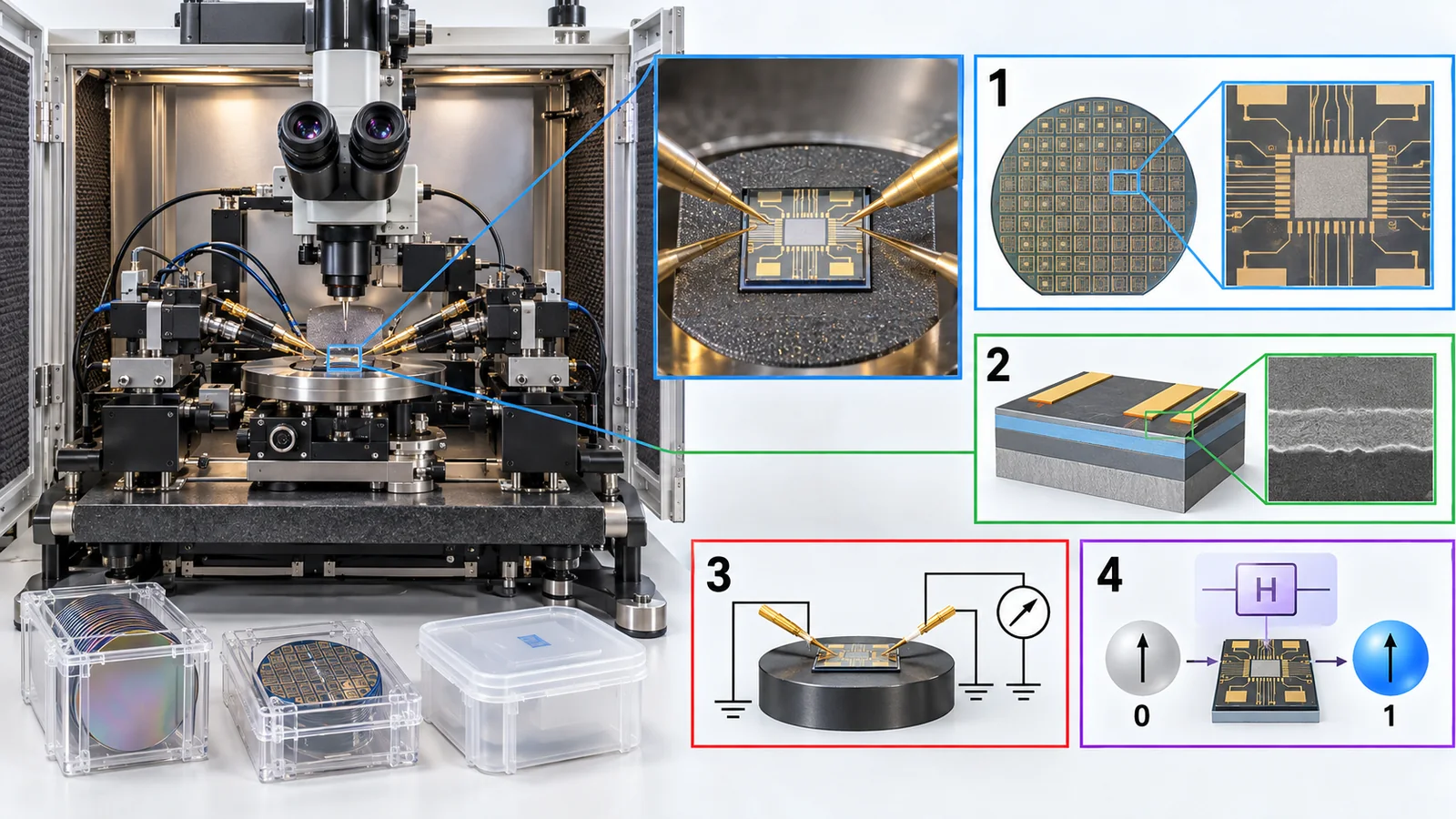
Martinis and colleagues showed that dielectric loss from two-level defects (atomic-scale defects with two energy states) is a dominant decoherence source in superconducting qubits, and that better dielectrics and junctions of small area (about 10 µm2 or less) cut the loss sharply. In a phase qubit they report an improvement of the energy relaxation rate by a factor of 20 Sourced [Ref. 28]. The review by Müller and colleagues says that superconducting circuits made of aluminium or niobium are fundamentally limited by loss from two-level defects in the amorphous oxide layers that encase them Sourced [Ref. 29].
Along this line Place and colleagues replaced niobium with tantalum and took lifetime and coherence time above 0.3 ms Sourced [Ref. 9], and Bland and colleagues changed the substrate to high-resistivity silicon and reached a best T1 of 1.68 ms Sourced [Ref. 10]. For a materials engineer, a qubit is also a very sensitive "detector" of material loss (the review by Müller and colleagues notes that superconducting circuits can probe individual defects [Ref. 29]). That Bland and colleagues express lifetime through a quality factor Q shows that the picture of loss translates into the same language as dielectric loss in materials (our commentary).
The lifetime of a superconducting qubit is affected by electrons whose pairs have been broken (quasiparticles) in the superconductor. Vepsäläinen and colleagues presented evidence that ionizing radiation from environmental radioactive materials and cosmic rays contributes to the observed excess density of quasiparticles, and predicted that this would ultimately limit the coherence times of superconducting qubits of the type they measured to milliseconds. They also showed that radiation shielding reduces the effect (they describe it as a small effect for today's qubits that will be critical for fault-tolerant superconducting machines) Sourced [Ref. 30]. For a materials engineer, even "the radiation environment where the machine sits" and "radioactive elements in surrounding materials" bear on lifetime (our commentary).
The lifetime of a spin qubit is set by the nuclear-spin isotopes and impurities in the crystal. Balasubramanian and colleagues reported a room-temperature electron-spin T2 of 1.8 ms in CVD diamond in which 13C was reduced to 0.3% and other paramagnetic defects were below 1013 cm−3 Sourced [Ref. 11]. Tyryshkin and colleagues reported a donor electron-spin T2 of up to 2 s in 28Si with residual 29Si below 50 ppm Sourced [Ref. 13]. A review of isotope engineering is by Itoh and Watanabe [Ref. 31]. For a materials engineer, controlling the isotope ratio and impurity concentration during crystal growth translates directly into longer qubit lifetimes (our commentary).
In ion traps the ion sits close to the electrode surface, so electric-field noise from the electrode surface causes effects such as heating of the ion. The review by Brownnutt and colleagues summarises measurements of electric-field noise inferred from ion heating rates, and says that the presence of several noise sources and different scalings with distance complicate interpretation, and that the mechanisms behind much of this noise are poorly understood Sourced [Ref. 32]. For a materials engineer this means that electrode material, surface cleanliness and processing bear on gate errors, but which factor dominates has not yet been sorted out (our commentary; a review of materials challenges overall is by de Leon and colleagues [Ref. 33]).
11. How to read evaluations and standards
The quality of a qubit is read with three yardsticks: its lifetime (T1 and T2), the accuracy of operations (fidelity, error rate) and the performance of whole circuits. The table sets out how each is measured (RB, tomography, quantum volume and so on) and the state of standards for terms and performance metrics, as far as we could confirm (checked 16 October 2026).
| What is measured | Representative benchmark or evaluation method (name, source) | Standards and guidance (ISO/IEC, IEEE and others) | How to read it |
|---|---|---|---|
| Lifetime (T1, T2) | T1 decay measurement, Ramsey (T2*), Hahn echo (T2E), CPMG. Procedures as explained in the review [1] Sourced | Could not be confirmed (ISO/IEC 4879:2024 is a vocabulary standard, but whether it defines T1 and T2 is unconfirmed because we did not read the text) [34] Sourced | T2 changes with its kind (T2*, T2E, CPMG). Check single or ensemble, memory use, and conditions |
| Accuracy of operations (error rate, fidelity) | Standard RB (Emerson et al., Knill et al., Magesan et al.) [22, 21, 3], interleaved RB [24], simultaneous RB [25], gate set tomography [7] Sourced | Could not be confirmed (IEEE P7131 has a working group on performance metrics and benchmarking, but we found no published standard) [35] Not yet confirmed | Check which operation, how many qubits, average or best, and how it was measured. An RB error rate cannot be compared directly with fault-tolerance thresholds [7, 6] |
| Definition of fidelity | The relation between average gate fidelity and process fidelity (Nielsen, 2002) [2] Sourced | Could not be confirmed | Distinguish state, process and average gate fidelity |
| Whole-circuit performance | Quantum volume (Cross et al., 2019) [36], RB with mirror circuits [26], layer fidelity measuring error per layered gate (EPLG; McKay et al., 2023) [37], the speed metric CLOPS (Wack et al., 2021) [38], application-oriented benchmarks [39], measuring capabilities (Proctor et al.) [27] Sourced | Could not be confirmed (as above) | McKay et al. state that quantum volume focuses on the best subset of a device and cannot show average performance over many qubits, and propose layer fidelity. Each metric measures something different |
| Overview of benchmarking | The survey by Lorenz et al. (2025) organises benchmarks at the levels of qubits and gates, processors, software and applications, and argues for standardisation [40] Sourced | Could not be confirmed | A survey's recommendations are not themselves a standard |
| Terms | — (terminology, not evaluation) | ISO/IEC 4879:2024 "Information technology — Quantum computing — Vocabulary" (edition 1, May 2024, IEC/ISO JTC 3) [34] Sourced / IEEE P7130 "Standard for Quantum Technologies Definitions" (on IEEE's page an active PAR, that is, a project under development; PAR approved 23 September 2021) [41] Not yet confirmed | A vocabulary, not a standard that decides pass or fail for performance. We have not read the texts and state none of their definitions |
The arrangement of this table is our own organisation (Our calculation). The ISO number, title and date were checked on ISO's committee page and the IEEE status on IEEE SA's pages (checked 16 October 2026). Standard texts are paid or unread, so we limit ourselves to title and scope.
Reading notes (for materials engineers)
- Read T1 and T2 numbers together with their kind and conditions: T1 or T2, T2* or T2E or CPMG, single or ensemble, for gates or memory, at what temperature. Do not rank numbers measured under different conditions
- Check what the "fidelity" is a fidelity of: single- or two-qubit, average or best, RB or tomography. An RB number cannot be compared directly with a fault-tolerance threshold [Refs. 7, 6]
- Read lifetime and gate time together: a long lifetime does not reduce errors if the gate is slow (Chapter 6)
- Check whether a standard is a recommendation or a requirement: ISO/IEC 4879 is a vocabulary, and IEEE P7130 and P7131 are projects under development. For any claim of "compliance", ask which standard and which clause
12. Glossary
- Coherence
- The wave-like order of a quantum state (the phases being in step).
- Decoherence
- The environment disturbing a quantum state so that it degrades (the arrow blurs).
- T1 (energy relaxation time)
- The time for the "1" fraction to fall to 1/e (about 37%).
- T2 (phase relaxation time)
- How long the phase stays in step. Its value depends on how it is measured. T2 ≤ 2×T1.
- Tφ (pure dephasing time)
- The time for the phase alone to be disturbed, apart from energy relaxation. 1/T2 = 1/(2T1) + 1/Tφ.
- T2* (Ramsey)
- T2 measured by Ramsey interference. Includes slow fluctuations and tends to be short.
- T2E (Hahn echo)
- T2 measured with a mid-way flip (π pulse). Cancels slow fluctuations.
- CPMG, dynamical decoupling
- Inserting many π pulses to cancel fluctuations and keep the phase longer.
- Fidelity
- A number showing how close the actual result is to the ideal. Closer to 1 is better.
- Error rate
- 1 − fidelity. A guide to the probability of error in one operation.
- Average gate fidelity
- A gate's fidelity averaged over all input states. What RB reports.
- Process fidelity
- A fidelity showing how close the whole operation is to the ideal operation.
- Diamond norm
- A measure of the size of an operation's error that includes the worst input. Fault-tolerance thresholds are stated in it.
- SPAM error
- Error in state preparation and measurement.
- Randomized benchmarking (RB)
- A method that finds the average error rate per operation using random sequences of operations.
- Interleaved RB
- An RB that finds the error rate of one particular gate.
- Gate set tomography (GST)
- A measurement that characterises a whole set of gates in detail. Allows comparison with thresholds.
- Two-level system (TLS)
- An atomic-scale defect in a material with two energy states. It absorbs energy and shortens lifetime.
- Quasiparticle
- An electron left over when a pair in a superconductor breaks. It shortens a qubit's lifetime.
- Transmon
- The typical form of a superconducting qubit.
- Quantum volume
- A metric of whole-device performance based on how well random circuits run.
- Layer fidelity (EPLG)
- A metric of the fidelity of a layer of many qubits, measured by simultaneous RB.
13. References (primary sources)
- Krantz P. et al. "A quantum engineer's guide to superconducting qubits", Appl. Phys. Rev. 6, 021318 (2019), DOI 10.1063/1.5089550 — doi.org/10.1063/1.5089550
- Nielsen M. A. "A simple formula for the average gate fidelity of a quantum dynamical operation", Phys. Lett. A 303, 249–252 (2002), DOI 10.1016/S0375-9601(02)01272-0 — doi.org/10.1016/S0375-9601(02)01272-0
- Magesan E., Gambetta J. M., Emerson J. "Scalable and Robust Randomized Benchmarking of Quantum Processes", Phys. Rev. Lett. 106, 180504 (2011), DOI 10.1103/PhysRevLett.106.180504 — doi.org/10.1103/PhysRevLett.106.180504
- Ballance C. J. et al. "High-Fidelity Quantum Logic Gates Using Trapped-Ion Hyperfine Qubits", Phys. Rev. Lett. 117, 060504 (2016), DOI 10.1103/PhysRevLett.117.060504 — doi.org/10.1103/PhysRevLett.117.060504
- Sung Y. et al. "Realization of High-Fidelity CZ and ZZ-Free iSWAP Gates with a Tunable Coupler", Phys. Rev. X 11, 021058 (2021), DOI 10.1103/PhysRevX.11.021058 — doi.org/10.1103/PhysRevX.11.021058
- Sanders Y. R., Wallman J. J., Sanders B. C. "Bounding quantum gate error rate based on reported average fidelity", New J. Phys. 18, 012002 (2016), DOI 10.1088/1367-2630/18/1/012002 — doi.org/10.1088/1367-2630/18/1/012002
- Blume-Kohout R. et al. "Demonstration of qubit operations below a rigorous fault tolerance threshold with gate set tomography", Nat. Commun. 8, 14485 (2017), DOI 10.1038/ncomms14485 — doi.org/10.1038/ncomms14485
- Google Quantum AI "Quantum error correction below the surface code threshold", Nature 638, 920–926 (2025), DOI 10.1038/s41586-024-08449-y (arXiv:2408.13687) — doi.org/10.1038/s41586-024-08449-y
- Place A. P. M. et al. "New material platform for superconducting transmon qubits with coherence times exceeding 0.3 milliseconds", Nat. Commun. 12, 1779 (2021), DOI 10.1038/s41467-021-22030-5 — doi.org/10.1038/s41467-021-22030-5
- Bland M. P. et al. "Millisecond lifetimes and coherence times in 2D transmon qubits", Nature 647, 343–348 (2025), DOI 10.1038/s41586-025-09687-4 — doi.org/10.1038/s41586-025-09687-4
- Balasubramanian G. et al. "Ultralong spin coherence time in isotopically engineered diamond", Nat. Mater. 8, 383–387 (2009), DOI 10.1038/nmat2420 — doi.org/10.1038/nmat2420
- Abobeih M. H. et al. "One-second coherence for a single electron spin coupled to a multi-qubit nuclear-spin environment", Nat. Commun. 9, 2552 (2018), DOI 10.1038/s41467-018-04916-z — doi.org/10.1038/s41467-018-04916-z
- Tyryshkin A. M. et al. "Electron spin coherence exceeding seconds in high-purity silicon", Nat. Mater. 11, 143–147 (2012), DOI 10.1038/nmat3182 — doi.org/10.1038/nmat3182
- Muhonen J. T. et al. "Storing quantum information for 30 seconds in a nanoelectronic device", Nat. Nanotechnol. 9, 986–991 (2014), DOI 10.1038/nnano.2014.211 — doi.org/10.1038/nnano.2014.211
- Wang Y. et al. "Single-qubit quantum memory exceeding ten-minute coherence time", Nat. Photonics 11, 646–650 (2017), DOI 10.1038/s41566-017-0007-1 — doi.org/10.1038/s41566-017-0007-1
- Saeedi K. et al. "Room-Temperature Quantum Bit Storage Exceeding 39 Minutes Using Ionized Donors in Silicon-28", Science 342, 830–833 (2013), DOI 10.1126/science.1239584 — doi.org/10.1126/science.1239584
- Gaebler J. P. et al. "High-Fidelity Universal Gate Set for 9Be+ Ion Qubits", Phys. Rev. Lett. 117, 060505 (2016), DOI 10.1103/PhysRevLett.117.060505 — doi.org/10.1103/PhysRevLett.117.060505
- Clark C. R. et al. "High-Fidelity Bell-State Preparation with 40Ca+ Optical Qubits", Phys. Rev. Lett. 127, 130505 (2021), DOI 10.1103/PhysRevLett.127.130505 — doi.org/10.1103/PhysRevLett.127.130505
- Xue X. et al. "Quantum logic with spin qubits crossing the surface code threshold", Nature 601, 343–347 (2022), DOI 10.1038/s41586-021-04273-w — doi.org/10.1038/s41586-021-04273-w
- Evered S. J. et al. "High-fidelity parallel entangling gates on a neutral-atom quantum computer", Nature 622, 268–272 (2023), DOI 10.1038/s41586-023-06481-y — doi.org/10.1038/s41586-023-06481-y
- Knill E. et al. "Randomized benchmarking of quantum gates", Phys. Rev. A 77, 012307 (2008), DOI 10.1103/PhysRevA.77.012307 — doi.org/10.1103/PhysRevA.77.012307
- Emerson J., Alicki R., Życzkowski K. "Scalable noise estimation with random unitary operators", J. Opt. B 7, S347–S352 (2005), DOI 10.1088/1464-4266/7/10/021 — doi.org/10.1088/1464-4266/7/10/021
- Magesan E., Gambetta J. M., Emerson J. "Characterizing quantum gates via randomized benchmarking", Phys. Rev. A 85, 042311 (2012), DOI 10.1103/PhysRevA.85.042311 — doi.org/10.1103/PhysRevA.85.042311
- Magesan E. et al. "Efficient Measurement of Quantum Gate Error by Interleaved Randomized Benchmarking", Phys. Rev. Lett. 109, 080505 (2012), DOI 10.1103/PhysRevLett.109.080505 — doi.org/10.1103/PhysRevLett.109.080505
- Gambetta J. M. et al. "Characterization of Addressability by Simultaneous Randomized Benchmarking", Phys. Rev. Lett. 109, 240504 (2012), DOI 10.1103/PhysRevLett.109.240504 — doi.org/10.1103/PhysRevLett.109.240504
- Proctor T. et al. "Scalable Randomized Benchmarking of Quantum Computers Using Mirror Circuits", Phys. Rev. Lett. 129, 150502 (2022), DOI 10.1103/PhysRevLett.129.150502 — doi.org/10.1103/PhysRevLett.129.150502
- Proctor T. et al. "Measuring the capabilities of quantum computers", Nat. Phys. 18, 75–79 (2022), DOI 10.1038/s41567-021-01409-7 — doi.org/10.1038/s41567-021-01409-7
- Martinis J. M. et al. "Decoherence in Josephson Qubits from Dielectric Loss", Phys. Rev. Lett. 95, 210503 (2005), DOI 10.1103/PhysRevLett.95.210503 — doi.org/10.1103/PhysRevLett.95.210503
- Müller C., Cole J. H., Lisenfeld J. "Towards understanding two-level-systems in amorphous solids: insights from quantum circuits", Rep. Prog. Phys. 82, 124501 (2019), DOI 10.1088/1361-6633/ab3a7e — doi.org/10.1088/1361-6633/ab3a7e
- Vepsäläinen A. P. et al. "Impact of ionizing radiation on superconducting qubit coherence", Nature 584, 551–556 (2020), DOI 10.1038/s41586-020-2619-8 — doi.org/10.1038/s41586-020-2619-8
- Itoh K. M., Watanabe H. "Isotope engineering of silicon and diamond for quantum computing and sensing applications", MRS Commun. 4, 143–157 (2014), DOI 10.1557/mrc.2014.32 — doi.org/10.1557/mrc.2014.32
- Brownnutt M. et al. "Ion-trap measurements of electric-field noise near surfaces", Rev. Mod. Phys. 87, 1419–1482 (2015), DOI 10.1103/RevModPhys.87.1419 — doi.org/10.1103/RevModPhys.87.1419
- de Leon N. P. et al. "Materials challenges and opportunities for quantum computing hardware", Science 372, eabb2823 (2021), DOI 10.1126/science.abb2823 — doi.org/10.1126/science.abb2823
- ISO/IEC "ISO/IEC 4879:2024 Information technology — Quantum computing — Vocabulary" (edition 1, May 2024, IEC/ISO JTC 3; checked on ISO's committee page) — iso.org/standard/80432.html
- IEEE SA "Quantum Benchmarking Working Group P7131" (page of the working group on quantum computing performance metrics; checked 16 October 2026) — sagroups.ieee.org/7131
- Cross A. W. et al. "Validating quantum computers using randomized model circuits", Phys. Rev. A 100, 032328 (2019), DOI 10.1103/PhysRevA.100.032328 — doi.org/10.1103/PhysRevA.100.032328
- McKay D. C. et al. "Benchmarking Quantum Processor Performance at Scale", arXiv:2311.05933 (2023) — arxiv.org/abs/2311.05933
- Wack A. et al. "Quality, Speed, and Scale: three key attributes to measure the performance of near-term quantum computers", arXiv:2110.14108 (2021) — arxiv.org/abs/2110.14108
- Lubinski T. et al. "Application-Oriented Performance Benchmarks for Quantum Computing", IEEE Trans. Quantum Eng. 4, 1–32 (2023), DOI 10.1109/TQE.2023.3253761 — doi.org/10.1109/TQE.2023.3253761
- Lorenz J. M. et al. "Systematic benchmarking of quantum computers: status and recommendations", arXiv:2503.04905 (2025) — arxiv.org/abs/2503.04905
- IEEE SA "IEEE P7130 Draft Standard for Quantum Technologies Definitions" (project page) (active PAR, approved 23 September 2021; checked 16 October 2026) — standards.ieee.org/ieee/7130/10680/
14. Claim-to-source audit
| Claim in the text | Basis | Category |
|---|---|---|
| The two faces of decoherence (T1 relaxation, T2 dephasing); how T1 and T2 are measured (T1 decay, Ramsey, Hahn echo, CPMG); 1/T2 = 1/(2T1) + 1/Tφ and T2 ≤ 2T1; the measurement example T1 = 85 µs, T2* = 95 µs, T2E = 120 µs | Text and Fig. 5 of the review by Krantz et al. (2019) Reference 1 https://doi.org/10.1063/1.5089550 | Sourced |
| The relation between average gate fidelity and process fidelity, F_avg = (d·F_process + 1)/(d + 1) | Abstract of Nielsen (2002) Reference 2 https://doi.org/10.1016/S0375-9601(02)01272-0 | Sourced |
| The proposals and properties of randomized benchmarking (accounting for preparation and measurement errors, the average error rate, the link to the diamond norm); interleaved RB, simultaneous RB, mirror-circuit RB | Abstracts of Emerson et al., Knill et al., Magesan et al., Gambetta et al., Proctor et al. Reference 22 https://doi.org/10.1088/1464-4266/7/10/021 Reference 21 https://doi.org/10.1103/PhysRevA.77.012307 Reference 3 https://doi.org/10.1103/PhysRevLett.106.180504 Reference 23 https://doi.org/10.1103/PhysRevA.85.042311 Reference 24 https://doi.org/10.1103/PhysRevLett.109.080505 Reference 25 https://doi.org/10.1103/PhysRevLett.109.240504 Reference 26 https://doi.org/10.1103/PhysRevLett.129.150502 | Sourced |
| That the RB error rate cannot be compared directly with fault-tolerance thresholds (diamond norm); that GST showed a trapped-ion qubit meets a 6.7×10⁻⁴ threshold; a method to bound the error rate from average fidelity; that structured programs fail up to an order of magnitude earlier | Abstracts of Blume-Kohout et al. (2017), Sanders et al. and Proctor et al. (2022) Reference 7 https://doi.org/10.1038/ncomms14485 Reference 6 https://doi.org/10.1088/1367-2630/18/1/012002 Reference 27 https://doi.org/10.1038/s41567-021-01409-7 | Sourced |
| The reported values in the Chapter 8 tables (superconducting T1 68 µs, T2,CPMG 89 µs; tantalum above 0.3 ms; Ta/Si T1 up to 1.68 ms; NV 1.8 ms and above 1 s; 28Si donor T2 up to 2 s; 31P nuclear spin above 30 s; ion above 10 min; ionised donors 39 min) | Texts and abstracts of each paper Reference 8 https://doi.org/10.1038/s41586-024-08449-y Reference 9 https://doi.org/10.1038/s41467-021-22030-5 Reference 10 https://doi.org/10.1038/s41586-025-09687-4 Reference 11 https://doi.org/10.1038/nmat2420 Reference 12 https://doi.org/10.1038/s41467-018-04916-z Reference 13 https://doi.org/10.1038/nmat3182 Reference 14 https://doi.org/10.1038/nnano.2014.211 Reference 15 https://doi.org/10.1038/s41566-017-0007-1 Reference 16 https://doi.org/10.1126/science.1239584 | Sourced |
| The gate accuracies in the Chapter 8 table (ion 99.9934%, 99.9%, 3.8×10⁻⁵, 8×10⁻⁴, 6×10⁻⁴; superconducting CZ 99.76%, iSWAP 99.87%, single-qubit 99.994%; neutral atom 99.5%; silicon spin above 99.5%) | Abstracts of each paper Reference 4 https://doi.org/10.1103/PhysRevLett.117.060504 Reference 17 https://doi.org/10.1103/PhysRevLett.117.060505 Reference 18 https://doi.org/10.1103/PhysRevLett.127.130505 Reference 5 https://doi.org/10.1103/PhysRevX.11.021058 Reference 10 https://doi.org/10.1038/s41586-025-09687-4 Reference 20 https://doi.org/10.1038/s41586-023-06481-y Reference 19 https://doi.org/10.1038/s41586-021-04273-w | Sourced |
| That dielectric loss from two-level systems is a dominant decoherence source in superconducting qubits (relaxation rate improved 20-fold); the fundamental limit from two-level defects in oxide layers | Abstracts of Martinis et al. (2005) and Müller et al. (2019) Reference 28 https://doi.org/10.1103/PhysRevLett.95.210503 Reference 29 https://doi.org/10.1088/1361-6633/ab3a7e | Sourced |
| That ionizing radiation raises the quasiparticle density and could limit coherence to milliseconds; that shielding lengthens the relaxation time | Abstract of Vepsäläinen et al. (2020) Reference 30 https://doi.org/10.1038/s41586-020-2619-8 | Sourced |
| Isotopes and purity: T2 = 1.8 ms in diamond with 13C at 0.3%; T2 up to 2 s in 28Si (29Si below 50 ppm); a review of isotope engineering; a review of materials challenges | Balasubramanian et al., Tyryshkin et al., Itoh and Watanabe, de Leon et al. Reference 11 https://doi.org/10.1038/nmat2420 Reference 13 https://doi.org/10.1038/nmat3182 Reference 31 https://doi.org/10.1557/mrc.2014.32 Reference 33 https://doi.org/10.1126/science.abb2823 | Sourced |
| A review of electric-field-noise measurements near ion-trap electrode surfaces (multiple noise sources; many mechanisms poorly understood) | Abstract of Brownnutt et al. (2015) Reference 32 https://doi.org/10.1103/RevModPhys.87.1419 | Sourced |
| Error from finite lifetime over a gate time (the Sung et al. CZ and iSWAP gates being close to the T1 limit); the speed/fidelity study over two-qubit gate times of 3.8 to 520 µs in ions | Abstracts of Sung et al. (2021) and Ballance et al. (2016) Reference 5 https://doi.org/10.1103/PhysRevX.11.021058 Reference 4 https://doi.org/10.1103/PhysRevLett.117.060504 | Sourced |
| The proposals of quantum volume, layer fidelity (EPLG), CLOPS and application-oriented benchmarks; a survey of benchmarking | Cross et al., McKay et al., Wack et al., Lubinski et al., Lorenz et al. Reference 36 https://doi.org/10.1103/PhysRevA.100.032328 Reference 37 https://arxiv.org/abs/2311.05933 Reference 38 https://arxiv.org/abs/2110.14108 Reference 39 https://doi.org/10.1109/TQE.2023.3253761 Reference 40 https://arxiv.org/abs/2503.04905 | Sourced |
| The number, title and date of ISO/IEC 4879:2024 "Information technology — Quantum computing — Vocabulary" (edition 1, May 2024, IEC/ISO JTC 3); whether it defines T1 and T2 is unconfirmed (text not read) | ISO's committee page Reference 34 https://www.iso.org/standard/80432.html | Sourced |
| That IEEE P7130 is under development (active PAR, approved 23 September 2021); that the IEEE P7131 working group is active and we found no published standard | IEEE SA pages Reference 41 https://standards.ieee.org/ieee/7130/10680/ Reference 35 https://sagroups.ieee.org/7131 | Not yet confirmed |
| The T1 decay table (e^−1 and so on), the T2 and Tφ table, the lifetime-error formula and table (numerical check of ε = 1 − (3 + 2e^(−t/T2) + e^(−t/T1))/6), the F_avg example, the simulated RB data and fits (0.1003% and 0.5046%) | Our own calculation (Python, NumPy; seed 0). Not the results of any real device | Our calculation |
| Rankings of numbers across technologies, the text of ISO/IEC 4879, the publication state of IEEE P7131, and a full comparison of mean and best T1/T2 of every device | Could not be confirmed from the primary sources available in this survey, so not stated | commentary |
| Readings such as "decoherence happening because someone looked is wrong", "a long T2 means a good qubit is wrong", "long lifetime and fast gates are separate efforts", "RB 99.9% is an average metric", "do not rank technologies under different conditions", and the analogies with their limits | Our own organisation and commentary based on the published material; not views expressed by the organisations cited | commentary |
| That Figs. 1 to 10 are explanatory drawings and not observations of real data, and that Figs. 1 and 10 are ImageGen-generated conceptual illustrations | Note in this article | commentary |
Last updated: 16 October 2026. Sources are limited to primary material (a review, peer-reviewed papers, arXiv papers, and official ISO and IEEE pages). Values from each paper are shown as values under its own measurement conditions, and we do not rank devices of different technologies. The numerical examples (decay, lifetime-limited errors, simulated RB data) are our own illustrative calculations, not results from real devices. We could not confirm the text of the standards, the publication state of IEEE P7131, or an exhaustive comparison of device values, so we do not state them. All figures are explanatory conceptual diagrams or drawings that include our own calculations; Figs. 1 and 10 are ImageGen-generated conceptual illustrations.